

Chocolate Is Such a Playful Food. How Much Imagination Is Packed Inside It?
Have you seen *Charlie and the Chocolate Factory*? The fairy-tale spirit of that film has been slowly seeping into our lives: online, on supermarket shelves and in real shops.
Have you seen Charlie and the Chocolate Factory? The fairy-tale spirit of that film has been slowly seeping into our lives: online, on supermarket shelves and in real shops.
"If your chocolate had a personality of its own, what would it be?"
"A classic, elegant person. Probably a man," said Arunas Matacius, co-founder of the Lithuanian chocolate company Chocolate Naïve.
Julia Zotter, who runs the China business of the Austrian chocolate company Zotter Chocolate, gave a very different answer: "Hard to describe. Probably a foodie. Oh, a chef: a crazy chef who loves to experiment. He's eager to try all sorts of new things. He's an outsider, but he also likes popular tastes." This high-end brand keeps developing new flavors and new types of chocolate, and now has about 400 of them: raspberry, soy milk, chili, even fish and bacon...
Chocolate may be the most accommodating and malleable of foods. It flows, it can take almost any shape, it comes in hundreds of flavors and is made into every kind of form. An ordinary chocolate eater may not be able to tell you about ingredients or cocoa content, but he can easily list the chocolate bars and gold coins he has eaten, and those brightly colored chocolate beans.
If more and more food brands rely on eye-catching packaging to rush customers into buying in the shortest possible time, chocolate companies must be the best at it: "Hey, we don't just taste good. We can make you happy, and show you how wonderful the world is."
Chocolate Naïve, the company that chose to be a classic man, believes that "Simple is very complex." Its best-known series, "Back to Basics," comes in all-white packaging, and each bar looks like a small, clean-looking book. The cover shows only a man riding a unicycle and the cocoa content, given as a number. "Every design should have a soul and a story. Each of our bars tells a small story. It might be about our memories, or about a local tradition, like going into the countryside to pick mushrooms or to look at the bees," Matacius told QDaily.

Chocolate Naïve packaging
For many chocolate brands, packaging does more than catch the eye and get a customer to take a bar off the shelf. It is an important way of talking to customers. It is the first thing that tells consumers there is a brand behind the chocolate in their hands: a brand with a life and a story of its own, with its own character, values and way of doing things, and with a dream it is chasing. Only memorable design brings customers back again and again.
The packaging of the British brand The Grown Up Chocolate carries photos of children: a mischievous kid secretly wearing mom's high heels, or another in a wide-brimmed hat, raising a telescope to look into the distance. The brand says its chocolate suits adult tastes while feeding adults' nostalgia, helping them recover the taste of the childhood chocolate they have not had since they grew up.
The Grown Up Chocolate packaging
Compartes Chocolate, from Los Angeles, makes a "World" series and an "Endless Dreams" series. The first offers exotic flavors from 13 countries (rose and pistachio from Egypt, ginger and lemongrass from Thailand), and its packaging draws on those countries' totems, prints, art and culture. The second offers authentic local flavors in an American style. It marks Compartes' 62nd anniversary and carries the "American dream" that the brand and its founder, Jonathan Grahm, have pursued over the years.
Compartes Chocolate's "World" series packaging
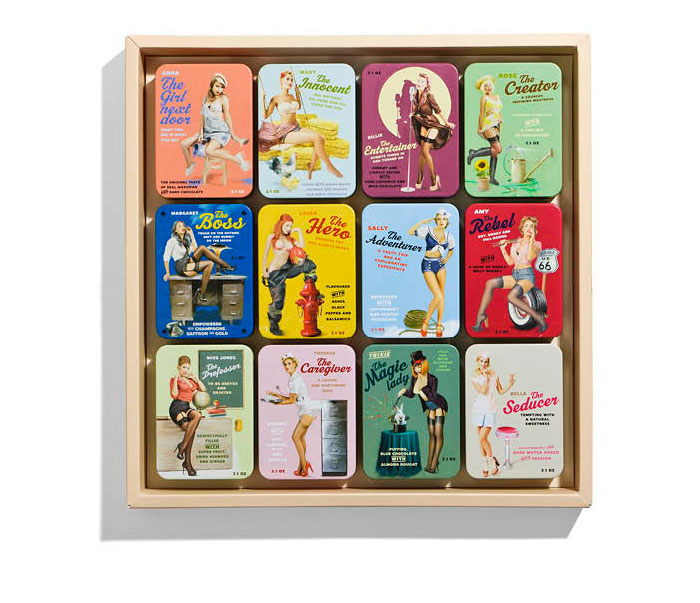
Chocolate with Attitude also refuses to be ordinary. Its packaging is wildly imaginative, and the illustrations, formats and themes of its different packages seem to have nothing to do with one another. A box holds 12 small chocolates, each standing for a personality and an "archetype" (the psychologist Carl Jung's term). This is not a split personality, though. The brand believes that all of them together make up its "Attitude."
Chocolate with Attitude packaging
Zotter Chocolate, the brand that likens itself to a chef who loves to experiment, says it is devoted to fighting boredom, and its nearly 20-year history is full of the bizarre and the unorthodox. For years it has worked with the Austrian painter Andreas H. Gratze, who paints the cover art for its packaging. He first tastes each new chocolate, gives it a personality, and only then starts on the illustration. Each package has a theme, such as "Secret Forbidden Place," "White Goddess," "Mango Tango" or "Burning Passion," and these are the stories he wants to tell. Gratze's work has a strong personal style: bright, intense colors, exaggerated and unrestrained subjects, and sometimes abstract and obscure images. It has become part of Zotter's brand identity. "In Austria, everyone recognizes our chocolate. Even if it's a new package, even if they don't see the brand name, they know it the moment they see it," Julia said.
Packaging for Zotter Chocolate's "Mitzi Blue" record-themed chocolate series
For all its flavors and collaborators, Zotter Chocolate is not a big company. "If everyone living in Shanghai ate one piece of our chocolate, our factory in Austria would need four years to make it all. That's how small we are."
Another brand we interviewed, the Vietnamese company Marou Chocolate, was founded by the Frenchman Vincent Marou and a friend. The two founders make every business decision, large or small, themselves, and they are willing to spend more on packaging design. Each Marou Chocolate bar is named after the province where its cocoa beans were grown, and its color matches the color of those beans. The patterns on the packaging reflect Vietnam's natural world: animals, flowers, fruit, even the tropical monsoon.
Marou Chocolate packaging
This may be what makes the chocolate business so appealing: although big companies such as Cadbury still dominate the market, countless tiny companies can find their own way to survive.
As Julia Zotter puts it, the big companies in the chocolate market, such as Cadbury, are generally the ones that make chocolate industrially, and they rarely change their flavors or designs. A small company, by contrast, can be as small as one person who makes, designs and packages the chocolate alone.
Old-school chocolate brands may choose stiff but classic packaging. Mainstream mass producers like to put mouth-watering pictures of chocolate and company slogans front and center. Small independent companies use more varied, more artistic packaging. In fact, they contribute the most imagination to chocolate packaging design.
Marou Chocolate would not give figures, but it told QDaily that it does spend a great deal of money and time on design, because it wants to launch new products and new packaging every year, each expressing a different side of the brand. Arriving at a design that defines a brand takes a lot of work. The founders spend a long time trying different directions and designs, sometimes taking months to decide, and building a brand image in consumers' minds then takes several more years. But Vincent Marou thinks the cost is worth it. A distinctive, appealing brand image makes a company more competitive, which means selling more chocolate.
With enough budget, a brand can of course hire a professional design consultancy. The British design firm Pearlfisher's work for the chocolate brand Green & Black's is one example.
Green & Black's makes only organic chocolate and sells it at premium prices. In its design, Pearlfisher dropped many traditional symbols of "luxury," such as shiny gold materials, and chose plain paper and simple single-color packaging to convey one idea: today's everyday luxuries should be organic, environmentally friendly and healthy. Pared-down design, with natural packaging materials and natural ingredients, is also gradually becoming a trend in chocolate packaging.
Pearlfisher has observed that chocolate buyers today increasingly want a kind of "everyday luxury": not just a quality product, but a brand that is more open and more sincere and that engages with them more. So chocolate brands have to use different materials, along with visual language such as imagery and structure, to create good packaging that communicates with consumers and meets their needs.
Packaging designed by Pearlfisher for Green & Black's
Some chocolate companies want to stretch your idea of what this food can be. How about a chocolate experience store, for instance? That does not mean a lavishly decorated shop like the Godiva stores you now see everywhere. It means a place where you experience chocolate in all its forms. From Cadbury World in Birmingham, England, to the Imhoff Chocolate Museum in Cologne, from the Mast Brothers chocolate factory in the United States to Shiroi Koibito Park in Sapporo, Japan, these romantic places really exist, and they are not far away.
Zotter Chocolate has built such a place in Shanghai's Yangpu District, which it calls the "Chocolate Theater." The building was once the cotton warehouse of a century-old textile mill. Renovated, the old factory building keeps its original brick-and-stone structure and now houses a small chocolate-making workshop, a chocolate shop, and a Viennese café serving drinking chocolate and Austrian apple strudel. Visitors who sign up for the "Chocolate Tour" can watch the production staff at work through glass windows and take part in the whole chocolate-making process.
The Chocolate Theater, converted from a factory warehouse
The tour opens with a film about the history of the Chocolate Theater and the cocoa plantations. In the tasting area, each visitor gets a small spoon with a cute design. Visitors can taste anything edible along the way "from bean to bar." They can, for example, squeeze freshly roasted cocoa beans out of a test tube, crack the hard shells with the spoon and eat the nibs inside. That is chocolate at its most basic: bitter and a little raw. The theater also has a scent area, where visitors play a "scent game": smell an aroma, then guess the spice. Coconut, ginger and lavender are generally entry level; cinnamon, fennel seed and vanilla are harder.
The scent station holds different spices (rose shown here)
At the "Chocolate Gas Station," visitors fill up from a chocolate fountain and compare pure chocolate liquor with processed chocolate syrup. The finished chocolates that follow cover everything the brand sells, from plain solid bars to filled chocolates, chocolate beans, hot chocolate, and liquid chocolate blended with alcohol.
Chocolate fountain
Visitors can also make their own chocolate in the workshop. They pick a mold and a flavor, pour in the chocolate, add nuts, petals or other toppings, and after ten-odd minutes of cooling they have a creation of their own. The hour-and-a-half tour gives them more than something to eat.
Chocolate workshop
Finished products from the "Mitzi Blue" series
Finished products on sale in the shop
In Julia Zotter's view, China's chocolate market is very young, the chocolate on sale is not yet varied, and Chinese consumers are more interested in and curious about chocolate and the stories behind it than consumers in Europe and America. Together, that adds up to a huge opportunity. So the company has grown from a franchised online-store brand into a chocolate theater that not only sells chocolate but also gives Chinese consumers a special chocolate experience.
"Basically, we're also conveying a way of life. These chocolates are like a joke played on you. You may like the different flavors in your mouth, or you may not. But everyone can get what they want from the whole experience and enjoy eating chocolate," Julia Zotter said.
Images courtesy of Zotter Chocolate, Compartes Chocolate, Square Space, Chocolate Naïve, Marou Chocolate
Translated from the original QDaily article. Original publication date retained.