

Why Can't Americans Learn to Love Uniqlo?
Its products, marketing and store locations all have problems, and American shoppers still hold the same stereotypes about Japanese brands. Uniqlo has run into one difficulty after another in the United States.
Its products, marketing and store locations all have problems, and American shoppers still hold the same stereotypes about Japanese brands. Uniqlo has run into one difficulty after another in the United States.
Ten years after it arrived in America, Uniqlo still hasn't managed to make money from Americans.
Tadashi Yanai, the company's usually self-assured CEO, is getting restless. In August he paid heavily for a full-page ad in the print edition of The New York Times, and also bought the most prominent slot on the paper's website, at the very top of the homepage, to run a "letter to America." It was out of character for a company that had always kept a low profile in the United States.
We will get to what the letter says. First, a question: is Uniqlo's anxiety just Yanai fretting over nothing, or has Uniqlo really failed to crack America?
Turn the calendar back three years. In 2012, Yanai announced Uniqlo's "2020 plan." Under it, Uniqlo's annual US sales would reach US$10 billion by 2020, and its global sales US$50 billion. According to the fiscal 2015 report (September 2014 to August 2015) of Uniqlo's parent company, Fast Retailing, the group's global sales for the year came to 1.6817 trillion yen (about US$13.8 billion) — less than half the 2020 target.
In the same year, Uniqlo's sales in Greater China passed 304.4 billion yen (about US$2.5 billion), up 46.3% year on year. It also opened 165 new stores worldwide, bringing its international store count to 798. In Europe, Uniqlo still has room to improve, but Yanai and his senior managers were reasonably satisfied, calling the results "better than expected." South Korea and Australia also beat expectations, and Southeast Asia is growing steadily.
Only when the report reached America did the pride disappear: "In fiscal 2015, Uniqlo USA's results fell short of expectations, and its losses increased."
Fast Retailing has not disclosed how much Uniqlo lost in America. But Goldman Sachs analyst Sho Kawano estimates that the US losses for the last fiscal year may have reached US$84 million, and that the gloom will last through fiscal 2016.
Uniqlo is indeed in trouble in America. Worse, judging by how the US business is doing now, there is no way it can meet its plan by 2020.
Could it be that American fast fashion as a whole is in decline, and Uniqlo is not alone?
It is not. In fiscal 2014 (February 2014 to January 2015), the brands of Inditex, Zara's parent company, sold US$2.7 billion in the US (more than Uniqlo's fiscal 2015 sales in Greater China), 14% of the group's total. H&M is an even safer winner: in the first three quarters of 2015, its US sales rose 22% year on year, and its US store count reached 381 — nearly 10 times Uniqlo's.
Look around, and of the world's four big fast-fashion companies, only Gap and Uniqlo are left suffering together. We have already looked at Gap's troubles. Back to Uniqlo USA: where exactly has it gone wrong?
Time to bring out the letter Yanai placed in The New York Times and see what he has to say for himself.
The letter opens: "Dear America: In this country, any wonderful product will be welcomed. When I founded Uniqlo in Japan in 1984, I believed that one day it would come to America." Yanai goes on to say that optimism, restlessness, an entrepreneurial spirit and ambition are qualities America and Uniqlo share. The second half of the four-paragraph letter adds words such as "fun," "classic," "innovative" and "combining style and function."
 Uniqlo's ad on The New York Times website, early August this year
It reads like a letter to consumers from a brand that has only just entered the American market. It works hard to stick labels on its own image, as if afraid people won't know it exists.
In 2006, Uniqlo opened its first global flagship store in SoHo, one of New York's busiest neighborhoods. In October 2011 it opened two more New York stores in quick succession: one on 34th Street, with 64,000 square feet (nearly 6,000 square meters) of floor space, and one on Fifth Avenue, home to the biggest names in fashion, at a rent of US$300 million over a 15-year lease.
Uniqlo's Fifth Avenue flagship in New York before it opened. Image from notclosed.com
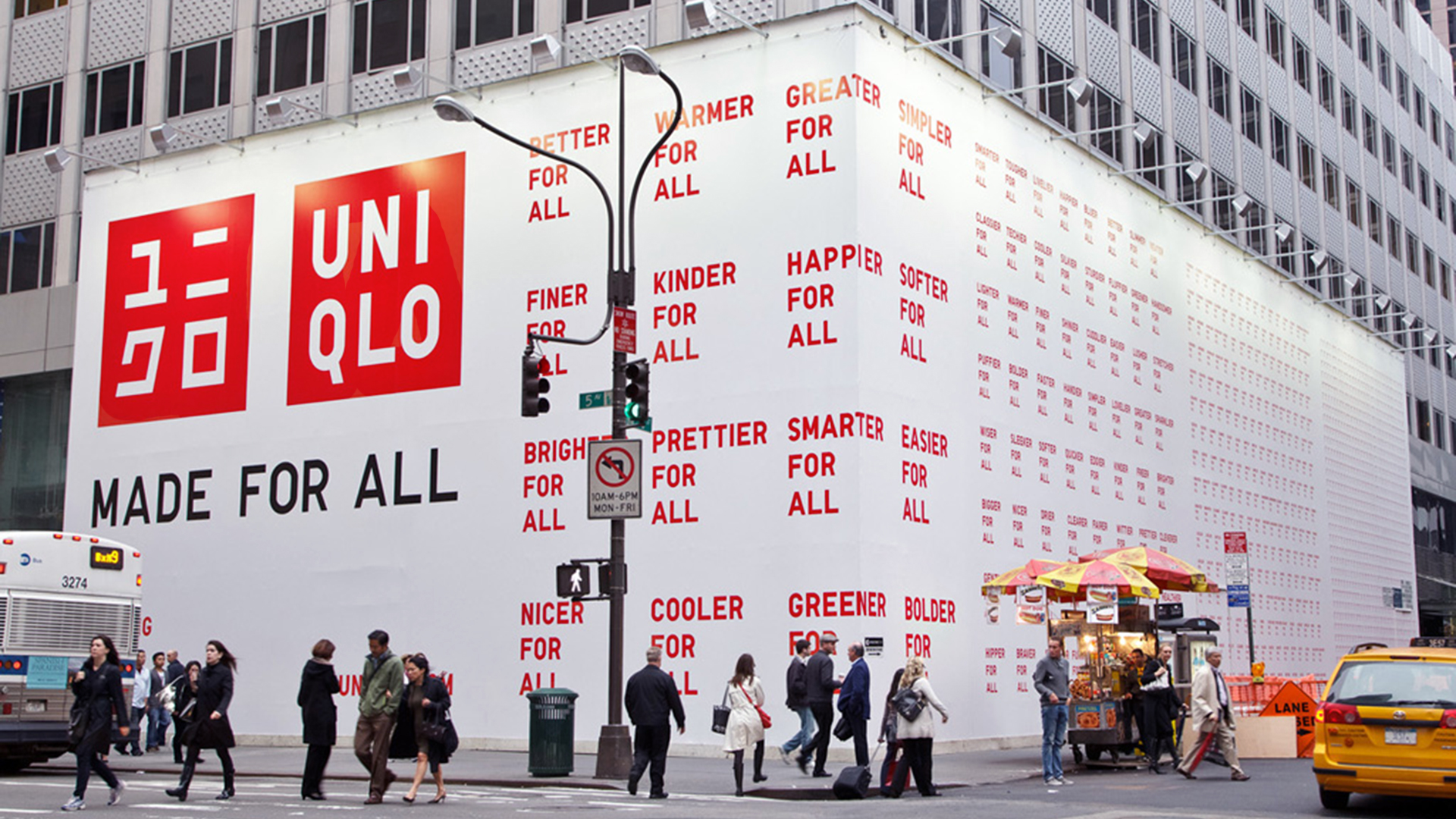
The Fifth Avenue flagship, three stories tall. Image from Uniqlo's official website
Inside the ground floor of the Fifth Avenue flagship. Image from scene7.com
These gleaming glass storefronts did draw in plenty of American shoppers, but most people simply walked on by. They didn't know what was actually for sale behind the glass.
You could say that the confidence Uniqlo brought to America came from the fanfare around these flagships, and it was never going to last. Even now, the company is still looking for a way to "introduce itself accurately."
"The most important thing is how we show customers our brand, our company and our products. I don't think we've done that yet — not at all," Uniqlo creative director Yukihiro Katsuta told the business blog Business of Fashion.
American clothing retail is fiercely competitive. Among traditional fashion brands there are American Eagle, Abercrombie & Fitch and American Apparel; in fast fashion there are Zara, H&M and Forever21. Any of them that sells a fair number of basics counts as a Uniqlo competitor.
At first glance, a brand from so far away doesn't seem to have much of an edge. If that is what you think, you have just proved another of Uniqlo's problems (in China as well as America): its marketing doesn't match the added value of its products.
Uniqlo's UT T-shirt line has won it fans in places like New York and San Francisco, but selling T-shirts was never Yanai's ambition. From its early fleece to today's Heattech and AIRism, the lines Uniqlo is proudest of are the ones with real technology in them. Uniqlo says the fibers in Heattech react to moisture the body gives off and turn it into heat to keep the wearer warm, while AIRism is made of ultra-fine fibers that wick sweat away quickly, which suits it to summer. This is what sets Uniqlo apart from other brands in America.
But it has not shown that to American consumers.
"In the US, Heattech and AIRism are not yet household names. However advanced the technology, American consumers don't know about it, because the brand has never introduced itself," Connie Wang, fashion features director at the American lifestyle site Refinery29, told us by email.
Wang thinks Uniqlo's American ads have "too much text and explanation. They aren't funny enough to spark the imagination. They aren't sexy enough, either."
"For American consumers who don't know the brand, these ads are very confusing," she said.
Samantha Henig, an editor at The New York Times Magazine, complains that Uniqlo's ads are unclear
A Uniqlo ad at a PATH station in New York. Image from jcdecauxna.com
A new-store opening ad on a San Francisco bus
Another bus ad — this is how H&M does it. Image from closettour.com

Uniqlo has realized this. In 2014, John C Jay, formerly a creative director at the agency Wieden+Kennedy, formally joined Uniqlo. Yanai called his arrival "a fresh start for Uniqlo in innovation and creative communication." The annual report also says Uniqlo will spend more on advertising and marketing in the United States and make good use of newspaper ads. That is why Uniqlo ads have started appearing in The New York Times.
Uniqlo is also slowly copying its rival H&M by working with brands, designers and celebrities. But set the two side by side and Uniqlo's strategy looks puzzling.
H&M is forever teaming up with big names (Jimmy Choo, Lanvin, Versace, Marni, Maison Martin Margiela, Alexander Wang and others). Uniqlo's partners are much quieter: the French supermodel Ines de La Fressange, the Japanese streetwear designer Jun Takahashi, the Irish designer Orla Kiely. Ordinary American shoppers are bound to ask: who are these people? So the work gets done, but it doesn't have much effect.
Not every collaboration has fallen flat. In 2014, Uniqlo teamed up with the Museum of Modern Art (MoMA) in New York to launch the SPRZ NY (Surprise New York) line, which put work by artists Americans know well, such as Andy Warhol and Jackson Pollock, onto T-shirts. After its launch at the Fifth Avenue flagship, the line was rolled out to Uniqlo's markets around the world.
Projects like this tend to achieve three things at once: they bring Uniqlo closer to American consumers, get its products more media coverage, and broaden its product range in every market.
Still, SPRZ NY's popularity raises a question. Why did designs drawing on American culture catch on in America and then spread around the world, while Uniqlo's other designs leave Americans cold? Do American consumers simply not care for Asian taste?
The question inevitably brings to mind Muji's cool reception in America. From March to August this year, Muji's profit in East Asia rose 95% year on year, while it lost nearly US$4 million in Europe and America.
"Uniqlo is as Japanese as IKEA is Swedish," Wang wrote in an article titled Why Uniqlo Might Soon Become the IKEA of Fashion. Everything from the way staff treat customers in Uniqlo's US stores to the in-store gift wrapping, she says, feels distinctly Japanese.
She is exactly right.
"Modern Japan" is a theme running through every Uniqlo global flagship. When Kashiwa Sato, Uniqlo's former creative director, planned the design of these flagships, he treated the look of contemporary Tokyo as an essential ingredient.
But do American consumers like these touches from the East? A question like that is hard to answer. One explanation tied to "coming from Japan" may hold, though: to American consumers, Japanese brands broadly mean "high tech" and "high price." Sony and Lexus, in their heyday, taught them that. Even things with little to do with technology are known in America for being expensive — Japanese restaurants, for example.
So in Americans' minds, Uniqlo must be expensive too, and ordinary shoppers stay away. Those who care less about price expect Uniqlo to be more high-tech, but they can't see how clothes could be high-tech at all.
"People think Uniqlo's clothes are expensive," David Chang, the Asian-American celebrity chef in New York, told The New York Times. "That's because where they live, say Texas, there's no Uniqlo. They think this [men's V-neck wool sweater] costs $250, when it's actually under 100 bucks."
Over the past 10 years, Fast Retailing has also tried to break into America in one go by buying American department stores and brands. In 2007 it bid US$900 million for the department store Barneys, and failed. In 2014 talk of a deal for J. Crew made plenty of noise but came to nothing. In 2009 Fast Retailing did buy the niche brand Theory, but that did nothing for Uniqlo's position in America — and Theory had plenty of unsolved problems of its own as it expanded in Asia and Europe.
Beyond positioning, marketing, collaborations and American stereotypes about Japanese brands, many other problems keep Uniqlo from finding its feet in America. Its designs, for one, are not fashionable enough — though fashion was never what Uniqlo was after.
"Senior management has realized they need to put more effort into educating American consumers and telling them who Uniqlo is," Wang, who has interviewed Yanai, told QDaily. "They know they made mistakes in their first push into a Western market, but they're still fairly confident about the future."
Those mistakes should include sizing and design details.
Thirty to 40 percent of Americans are obese, and their builds differ from Asians' too. Uniqlo, whose clothes have always been cut with no real waist, thought its basics were already roomy enough, but it still underestimated how big, bigger and biggest American bodies run. It will have to design new cuts, and its costs will rise with them.
Size labels are another problem. In Asia, clothing sizes are mostly given in letters (XS, S, M, L and so on), while Americans are used to numbers (0, 2, 4, 6 and so on). On Uniqlo's US website and in its stores, many items are still labeled with the letter sizes Asian shoppers know, which makes shopping harder work for Americans.
Then there is a problem Uniqlo would rather not talk about, and one it can no longer undo. In 2005, before the Fifth Avenue and 34th Street flagships, Uniqlo opened three stores in small New Jersey towns with populations under 100,000. They were its first stores in America, and all were tucked inside department-store malls. Picking such out-of-the-way spots was like testing the Shanghai market from Jiading, or Beijing from Tongzhou.
Uniqlo was really trying to copy Gap and go mass-market, but it forgot that Gap, as an American brand, has an American character and a home-field advantage. American malls are where stores look most alike, which made it hard for Uniqlo to show off its Japanese character, and small-town shoppers are less open to foreign things than big-city ones.
To this day, Uniqlo still has nearly 30 stores hidden away in malls in small towns like these. They are a legacy of its early years, and they keep draining its energy and money in America.
After losing 10 years this way, Uniqlo now hopes to turn things around with a letter in The New York Times. That will not be easy.
"The problems facing Uniqlo are as high as a mountain," Goldman Sachs analyst Sho Kawano concluded.
With 2015 nearly over, the ambitious Uniqlo has less than five years left to deliver its 2020 plan. Perhaps it should not take that deadline so seriously. For a brand that is a giant in Asia, what matters most now is to rein in its giant strides and take small, steady steps in America, one at a time.
Yanai has realized this too. Because the earlier expansion went badly, he has decided to slow the pace of US store openings. Over the past year Uniqlo opened 17 new stores in America; next year it plans to open only five.
Still, Yanai is impatient after all. "We must concentrate Fast Retailing's resources and win the American market as soon as possible," he wrote in the annual report.
Images from Uniqlo's official website, japantimes.co.jp

Translated from the original QDaily article. Original publication date retained.