

This Bag Is a Bit Dirty, a Bit Smelly and Not Very Fashionable. Why Has It Taken Over the World? | Market Inventors
Freitag is one of the best examples of "making not just a product, but a brand." Here is how it won its fans, and how it keeps them.
Freitag is one of the best examples of "making not just a product, but a brand." Here is how it won its fans, and how it keeps them.
On November 20, in Chuangyi Mixpace, a co-working space on Yuyuan Road in Shanghai, a young man whose Instagram handle is watchpigcjc cut down a rope hanging on the wall and became the first to collect the prize that was his that day: a white Freitag canvas bag.
watchpigcjc won because he had entered a photography contest called "Shanghai in the Bag." More than 100 people entered the contest, which was launched on Instagram and on a WeChat official account, and his photo was judged the best of them all.
He works in video design. Counting small accessories, he already owns more than 30 of these bags. Ask him anything about Freitag and he has an answer; he can tell you without a pause which styles and colors are "rare."
In front of the stage, the packed crowd broke into applause. Only by pushing through it could you see the Freitag photos and posters on the walls, and the row of handsome bicycles parked inside.
All these people had come for a bag made from recycled truck tarpaulin. To most people, a Freitag bag is still unfamiliar. You may have glimpsed one on the street, but it hardly counts as fashionable or eye-catching. To fans like the people in that room, though, it is a creative product that has already swept the world, and its ideas, its story and its design pass by word of mouth again and again. To them, it is the trend; it is cool.
The contest was held partly to welcome Freitag's founder, Daniel Freitag, to Shanghai. Daniel had not come to open a store, and he has no concrete plans yet. But because Jeannine, the company's new-markets manager, has been traveling to China often, Daniel keeps getting emails from fans here, full of stories about the bag and carrying one invitation: "Come and do something here!" His last trip to China was 15 years ago.
We Can't Skip Its Story
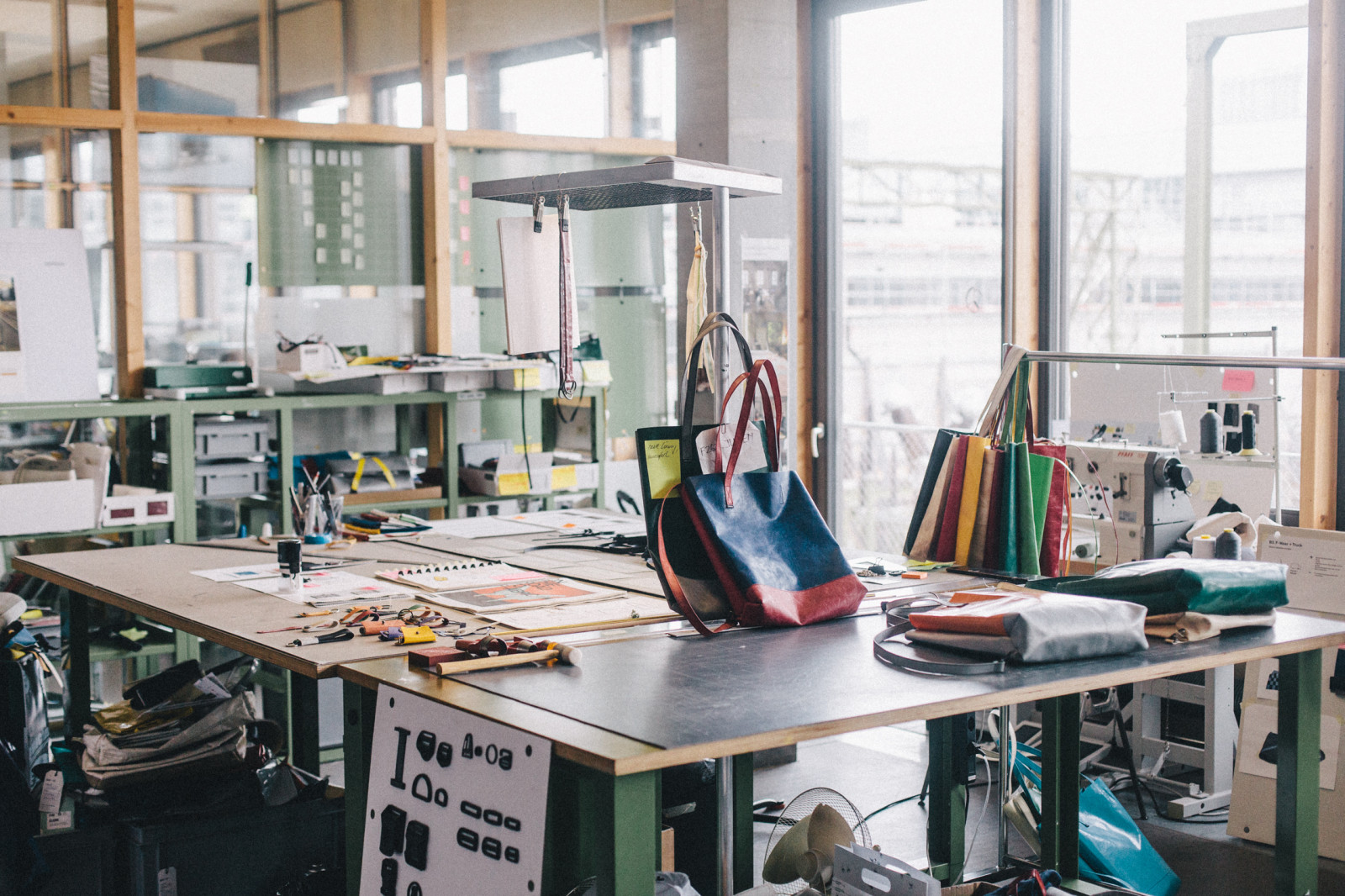
Freitag was founded in 1993, and at first it made a single messenger bag. The body was cut from waterproof truck tarpaulin, the strap was made from a car seat belt, and the edges were trimmed with bicycle inner tube. Because every Freitag bag is made from recycled material, every one is unique.
At the time, Daniel Freitag and his older brother Markus Freitag were about 20. In Daniel's words, theirs was really a "know-how" business: if you know something others don't, you can build a business on it.
The two young brothers were both designers and keen cyclists, and they wanted a practical bicycle messenger bag that could carry a load and keep out the rain. In 1993 nothing like it existed in Switzerland. The brothers decided to make one themselves, but like everyone else they had no idea where to find suitable material, so they wandered around looking for inspiration.
Then one day a truck drove past their apartment. Looking at the waterproof tarpaulin over its load, they suddenly realized they could use it. Later they noticed that the patterns and lettering printed on the tarps were interesting too, and made distinctive design elements in their own right. Those two discoveries produced a new idea.
They drew the design in one afternoon. Markus then rode his bicycle to a local haulage company and came back with a small piece of truck tarp, and they spent about a day at the sewing machine. Within three days, the prototype of the very first Freitag bag was finished.
 The first messenger bag
The apartment where they worked in the early days
Colorful tarpaulins on trucks: this is the raw material
You may have read this founding story in plenty of other places, and yes, it makes light, pleasant reading. But Daniel told QDaily that they ran into many difficulties at the start.
Their workshop, for one, was the student apartment Markus shared with a classmate. It was tiny, and two sewing machines took up part of it. Once they had the tarps, everything happened in that apartment, from cutting the heavy material to washing the filthy pieces in the bathtub. That could not go on for long. So the real difficulty became finding partners willing to do this work for them.
The trouble was that the recycled material was old and dirty, and making a Freitag bag was nothing like ordinary manufacturing; there was nothing industrial about it. Nobody was keen to say, "All right, I'll wash it. All right, I'll sew it." People had no idea how to handle such unusual material, and they did not see a business in it, only a waste of time.
Winning over that first group of partners was hard, of course. Daniel still sighs a little when he looks back, but the struggle nonetheless set him and his company moving in a good direction.
How Did Freitag Become a Craze?
Every year Freitag uses 350 tons of brightly colored truck tarpaulin. If the trucks that supplied it lined up, the queue would stretch nearly 100 kilometers. Those tarps become 350,000 products a year, in a widening range of bags and accessories: fairly unisex backpacks and crossbody bags, women's shoulder bags and clutches, even phone cases and suitcases.
Search "Freitag" on Pinterest and you will find image after image of bag styles. Instagram has more than 12,000 posts tagged #freitagbag(s), in which people show off their bags and what is inside them (the "what's in my bag" posts you associate with trendsetters), or take stylish lifestyle photos with a Freitag bag in the frame.
FYI, the founder of the Freitag fan group in China, told us that most of these enthusiasts work in design and advertising, and sometimes start creative projects with their bags. Some take more playful or cooler photos; some paint their bags; some even take an original bag apart and use its material to design and make a new one themselves. "Beyond unique: even more unique," as FYI put it.
Shanghai in the Bag: a winning photo from Freitag's photography contest for this event
A winning photo from the photography contest
But Freitag bags did not catch on because of a wide product range; every brand has that. It sounds vague, but Freitag has a set of values, and, more important, it knows how to turn those values into material that spreads. Put bluntly, that is marketing.
By the 1990s, when Freitag was founded, environmental protection, green consumption and recycling had already grown from ideas and experiments into a trend. Daniel and Markus had used discarded materials in small design projects since childhood, and they still often get around by bicycle. But if they had simply practiced what they believed, or earnestly drilled the idea of "circularity" into the company and its products, customers would probably not have bought it at all.
Freitag understood this, so it took a more "positive" approach and turned the idea it promoted into a way of life. "We really do believe in 'the afterlife of things.' But we don't want people to buy these products because they feel sorry for the environment," Daniel Freitag said. "It's not about educating people. It's about conveying something positive, so that they like the thing for how it works and how it looks, and feel that they are living a certain way of life."
The focus is the product itself. Old waterproof truck tarps are collected, cut, washed and sewn into something entirely different from what they were. The bag tells its owner plainly that this material has been used before and now exists in another form. It is sturdy and durable, and it has a particular beauty of its own.
FYI, a longtime fan, is himself an industrial designer. What draws him to Freitag, he says, is not the idea itself but the way the company tells its story through a product; it has in fact worked out the product's function, versatility and other details with great care.
Only because the product is this appealing can Freitag go on to talk about "recycling" and "reuse."
People who like Freitag mostly like the product itself, not just high-minded talk about "recycling" and "circularity"

The event venue
Freitag is closely tied to bicycle culture (they are messenger bags, after all). Daniel's slideshow includes a section with this manifesto: "Cyclists say:
We only want to own things that last
We mend and repair!
We believe in a system designed to be compatible
Slow down, but gain time
Joy is circular too
Cycling is joy"
Every line is unimpeachably correct. The company also makes fun short videos and product ads that show, very playfully, how the bags are actually made. Each single-product ad brings the product to life: whether it is a bag, a key ring or a phone case, it moves, jumps and plays with people.
Ad for the R120 Austen bag
Ad for the key ring
In 2010 Freitag launched a more upmarket line, the Reference series, aimed at an older audience with more money to spend. Every product in it is named after a famous journalist; the company says this is a tribute to people throughout history who fought for freedom of speech. To promote the series, Freitag also ran a newspaper office in Zurich for three weeks, printing a Freitag-themed paper every day on an old-fashioned press.
Freitag's own language has to be funny and immediate, as if what it describes were happening right now, the company's copywriter Johnne Eisenhut once explained in an interview with the Museum für Gestaltung Zürich. "I quote a lot of lines from film, music and contemporary culture, break them apart, and turn them upside down and put them back together," he said. In fact every form of Freitag's "language" works this way: it is playful and steeped in contemporary culture.
What Exactly Do Freitag's Fans Love About It?
Ask people why they like Freitag's products and many reach for the same word: texture. Texture is a vague, subjective idea, but it is exactly what moves people about this product. The bags are solid and stiff, for one. And because the material has been used many times and worn by years of bad weather, many Freitag bags look old. Yet plenty of people love precisely that weathered look, and some even treat their bags specially to get it.
Daniel Freitag also sees "old" as a virtue: "It's part of our story, and that quality helps tell our story."
By 1995 the company's workshop had moved to a fairly large local industrial area, and Freitag hired a photographer for the first time to shoot promotional pictures of the founders. They wore green uniforms and dressed like workers. "We just like this approach. It's not fashionable at all, it feels industrial. We do belong to the fashion industry, but in a way we're also anti-fashion," Daniel told QDaily.
Daniel Freitag: "The green color and the canteen atmosphere feel more like 'we are making things' than 'we are designing things.'" (Daniel and Markus in 1995)
Beyond texture, being one of a kind also makes Freitag's products appealing.
At different moments, Daniel has suddenly felt that Freitag was catching on. The first time was in the company's early days in Switzerland, when he saw a stranger carrying one of his bags. Later it happened in New York: "When I saw him I thought, oh, he really does speak American English, he's not a Swiss tourist visiting the US. Realizing that our product could win over people in New York gave me a sense of achievement." Freitag had not opened a store in the US; at the time it had only a single pop-up shop.
The bag took off in much the same way in every country. Its texture, its design and its uniqueness drew in people working in creative industries, people who like to be different and are more open to new things. From them, awareness of and affection for Freitag slowly spread outward.
Retailers know that "one of a kind" sells, too; there are always people willing to pay for something different. So even though Freitag now runs its own stores in several larger markets, retailers keep approaching it about partnerships. These partners are what helped it build a sales network around the world. When Daniel visited Shanghai 15 years ago, he met the Chinese partners who knew the brand at the time, and a meeting with them is on this trip's schedule too.
Designing a Product, or Designing a Brand?
Wherever they go, the brothers Daniel and Markus stress a "holistic" approach to design: they do not just design products, they design a company. Defining their values, marketing and branding are all part of it.
Although they are the founders and in practice the top bosses, Daniel and Markus both carry the title "creative director," not CEO. Freitag now has 150 employees and several departments. Daniel believes that at this stage the company should diversify without diluting its image and values.
So it has gradually introduced products beyond bags and accessories. It began with T-shirts promoting the company's ideas, printed with the Freitag logo and the logos of the truck and car companies that supply its material. Later Freitag added its own clothing line, made from a workwear fabric the company developed entirely in-house. Called F-abric, the textile is 100% biodegradable: when you no longer want your jeans, you can dig a hole, bury them, and they will decompose on their own. The idea caused quite a stir when it was formally launched in the second half of last year.
Freitag makes clothing from the textile it developed itself
In the 20-plus years since its founding, Freitag's biggest difficulty has always been limited resources. That is easy to understand: it sells products made from a single kind of material and depends heavily on that particular material. The company now has a department dedicated to finding and buying truck tarps across Europe. At the same time, the number and range of products grow every year (women's bags, for example, need different material from unisex ones), and finding tarps of the right type and color has become a new problem.
In Daniel's view, "limited resources" is a broad idea. Raw material is only one part of it; the limits also include markets, money, people, time and the size of the company. The tension is that the Freitag brand is far stronger than the company's resources and what it can do at this stage. "We have 150 people, which is still very small, but people expect that behind the Freitag logo there's a big company thousands of times our size. So the biggest problem is how to meet people's huge expectations with limited resources," he told QDaily.
He need not worry much. Thanks to the brand's influence and the devotion of its fans, many things he believes the company cannot yet do because of its limits, the fans have, in a sense, "done for them."
When the first Freitag store opened in Tokyo, loyal fans were queuing at the door before dawn, as happens when big brands open stores or release new products. The publicity was excellent.
Freitag has attracted a following among cycling enthusiasts
FYI, the fan mentioned above, founded the Freitag China fan group in 2014. He felt that more and more people would come to love these truck-tarp bags, and he wanted to bring them together to share what they love. That love and sharing drive the growth of many brands. If you need a case study of the "fan economy," Freitag, the company that makes bags out of truck tarps, would certainly qualify.
Image sources:
Freitag, Freitag Instagram, UrbanVeloa, freundevonfreunden, Instagram (ID: Watchpigcjc, Pamhomme)
Translated from the original QDaily article. Original publication date retained.