

You've Been Seeing a Lot of British Plays on the Big Screen. What's the Story Behind Them?
First comes the “Heartthrob Season,” built around three productions starring fan favorites Benedict Cumberbatch (“Juanfu” to Chinese fans), Tom Hiddleston (“Dou Sen”) and James Franco (“Fu Lanlan”). Next is the “Awards Season,” with plays such as *The Audience*. Next year brings a “Shakespeare Season” of the classics.
First comes the “Heartthrob Season,” built around three productions starring fan favorites Benedict Cumberbatch (“Juanfu” to Chinese fans), Tom Hiddleston (“Dou Sen”) and James Franco (“Fu Lanlan”). Next is the “Awards Season,” with plays such as The Audience. Next year brings a “Shakespeare Season” of the classics.
Since around June this year, you may have heard one phrase more and more often: “watching plays at the cinema.”
It sounds odd, but people really are doing it. Plays that once could be seen only in a theatre are digitized and shown in cinemas like films, a hybrid of theatre and cinema.
The project that has spread the idea around the world is National Theatre Live (NT Live below), run by Britain's National Theatre. When one of its productions is on stage (say, when Benedict Cumberbatch plays Hamlet in a London theatre), cinemas in other British cities that have signed up to NT Live broadcast it live, and their audiences watch the Danish prince pace the stage asking himself “to be or not to be” at the same moment.
NT Live is not a film. What appears on screen is closer to a live broadcast of a sporting event (or, outside Britain, a recorded one), and in the cinema you may even catch the small mistakes actors make on stage. Yet it also lacks the immediacy of theatre. With a screen between them and the actors, viewers can no longer interact with the cast or share in the same emotional atmosphere.
Plenty of people doubt this “art form somewhere between film and theatre,” but it is catching on worldwide. NT Live launched in Britain in June 2009 with its first production, Phèdre. Since then 50 productions, including War Horse, Macbeth and King Lear, have traveled to countries around the world; in Asia, cinemas and theatres in Japan, South Korea, Saudi Arabia and India already show NT Live. To date, NT Live has reached more than 1,100 venues (half of them outside Britain) and has been seen by more than 3.5 million people worldwide.
This June, NT Live came to China. You can now see Frankenstein, starring Benedict Cumberbatch, and Shakespeare's Coriolanus, starring Tom Hiddleston, in cinemas. The second wave of “films,” released recently, also includes newer productions that have swept many theatre awards over the past two years, such as The Audience and The Curious Incident of the Dog in the Night-Time.
Today we want to tell you the story behind these British plays on the screen.
 Shakespeare's Coriolanus, starring Tom Hiddleston
The National Theatre's aim with NT Live is simple: to get its productions in front of more people, widening its audience and its influence around the world.
British theatre has long ranked high in the world. London's West End, with its cluster of theatres, is often named alongside New York's Broadway as the summit of English-language theatre.
There is no need to go back to Shakespeare's 16th century. Take this year: after the Tony Awards (in the US), the most closely watched prize in theatre in 2015, media around the world ran headlines such as “a triumph for British theatre,” “another British invasion” and “the British rule the Tonys.”
Half of the 10 actors nominated for best leading actor and actress were British, and the British productions The Curious Incident of the Dog in the Night-Time, Skylight, The Audience and Wolf Hall won awards including best play, best revival of a play, best direction, best actress and best scenic design. The list shows that this year British theatre excelled in acting and production, and in costumes, sets and lighting.
A Guardian article, “The British invasion of Broadway: a century of rivalry across the Atlantic,” asks why British theatre has been able to “invade Broadway” in recent years while getting better at reaching the world. Its answer: theatre has a long history in Britain, the public values it, and the state funds it generously. Because of this, theatre-makers are more willing to explore what theatre can do, and to experiment even in serious drama, rather than watching only the box office.
The National Theatre is one of the most important, and in some ways most cutting-edge, theatres in Britain and the world. Every year it draws 1.2 million visitors to its home on the South Bank of the Thames in London, and it invests heavily (and not only money) in its productions. War Horse took a full five years of development and rehearsal. The “war horse” is a puppet worked by people, yet on stage it looks utterly real and moves audiences. The Curious Incident of the Dog in the Night-Time, which this year won best play and several technical awards, uses 890 LED lights in all, and technology and multimedia do much of the work in its set design, creating a wondrous stage.
As a “national” theatre, the National Theatre receives substantial public funding and is seen as obliged to carry an art form the British are proud of to theatres everywhere: not just in London, and not just in its own building or during a play's run, but beyond geographic limits, so that audiences in markets around the world can enjoy its work.
War Horse uses a puppet horse, yet it never pulls the audience out of the story
The stage and scenes of The Curious Incident of the Dog in the Night-Time are stunning
With that aim, NT Live went abroad, and came to China.
It first arrived in 2012, a year after Frankenstein premiered in London. A cultural organization, the KT Wong Foundation, brought NT Live to China for the first time, screening it at the Broadway Cinematheque in Beijing's MOMA complex. The play's Chinese title then was Frankenstein's Soul and Flesh, and the cultural and education section of the British Embassy chose it as one of its major cultural exchange projects in China that year. With popular actors and a popular director (Danny Boyle, who made Trainspotting), the production caused a stir in a small circle.
In 2013-2014, Frankenstein and Coriolanus were screened again, at the Beijing People's Art Theatre and the Shanghai Grand Theatre. These were short runs with a cultural-exchange character, and both drew a lot of attention.
But NT Live's arrival in China at scale, for a long run in the Chinese market, goes back to War Horse, which the National Theatre staged with the National Theatre of China. In 2014 the two sides produced a Chinese-language version of this classic play, and that was the turning point. Because the collaboration went well, the National Theatre wanted NT Live to come to China for the long term, rather than as short screenings that leaned only on star power.
Once the project was settled, bringing in an NT Live production became a three-party process. Beijing Aozhewei Culture Communication Co., Ltd., which runs the Chinese market, consults with the National Theatre and selects titles with it. Once the two sides agree on a list, the National Theatre of China reviews the content once more (approval). The National Theatre then makes high-definition digital film copies and brings the material to China, and Beijing Aozhewei handles operations and promotion in China (translation, contacting venues, contacting ticketing partners and so on).
Because NT Live is such an unusual format, it works differently in China from the cultural products we know better, with a business model of its own.
The first way NT Live differs from film in China is that it can hardly get into the cinema chains. Most venues showing NT Live are not cinemas. In other countries, the National Theatre usually partners with well-established cinemas, whose larger networks reach more customers. In China, however, the authorities have ruled that NT Live is “not a film,” so it cannot be shown in regular cinemas. In the words of Li Congzhou, head of NT Live in China and CEO of Beijing Aozhewei Culture Communication Co., Ltd., it sits “in a gray area for approval.” In China, NT Live has ended up in all kinds of cultural venues: the cinemas of the China Film Archive and the Shanghai Film Museum, the Shanghai Dramatic Arts Centre, the National Art Museum of China and others.
The organizers are still trying to get it into more cinemas, but the people who come to NT Live were never the mainstream film audience anyway. Many are theatre lovers who, if not die-hard fans, are at least interested in plays and want a chance to see well-known British and American productions. Others are the venues' own audiences: film buffs at the China Film Archive who are not satisfied with what mainstream cinemas show, for example, or visitors to the UCCA Center for Contemporary Art who go to contemporary art shows or like pop culture (UCCA is in Beijing's 798 Art District). NT Live and these venues have set up membership ticketing, and some tickets go through a fast channel straight to members who come for the exhibitions or arthouse films.
British TV drama fans are also keen on NT Live. They are usually drawn to British dramas for their polish, dramatic tension and British cultural content, and a good British stage production has all of these, with leads who are familiar faces from British TV and film. Fans find what they are looking for, so they are willing to pay for a play with no actors in the room. Li Congzhou has noticed something interesting: in Beijing and Shanghai, the first two pilot cities, NT Live's audiences differ, and far more Shanghai viewers than Beijing ones come because they like British TV drama.
King Lear, directed by Sam Mendes
Chris O'Dowd, one of the leads of Of Mice and Men, plays Roy in the popular British sitcom The IT Crowd. He is no big star, but fans of British TV know him
By placing NT Live in many kinds of venues, NT Live and Beijing Aozhewei hope to carry this cultural form across boundaries and draw audiences of different backgrounds and tastes. Even so, they are still doing business in a niche market.
“Our audience is far smaller than cinema's, so we promote differently. The costs are different and the methods are different. Film carpet-bombs; NT Live makes pinpoint strikes,” Li Congzhou told QDaily.
That is true. Film promotion targets the general public. “The promotion is everywhere,” and the hooks and talking points are pitched at what a mass audience can grasp and accept, with a heavy dose of entertainment. For a typical Chinese film with stars, the budget spent directly on marketing and distribution is usually 20 million to 40 million yuan. The money pays for press conferences and promotional events, ads at bus stops and across the mass media, and the cast and director appearing on entertainment shows to win goodwill and stay visible.
NT Live's promotion is nowhere near that size or cost. “Pinpoint” means its promotion is targeted, aimed straight at particular audiences (the niche groups mentioned above who like theatre, British TV drama, or arts and culture). The main channel is online: ads on ticketing sites and online media, and articles and show information posted on its own social media accounts.
NT Live goes about this cleverly. Its official WeChat account, “British Theatre Live,” does not force-feed readers copy praising its own product. Instead it posts plenty of articles about British culture, full of information and fun to read, and each tied to a play that is showing or about to show.
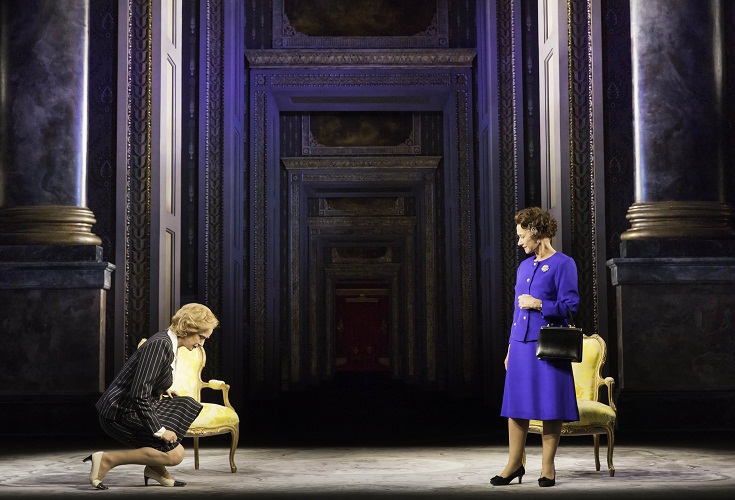
The Audience, part of NT Live's second wave, has the flavor of a secret history. It is about the private meetings Queen Elizabeth II has held with 12 prime ministers over her 60 years on the throne, meetings that were all kept confidential and were by turns intimate and combative. To promote it, NT Live's official WeChat account posted stories of British politics (“Lives of the Prime Ministers”) and royal content (how the Queen escapes the summer heat at her residence in Scotland, her love of corgis, the background of the audience room at Buckingham Palace), which fed the target audience's curiosity about British culture.
In The Audience, Queen Elizabeth II meets Margaret Thatcher
The story of the Queen and her corgis appeared on NT Live China's official WeChat account
They also hold offline screenings and invite arts media to watch the plays and write reviews. Li Congzhou says NT Live will work with the Beijing International Film Festival next year, and may have its own promotional slot at the festival.
These methods are, at heart, closer to how theatre is promoted. And what NT Live spends in China on its arrangements with venues (marketing, plus making the digital copies in Britain, translation and shipping) is about the same as for a good small-theatre play. So Li Congzhou prefers to position NT Live as a theatre product: its content is close to theatre, its target audience is theatregoers, and its business works more like theatre's.
From its official launch in China this June through early next year, NT Live is releasing plays in China in stages, each with its own theme. First comes the “Heartthrob Season,” built around three productions starring Benedict Cumberbatch, Tom Hiddleston and James Franco. The second stage, the “Awards Season,” brings The Audience, Skylight and The Curious Incident of the Dog in the Night-Time, winners of the Tony and Olivier awards, theatre's most prestigious prizes. Next year comes a Shakespeare Season of the classics.
Li Congzhou says these plays were chosen not just because they are “good plays,” but after “careful thought.” The 10 productions were picked to give a fairly full picture of the National Theatre's work, and promoting them by season and by series costs less than promoting each one separately. As for timing, the first season uses British and American “heartthrobs” as a hook to draw attention at launch. The Awards Season rides the buzz and strong reviews that followed this year's Tony Awards. The Shakespeare Season in the first half of next year marks the fact that 2016 is the 400th anniversary of Shakespeare's death.
In fact, both the conservative British side and NT Live's Chinese organizers worry about the risks of choosing and promoting plays. “After all, not every play has Cumberbatch. Hardly anyone has heard of the other plays we bring in, and even among Cumberbatch's plays, apart from the Shakespeare, hardly anyone has heard of them either.”
So far, though, audiences have responded better than they expected. The organizers had forecast 60% occupancy; it is now 70%-80%, and plays starring Cumberbatch almost always sell out. As of our interview, NT Live had held 95 screenings in Beijing, Shanghai and Wuhan, with more than 30,000 viewers, and will hold its 100th screening in Shanghai next January. Because the plays themselves are so good, people have gradually let go of their doubts about the format and the picture quality, and come to accept and enjoy it.
“This is not a new art form, but a new way of promoting theatre,” is how Li Congzhou defines it.
NT Live still has several problems to solve in China. The main one is reaching the whole country: it is still looking for ways into more cinemas, and trying to explain to the media and audiences who ask “Will the stars come to promote it?” that “They won't, but these plays are still worth seeing.” Next is improving ticketing and the viewing experience: making tickets easier to buy, and upgrading the equipment and staff service at screening venues.
Image sources:
Mashable, thirdrailrep, Ameliareviews, HuffingtonPost, Huffingtonpost uk, Griffith City Cinemas, dailymail, StageandCinema, Douban, New York Times, thefilmexperience
Translated from the original QDaily article. Original publication date retained.