

Great Design Often Looks Strange at First | 14 Rules of Good Design
This Spring Festival, we unpack the 14 intriguing claims about good design that Paul Graham makes in *Hackers & Painters*.
This Spring Festival, we unpack the 14 intriguing claims about good design that Paul Graham makes in Hackers & Painters.
Good Design Is Strange
Of Paul Graham's 14 claims about good design, strangeness may be the one that most depends on talent and inspiration. As he puts it himself: "Most of the qualities of good design can be cultivated, but I don't think strangeness can be."
Strangeness is sometimes unintended. Einstein did not set out to make relativity strange, and Michelangelo never tried to forge a distinctive style; the result simply emerged. Some outstanding works only look astonishing in hindsight.
But Graham adds a caveat: "Maybe they only look strange to me because I'm not smart enough. A dog would think a can opener was a miracle too. If I were a genius, I might find (Euler's formula) perfectly ordinary. It's not wrong, so what's strange about it?"
The Aeron Chair

Herman Miller makes office furniture. You may not know the name, but you have probably seen its signature products in offices large and small: a line of ergonomic chairs, including the Embody, Aeron, Mirra and SAYL, that many office workers treat as their computer chair of choice. The Aeron suits anyone who spends more than eight hours a day glued to a seat. Its support is so well judged that, reportedly, even people with herniated lumbar discs can sit and work in it without worry.
What makes the Aeron strange is the butterfly-shaped support frame behind the back and the taut, springy mesh of the backrest. Together they hold the full weight of a person leaning all the way back, firm but never hard. Lying back in it is so comfortable that it feels as if someone is giving you a push from behind.
There is more. When we look at a screen, our heads drift forward without our noticing, and after a while the neck starts to ache. The Aeron's five-degree forward tilt helps with exactly that.
You can imagine Herman Miller working through every ergonomic angle when it designed this chair, letting function dictate form. The result balances what the chair does with how it looks.
Arnhem Central Station, the Netherlands
What comes to mind when you picture a train station? Whatever it is, it probably doesn't look like Arnhem Central in the Netherlands.
The station looks more like a large shopping complex. It abandons the conventional structure of a station building and uses twisting walls and roofs for dramatic effect; inside the main hall, ceiling, walls and floor all run into one another.
The design was reportedly inspired by the Klein bottle, devised by the German mathematician Felix Klein. Like a Möbius strip, it is a twisted, closed surface with no edge, a surface that never ends. Yet the sculptural structure does not get in the way of the station working as a station. More remarkable still, many of the designs and solutions in this avant-garde project were proposed 15 years earlier.
The Mini Cooper
In China, it is said, 80% of Volkswagen Beetle owners and more than 60% of Mini owners are fashionable women. Yet these classic small cars began life as cheap, well-made people's cars. People's cars shared a set of traits: small size, low production cost, a low price, decent quality and stylish looks.
At the design stage, people's cars even had to meet strict specifications. The car had to carry four people, or two farmers plus a 50-kilogram sack of potatoes and a basket of eggs. It had to cross a plowed field without breaking a single egg in that basket. It had to reach 65 kilometers per hour and keep fuel consumption within a set limit.
The Mini Cooper is a model example of a car built to this brief. The direct trigger for its creation was the fuel shortage that followed the Suez Crisis. Its designer, Alec Issigonis, worked from the inside out. He turned the engine sideways, pushed the wheels out to the four corners of the body and put the gearbox underneath the engine. Everything, from the headlights and door handles to the radiator grille, was kept to a minimum. The frameless body did nothing beyond protecting passengers and covering the parts, and carried no ornament added to follow fashion. Yet this car, which paid no attention to styling, became a fashion favorite and, almost by accident, a classic for a generation.
The Axor Starck V Faucet
The French designer Philippe Starck has turned washing your hands into an art. He created the Axor Starck V faucet with Axor, a brand of the German bathroom-fittings giant Hansgrohe, his long-time partner. It overturns the look of the traditional metal tap. Starck cut back the metal and made the body of the faucet from clear crystal glass. He also reversed the usual downward flow: the water first swirls upward, then falls, in two stages, so you can watch it move as you would watch a natural spring.
The Axor Starck V comes in two parts. The handle can be fitted on the left or the right, as you prefer, and thanks to a water-saving valve design, the clear upper spout lifts out and can even go in the dishwasher.
The principle behind it is not hard to work out. But the faucet's shape, and the experience of using it, are so charming that you hardly want to turn the water off.
A Teaching Building at Nanyang Technological University, Singapore
Britain's Heatherwick Studio, always fond of surprises, has been just as bold with university buildings.
Take the teaching building it completed last year at Nanyang Technological University in Singapore. To avoid the conventional layout of box-shaped classrooms strung along corridors, the studio designed a cluster of tapering towers around a large central atrium. The complex consists of 12 towers that look like "giant European parsnips" (much like white radishes): a bold idea with a touch of playfulness.
It is more than a structural flourish. The building combines teaching facilities with social space, adding balconies, gardens and open-air walkways to get teachers and students talking and working together as much as possible, and to steer students away from the old habit of passive learning.
The project also offers a rare chance to rethink how a traditional university building should be designed.
Good Design Is Suggestive
A story with an open ending stays with us. Among works of art, those that spark fierce debate among viewers of different eras tend to last longest. Their creators leave room for the audience to take part, and the audience gains both the right and the desire to interpret and reshape them.
A suggestive design lets people use it however they like. They are not bound by fixed rules of use, nor do they have to follow the plans of designers and architects. They are freer: they arrange their belongings and their spaces as they see fit. It is the same reasoning behind the question "Why do hackers love Lego?" Lego supplies only basic pieces, and users combine them however they please to build full, rich worlds.
Nendo's Nest Shelf
At the 2015 London Design Festival, the Japanese design studio Nendo showed a shelf made with carbon fiber. Its capacity is easy to change: inside it hides a second shelf 4.8 millimeters thick, and pulling this out until the unit is fully extended doubles its width and volume. "It is as if another shelf of similar size grows out from the inside," is how Nendo describes the design.
The shelf is very flexible. You can set how far it extends to fit the room, or adjust the size of its compartments to suit your taste; it all depends on what you need. It can form a neat three-by-three grid or a set of uneven compartments, but the two sides always stay equal, so the shelf keeps its symmetry.
Cat Table 2.0
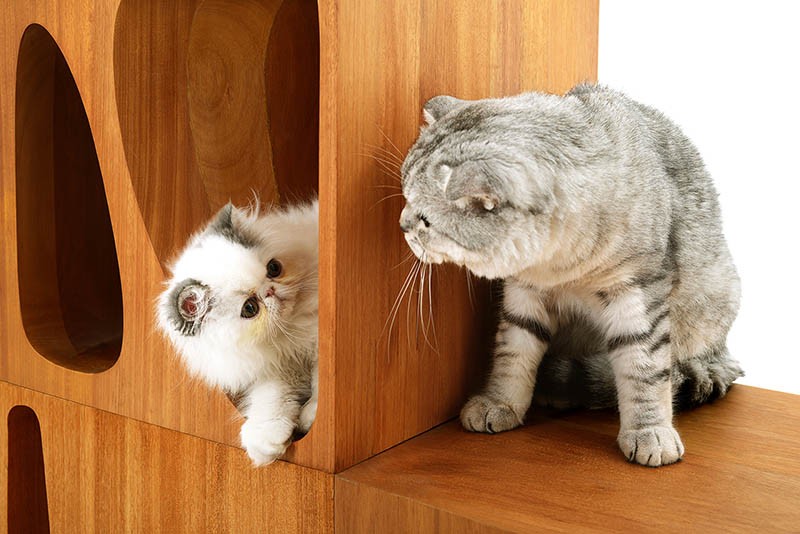
Cat Table 2.0, designed by Ruan Hao, founder of LYCS Architecture, and his team, is a textbook piece of modular furniture. It is not "a table" in the usual sense but a set of wooden cubes, each with a hole of a different shape and size cut through its center. Owners can stack the hollow cubes however they like into different pieces of furniture, while their cats rest, burrow and play in and on them.
Explaining the idea, Ruan Hao said that Cat Table 2.0 is an open system defined by its users. It has its own grammar and thousands of possible forms. The routes the cats take through it, and the shape of the furniture itself, change every time the owner rearranges it.
And because people and cats share it, the design itself encourages owners to keep rearranging it, to keep things new for the cats. Both get something out of it: they can play together without getting in each other's way.
Table Legs by Floyd, the Furniture Company That Sells Table Legs
Floyd is an unusual furniture company: it built its business by designing and selling table legs. It made its first product to counter disposable furniture, the cheap kind that ends up in a landfill when people move house.
The founders, Kyle Hoff and Alex O'Dell, designed a set of simple legs that clamp onto a tabletop. With them, you can turn any flat surface into a table. The legs work with boards salvaged from old wardrobes, old doors and other furniture and materials, giving them a second life. Users get the fun of doing their own woodwork and assembly, and end up with a table that is distinctly theirs.
As city life grows more changeable, furniture companies need to respond with flexibility. Floyd rethought both the culture of buying home furnishings and the way people live in cities. It later built on the original legs with "legs" for other spaces and other kinds of furniture, giving users more to create with.
Minecraft
Minecraft is one of the most popular games in the world. Released in 2009 by the Swedish studio Mojang, it is a sandbox game in which everything is built from blocks. Players use these blocks to gather resources, craft items, survive, explore and reshape the world.
Some call Minecraft a virtual Lego. It gives players enormous freedom and open-ended play: they can let their imaginations run, build any space, place or world, and invent their own ways to play.
The game has no clear built-in instructions or rules. You start with nothing: no tools, no shelter, only the rivers and hills, forests and deserts around you. You can explore in any direction, and when you tire of exploring, you can stop and build a house. Nor does the game set a goal. A player can act as a god remaking nature, or stay an ordinary person doing whatever it takes to survive in a harsh world.
Minecraft has not yet seeped into world culture as deeply as Lego, but it is moving the same way, becoming not just a game or a set of blocks but a tool, a medium and a means of expression. Its creative mode gives players unlimited use of every kind of block, so some people have spent long stretches using it as a painting tool, producing pictures, graffiti and sculpture. In Europe, governments such as Britain's and Denmark's have released large amounts of geographic and architectural data to rebuild streets and cities in Minecraft, creating detailed maps. It also makes an excellent marketing tool: a pixelated Boris Johnson, the mayor of London, recently appeared in Minecraft to promote London's games industry.
Image sources: Dezeen, LYCS Architecture, contemporist, Floyd, videogamer, minecraftgallery

Translated from the original QDaily article. Original publication date retained.