

How Starbucks “Played” Every Kind of “Correct” Company at Its Global Shareholders Meeting
At this important moment, CEO Howard Schultz gave most of his time to talking about his “American Dream.”
At this important moment, CEO Howard Schultz gave most of his time to talking about his “American Dream.”
At 9:40 a.m. Pacific time on the 23rd, a long line formed outside McCaw Hall in Seattle.
This performing arts center, open since 2003, stages the city's most important ballet, opera and other performances on ordinary days. Floor-to-ceiling glass, heavy red curtains and soft carpet all announce its stature.

If you are an individual or an institutional representative holding a certain number of Starbucks shares, you may have come here every March since 1992 for the annual global shareholders meeting — and if you look up, you can see the city's landmark, the Space Needle.
This year about 2,800 people queued outside waiting to get in. Perhaps because there was no particular dress code, most of them wore the rain shells so common in this wet city. Starbucks employees in aprons turned up in the line later, handing out coffee with professional smiles, serving people just as they would in a store, trying to look as friendly as possible.
Three days before the shareholders meeting, Bernie Sanders, one of the Democratic candidates in the 2016 U.S. election, had also come to Seattle to drum up support ahead of the Washington State primary on the 26th. More than 10,000 supporters waited in the rain outside KeyArena. Sanders offered no specific measures, but his speech still touched on free higher education, lower student debt, bigger Social Security benefits and higher taxes on billionaires and Wall Street speculators — an attempt to promise a better future.
Apart from the fact that McCaw Hall and KeyArena stand one street apart, the Starbucks shareholders meeting and Sanders's political rally had little to do with each other. Starbucks CEO Howard Schultz is a businessman with close ties to politics, and he wrote an op-ed himself in The New York Times last year denying that he would run for president in 2016. Even so, a company's shareholders meeting still has to hand shareholders a report card full of numbers, while a politician's rally throws out values to win people over.
Two and a half hours later, the two had arrived at much the same place.
Everyone walking out of the hall was handed a poster — the Starbucks ad that would take two pages of The New York Times the next day. You should know that Starbucks almost never runs ads; the only two times were in 2014. The first stressed the “third place” social quality of Starbucks cafes; the second, after the roasting plant store in Seattle opened, explained the technology inside it.
This time Starbucks pitched no product. In plain black-and-white copy, it called on every American citizen to rediscover the “American Dream” in a more optimistic, united, humane, fair and responsible way, and to build a better country. “This is not our once-every-four-years opportunity — it is a choice we can make every day.”
In this election year, Starbucks closed its shareholders meeting in a rather “politically correct” way. Or rather, it had been displaying its various kinds of “correctness” from start to finish.
Starbucks has always been “politically correct”
“For weeks I've been struggling to find a word for the situation Americans are in now. We understand less and less who we are and who we are going to become.”
By the time Schultz, in his familiar Brunello Cucinelli suit, stepped back onto the podium, he had already given shareholders large and small a strong report card: revenue up 17% for all of 2015, quarterly profit growth of 13%, 21%, 22% and 13%, and, of course, the highest stock return in the company's history.
Back on stage, he did what he does every year — talked about politics and society, matters strictly outside a company's business.
First came a film a little over a minute long, with Iraq War veterans, homeless people, the Democratic candidates Sanders and Hillary Clinton, and the Republican candidates Donald Trump and Ted Cruz, among others.
“The America we need is not one of hate, but of love, wisdom and compassion.” He cited Robert Kennedy, the Democrat whose eulogy after the assassination of the Black pastor Martin Luther King Jr. cooled the racial mood of the time. Kennedy, a candidate who had looked all but certain to win, was himself assassinated during the primaries, but as a former U.S. attorney general he is still held in considerable esteem in America. “We need leaders like that, a society like that,” Schultz said.
On many other occasions Schultz has talked about his father, a man who lost his livelihood after a workplace injury. This time he talked about his mother. It was because he held her hand as a boy and went to hear Robert Kennedy speak that he came to trust government, and built his convictions on top of that.
“I am the proof that the American Dream can come true.”
Objectively, the crisis of social division and the decline of the American Dream are becoming a more and more visible problem. In Our Kids: The American Dream in Crisis, published this March, the Harvard professor Robert Putnam shows that American society has polarized ever more sharply since 1970, and that the harshest of those tensions broke out in the Occupy Wall Street movement of September 2011. Distrust of conventional politicians, meanwhile, has opened a door for a more watchable “clown” candidate like Trump, who has floated lines such as building a wall along the border between the United States and Mexico — which has set a lot of people's nerves on edge.
Schultz can accept none of this, and a Schultz in savior mode is exactly what many Americans are glad to see.
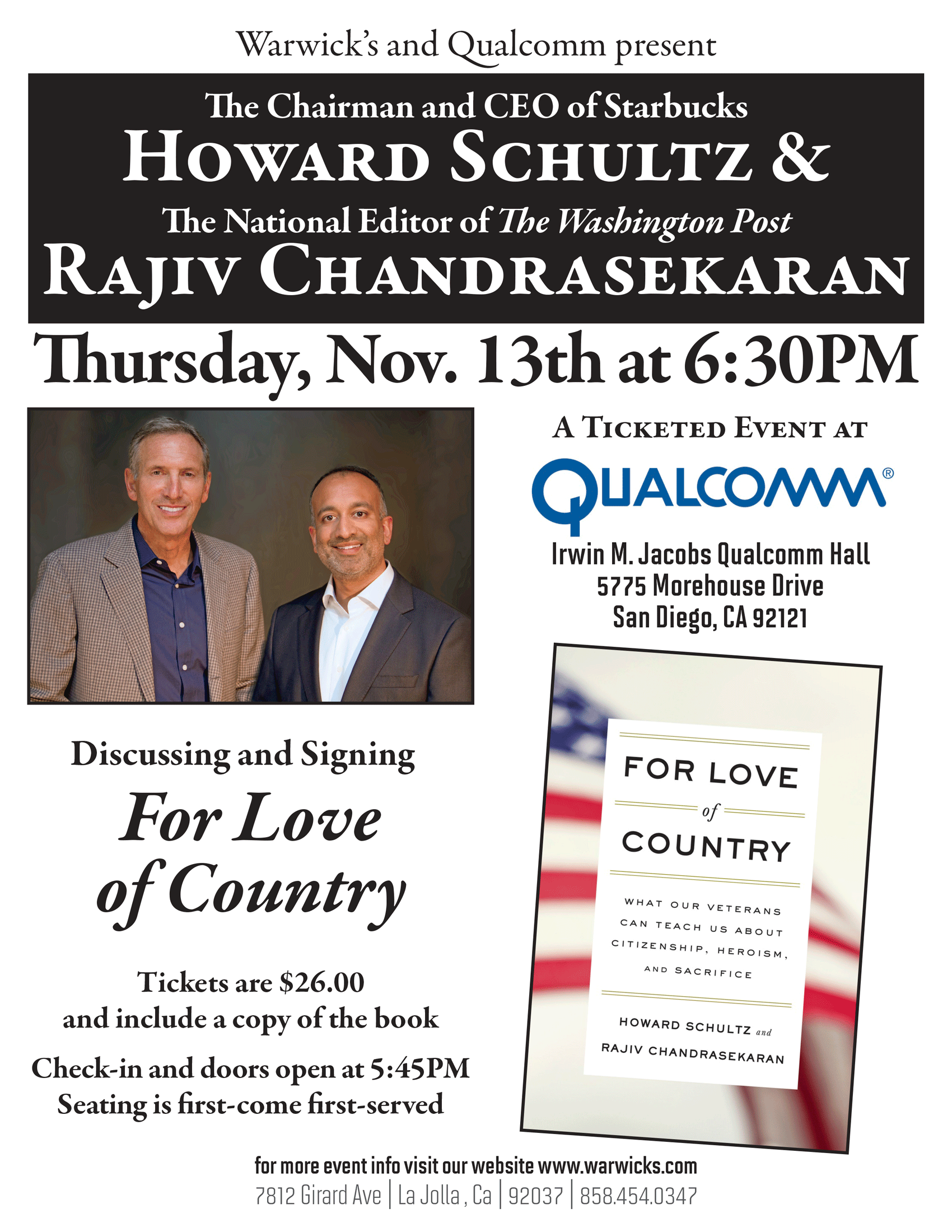
In 2014 he co-wrote For Love of Country with the former Washington Post reporter Rajiv Chandrasekaran, about young Americans who go off to war. This book, which states its patriotic feeling plainly, is still sold from a prominent spot in the company's first store at Pike Place Market.
Over several years Starbucks has worked with a number of NGOs and with companies including Target, Chipotle, JCPenney and FedEx to create jobs for young Americans. It also pays for employees to study at Arizona State University, and gives its own staff benefits such as health insurance and stock grants under its Bean Stock coffee-bean profit-sharing program. At this year's shareholders meeting, the whole hall observed a moment of silence for the Belgium bombings before the program began, and representatives of military veterans were invited to attend.
All of it conveys what Starbucks keeps stressing — the social responsibility and the value of employees that it says it believes in. The audience was moved, and the high point came when Schultz brought up the Nazi concentration camps.
In that brutal stretch of history there was a story about six people sharing one blanket. “Even then, most of them were still willing to share the blanket with others. I hope that you too, whatever your race, region, gender, sexual orientation or political views, can see what you have in common, and the care you have for one another, and take it all in.”
Many people stood up, and then came long applause.
Carrying that full emotion through to the end fell to this year's performing guest, Alicia Keys. Besides being an award-winning singer, she is a social activist who has helped raise money for children with AIDS in Africa and India.
“Starbucks is a company people can lean on,” she said between verses of the charity song We Are Here.
Choosing its investors, another “correctness” Starbucks has always held to
In his slides, Schultz shared photos of himself with Xi Jinping and Jack Ma. Material about the Chinese market in fact ran for nearly half an hour of the meeting.
China is the most important overseas market — nearly every multinational agrees on that, and Starbucks is no exception. Two months earlier Schultz had made a point of going to Chengdu for the “2016 Starbucks Partner and Family Forum.” You may remember that Jack Ma also showed up in person to vouch for Starbucks there. On the matter of “political correctness,” in fact, Schultz and Jack Ma have a good deal in common.
How much it values the Chinese market is of course the biggest reason Chinese media were present on this occasion. Among the roughly eight overseas outlets Starbucks had officially invited, aside from the British representative from the European headquarters, a Japanese reporter told me the main reason she had been invited was that Starbucks would launch its Starbucks Evening service in Japan this week.
By the hard numbers, Starbucks has been in the Chinese market for 17 years and has more than 2,000 stores in 100 cities. As it keeps pushing down into second- and third-tier cities, its new plan is to add 500 stores a year for the next five years. “The size of the middle class keeps growing, and we will invest further in the Chinese market,” Schultz said.
But as the new American national brand after McDonald's and Coca-Cola, Starbucks has more to think about — one sharp problem: American opinion is nowhere near as upbeat about China's economy as Schultz is.
In 2015 China's growth rate fell from 7.3% in 2014 to 6.9%, the lowest in 25 years. Industry figures such as the Citigroup economist Willem Buiter argued from this that China's economy was in a mess, and a monthly survey of fund managers by Bank of America Merrill Lynch last November found that a potential Chinese recession was the single biggest external risk to the global economy.
To plenty of Americans, Starbucks's investment in China carries risk. That is exactly the question Schultz was asked in Chengdu, in an interview with David Brancaccio, the host of Marketplace Morning Report, a program on APM, the second-largest radio network in the United States.
“Even with a lot of ‘noise’ — in some cases it is talk about China's many problems, economic problems, market headwinds — China is clearly going through significant development in the sense of a country in transition. I come to China every year, and I believe what I see. China's middle class will grow to 600 million people over the next 10 years, and we have made a long-term bet here,” he said at the time.
So Schultz badly needed the time at the shareholders meeting to pump American investors full of confidence about China. The Sichuan opera face-changing act that opened the meeting was one Schultz had watched in Chengdu and then named to be “imported” — and more important, all of the performers were employees of Starbucks stores in Chengdu. The pride in the brand that they carry is also one of Starbucks's biggest efforts and biggest gains in this market.
“We keep entering more cities in China, which makes consumers feel the brand is a positive one, and we will move down that road carefully, so we spend more time on developing our employees,” John Culver, CEO of Starbucks's Asia-Pacific business, said in a later interview.
All of this serves one end: keep the Chinese market growing fast, and hand investors a report card they like. Other than opening more stores, Starbucks in fact rarely talks about “what consumers do or want.” At least for now, it goes its own way.
“99% of our coffee beans are ethically sourced” — Starbucks does not neglect ethical correctness either
Kevin Johnson, who became Starbucks's chief operating officer last year, came on stage and first played a short film about coffee farmers in Costa Rica. Then came an achievement Starbucks is proud of: 99% of the coffee beans it now uses and sells are certified “Ethically Sourced” coffee, and for every bag of beans it sells in the U.S. market it promises to plant a tree — by the end of this year that number will reach 20 million. In fairness, this is a good thing.
Coffee trading has in fact been fought over for a long time.
In Black Gold, the 2006 documentary by Marc Francis and Nick Francis, for example, the directors went to Ethiopia to look at the whole pipeline of growing and selling coffee, and found that coffee farmers' labor costs and their pay were completely out of line with each other.
As one of the dominant coffee brands in the world, Starbucks of course knows how to handle this; it could easily move the share price. No listed company dares take business ethics lightly.
When Johnson, who has 34 years of experience at tech companies, finished with business ethics and began demonstrating the new Starbucks iOS app and the prepaid card it developed with Visa, the stage briefly looked like a tech-company product launch.
There is a standing joke that Starbucks is a tech company. Seattle, where the headquarters sits, is packed with Microsoft and Amazon and often gets called “little Silicon Valley”; and the Caohejing development zone in Shanghai, home to Starbucks's China headquarters, is also a place where tech companies cluster.
Last October Starbucks named Gerri Martin-Flickinger, a former Adobe executive, as its first CTO — which was more or less its answer to the joke: “We are very happy to accept technology and to draw on its power.”
But technology runs both ways. It can deliver better service, and it can also put distance between people. Starbucks wants to state its position: in line with its original idea of a “third place” beyond home and the office, it wants to use technology to get people talking to each other.
“Our technology is still tied to the stores. People can now give gifts through the Starbucks e-card, and they can use tools like Spotify to choose and share the music playing in a store,” Johnson said.
Starbucks thinks it is using the internet the right way. How it weaves a net of membership with the help of technology, and keeps the power inside that net — changing its points policy, which is to say the rules of the game, whenever it needs to — is a story for another time.
A more “automated” Starbucks, another kind of “correctness”
Besides Schultz, Johnson and Flickinger, who was making her first appearance, Michael Conway, who handles retail channels and brand awareness, was the last executive to speak. His formal title is President of Global Channel Development.
Back in April last year, Conway said the most important thing for his division over the next five years was to speed up the growth of K-Cup pods and to expand ready-to-drink products in international markets. So at this year's shareholders meeting he brought the fruits of that work: a ready-to-drink cold-brew coffee launching this summer; deeper cooperation with the Green Mountain Keurig machine, with more new pods including pumpkin and peppermint lattes; and, beyond its own Verismo machine, pods that will work with rival Nestlé's Nespresso machines in Europe.
Mass production by machine beats hand-made coffee on scale and efficiency by a wide margin. So even though Starbucks opened the Starbucks Reserve Roastery & Tasting in Seattle to show off its roasting process, and some Reserve stores use the Victoria Arduino Black Eagle, the machine designated for the WBC barista championship, these look more like image-building than anything else.
We could sense that already in how Starbucks's espresso machines have changed over the years. Early Starbucks baristas had to learn the LINEA from the Italian brand La Marzocco, known in Chinese as “hot mama” — a semi-automatic machine on which you control variables such as extraction time and pressure for a shot of espresso. That is nothing like the fully automatic ThermoPlan machines now standard in its stores, which get a coffee-making production line rolling at volume with a few buttons.
One thing is certain: a more “automated” Starbucks is coming. And with the brand advantage it has already built, these standardized products are in no short supply of a market right now. For a Starbucks after faster growth and bigger returns, this should count as a correct choice too.
But for shareholders, there may only ever be one kind of “correct”
Ideally Starbucks wants to present an “absolutely correct” version of itself — from products to strategy to prospects, and up to a company's culture and values. Starbucks seems to want to control everything; or rather, it does not want anything to go wrong anywhere.
In 2007 the New York Times columnist Joe Nocera wrote that Schultz wanted coffee quality on one hand and fast store openings on the other, and that the contradiction behind this, between speed and quality, could never be reconciled. As time has passed, the number of irreconcilable contradictions we can see has only grown.
Almost at the same time as the Starbucks shareholders meeting, an open letter drafted by the labor group Working Washington went out by email to American local media. Together with a prank website, sbuxshareholder, it raised the thing Starbucks least wants to raise.
It is the same problem that has been there since the end of 2014: Starbucks has failed to show employees their schedules at least 10 days in advance, which produces the overwork known as “clopening” — closing a store at 11 p.m. and going back to open it at 4 the next morning. A survey last September by another labor group, The Center for Popular Democracy, found that even then more than half of Starbucks employees learned their schedules less than a week ahead, and one in four had run into “clopening.”
As a business, Starbucks does things worth praising in how it carries out its corporate social responsibility. But in the end it exists to make money for shareholders, and that is what its global shareholders meeting is really for. Business is that cruel. As Schultz said on stage, a company first has to work hard at succeeding as a business, and only then can it do anything else.
Don't forget that at the end of 2014 Howard Schultz released the company's five-year growth plan, promising investors that revenue would reach $30 billion in 2019. In fiscal 2015 that figure was $19.2 billion.
As Schultz said on stage, a company first has to work hard at succeeding as a business.
Cover image from The Seattle Times, Starbucks, CDN, Mashable
Translated from the original QDaily article. Original publication date retained.