

How Do You Actually Sell Virtual Reality? We Browsed Taobao's 50 Best-Selling Stores
What users expect and what tech companies dream of are still a long way apart.
What users expect and what tech companies dream of are still a long way apart.
Virtual reality — “VR” — is probably a term you've been hearing constantly lately. But what is it, exactly?
In the marketing language of tech companies, the word keeps company with “the future,” “platform,” “the next-generation computer” and “ecosystem.”
At the Vive launch event, HTC said virtual reality would “change the way humans interact with the world and bring users a more immersive feeling.”
But how do the people actually selling these things by the truckload talk about them? We mean Taobao.
Search “VR” on Taobao and more than 4,000 results come up, most of the sellers based in Guangdong. The top store moves more than 60,000 units a month. Assuming none of the orders are faked, this headset, at 68 yuan apiece, brings in more than 4 million yuan a month.

That is not a small sum.
So we ran a test on Taobao's 50 best-selling VR sellers. What we wanted to know was: what is VR, in their telling?
Taobao is the most widely used consumer channel in China today, with about 450 billion yuan spent on it every month — more than Tmall and JD.com combined.
Closing a sale is their whole job, which may make Taobao sellers the people standing closest to consumers. They don't care about “interaction,” “the future” or “platforms.” Their goal is simple and direct: how do you talk this customer into buying today, and how fast can you make money.
After visiting 50 stores, we found that the VR they describe is nothing like the VR tech companies describe.
The Hottest VR on Taobao: Not One Costs More Than 200 Yuan
VR products today fall roughly into two types. Samsung's Gear and Google's Cardboard work by dropping a phone into a headset fitted with lenses; the display and the processing all happen on the phone's own chip.
Oculus and the HTC Vive have to be plugged into a computer, and they lean on that much faster hardware to do the computing, which makes for a smoother experience — far less of the dizziness that latency causes on mobile VR. We reviewed the HTC Vive earlier, and its virtual reality experience really is the best there is.
Almost every VR product on Taobao belongs to the first type. Unlike the Oculus and the Vive, which need a computer, everything on sale here is some form of phone box.
Ranked by sales volume, high to low, 98% of the listings sell this kind of headset and the remaining 2% sell content. The cheapest headset goes for 7.9 yuan, the most expensive for only 179.
By comparison, the 6,888-yuan Vive and the nearly 4,000-yuan Oculus cost far more, and on top of that you have to supply your own high-performance gaming PC, which is not cheap either.
Judging by the Posters Alone, You Might Think They Were Selling Porn
As you would expect, sellers put a person wearing the headset and pulling an exaggerated face on the poster, with “massive free content included” in big colored letters in the corner.
Taobao does police the goods listed on its platform — the products themselves, the descriptions, the chat logs with customer service, and so on.
But sellers can still hint, obliquely, that they have what you're after. Ask one point-blank whether they have skin flicks and you might get this:
“We don't supply illegal content. Ask that bluntly and no store is going to admit it — there are police officers online, you know, careful you don't get thrown in the dark room~ The content we give away is good stuff, really solid. Taobao guarantees the transaction, you can get a refund anytime if you're not happy, and we've bought shipping insurance for you.”
But do you think that stumps the all-powerful Taobao shopkeeper? Of course not. Some simply swap the product poster for a suggestive photo of a woman, with “2 GB of Japanese films included” or “shy shy~” tucked into the corner.
What sort of films do you suppose those are?
We tallied up these sellers' posters: 48% advertise “3D cinema” outright, 38% push the headset itself, 10% carry a straightforward sexual hint, and the remaining 2% are selling content.
Sellers Care About Content — For Now That Means Pirated Movies, TV Shows and Porn
Handing out free video is the single most important service these Taobao VR stores provide.
Ask any customer service rep at a Taobao VR store whether content comes free, and the answer is almost always “Absolutely!”
Plenty of sellers tell you so in the instructions or in the listing details: buy it and the content is on us. “Massive amounts,” “all kinds of good mainstream video” and “contact customer service for the content” are their favorite phrases.
“There's a ton of source material, all kinds of good mainstream video, and it keeps getting updated. Once your item arrives we'll give you a massive amount of video; what exactly you get will be explained when the package comes, okay.”
“We throw in a few hundred games, over 400 online videos and 1,000 GB of downloads~ It's all downloaded into a cloud drive, and we'll send it straight over to you, dear.”
On the content itself, the reps hint at pornography while keeping a foot in both camps.
“The content we give away includes big 3D movies, 360-degree video and so on… plus, well, you know…”
Some sellers even attach videos like that to the listing details.
Reps who aren't worried about being shut down can't wait to tell you, when you ask about content:
“Of course we send it. Japanese adult films, right?”
For these stores, telling a buyer they can watch porn on the headset probably works better than selling them on a sense of immersion.
For now, pornography is plainly a major engine for VR, and not only on Taobao. Pornhub, the world's largest porn site, recently opened a VR section.
They Think Consumers Care About the “3D Effect,” Not “Immersion”
Ask sellers what “VR” is and they give almost identical answers.
“This product is a 3D headset that combines watching movies and playing games. It turns your phone into an IMAX theater, a 3D arcade. No charging needed — just put your phone inside the 3D magic mirror, download the matching software, and watching through the headset gives you a 3D effect. Simple and easy, okay.”
“Dear, this is a virtual reality headset. You get to enjoy the 3D feeling. Just like watching a 3D movie at the cinema.”
“It's a 3D virtual reality headset, a new kind of phone accessory. With it your phone becomes a 3D theater, a 3D arcade in an instant — giant-screen effect, like you were really there.”
Most Taobao sellers of VR products will tell you plainly, as above, that it is a kind of headset: put your phone in and you can watch 3D movies at home. The immersion tech companies keep talking about is not something they much care about.
Press the point that 3D and VR are different things and some will answer, “VR is just watching side-by-side movies on your phone.”
“Just download a side-by-side movie to your phone, dear, that's VR. Do you know what VR is? It's watching a side-by-side movie on your phone. A side-by-side movie has two identical images on one screen — you can look it up on Baidu.”
Not every seller confuses 3D with VR, of course. Some will hand you an explanation an ordinary person almost certainly cannot follow, lifted from Baidu Baike:
“It is a product integrating simulation technology, computer graphics, human-computer interface technology, multimedia technology, sensor technology, network technology and other technologies, and is a brand-new means of human-computer interaction created with the help of computers and the latest sensor technology.”
But when we pushed and asked whether the thing they sell can do what Baidu Baike describes, the rep at that store answered honestly: “Probably not.”
We Tried the VR Headsets and Content We Bought on Taobao
We bought headsets from several top-ranked stores and got hold of the content by following the reps' instructions.
As hardware, the boxes barely differ. The slots take smartphones of roughly 4 to 6 inches, and apart from the remote, which needs batteries, the product contains no electronic components at all.
As for content, real VR content is very scarce.
We downloaded the two apps sellers recommend most often, 3D Bobo and Orange VR, and tested them with the headsets we had bought from those same stores.
By category, the apps carry 3D content of every sort, mostly film and TV video, with few games.
One fact: most of the film and TV material is 3D converted from 2D. Unlike 360-degree video, the angle does not change when you turn your head.
The experience boils down to this: your field of view is mostly pitch black, with a screen in the middle. And the so-called 3D effect is not as good as you would hope.
There is 360-degree panoramic video too, but it is very scarce, and what exists is mostly film clips a minute or two long.
The phone screen's resolution and size hold the viewing experience back as well — a few minutes in the headset and your eyes start to hurt.
To stop you from taking the content and then returning the box, sellers only tell you how to get the files after the package arrives. The seller we bought our headset from delivered the video through a WeChat official account.
They had us follow that account, and through the menu bar we got Baidu Cloud links to the movies.
Alongside the pirated video, there were plenty of “skin flicks” on offer too; the route to them was just better hidden.
The process is a bit involved. The first official account steers you to follow a second one, which comes stocked with Baidu Cloud links. Once you reply with an extraction code, it tells you the extraction code for each of the videos.
Tech Companies Expect Something Far More Advanced
On the question of what VR is, Taobao — and the consumers behind it — and the tech companies are separated by an enormous gap in understanding. One basic reason is that the companies expect more.
In their vision, the route runs like this: draw users in with cutting-edge products, starting by painting a beautiful picture of the future. In the Vive ad, users scream and whoop inside a simulated world; the message is that this thing exceeds your expectations and is worth buying.
Taobao shopkeepers care about none of that. Their route runs the other way: satisfy whatever users want from VR first, then go looking for selling points. Which explains how pornography ends up driving sales.
VR is still at a very early stage, and high prices and complicated setup shut ordinary consumers out. Mobile VR — the headset box — is cheaper and easier to get into, and for the time being it will be the most mainstream VR product there is.
What Taobao Shows Us: What Virtual Reality Needs to Succeed
First, it cannot be expensive. Anything that genuinely delivers a VR experience has to be cheap enough.
As with smartphones in their day, new technologies and new devices eventually follow Moore's Law down in price — being affordable to ordinary people is the basis for becoming widespread.
John Markoff, the New York Times reporter who has covered technology for 39 years and watched VR rise and fall several times, told QDaily in an earlier interview that he thinks a VR device has to cost US$100 or less — the price of a Christmas present for a child:
“Every year somebody asks whether this is the year VR arrives. But I can tell you it will take at least ten years, maybe longer, for VR prices to fall to an acceptable level. A $500 price tag is not going to make VR devices the next mobile wave in a hurry.”
Beyond cheap, the content has to be good enough. What moves an ordinary user to buy VR is not the plastic box itself but what comes attached to it.
Which is why every Taobao seller stresses the mountain of free content. It just happens that today the demand is for pornography and fake 3D movies; later it might be games, proper VR films, TV shows and… pornography.
This is what tech companies are pushing for. Google, Oculus and Vive have each fenced off a developer platform, urging developers to build more games, apps, and film and TV content.
When it comes to explaining what VR actually is, tech companies may need more effective methods. Offline experience stores, for instance, will be the intermediate form through which VR devices reach users.
Before VR becomes “the next computing platform,” we will probably have to wait a while longer.
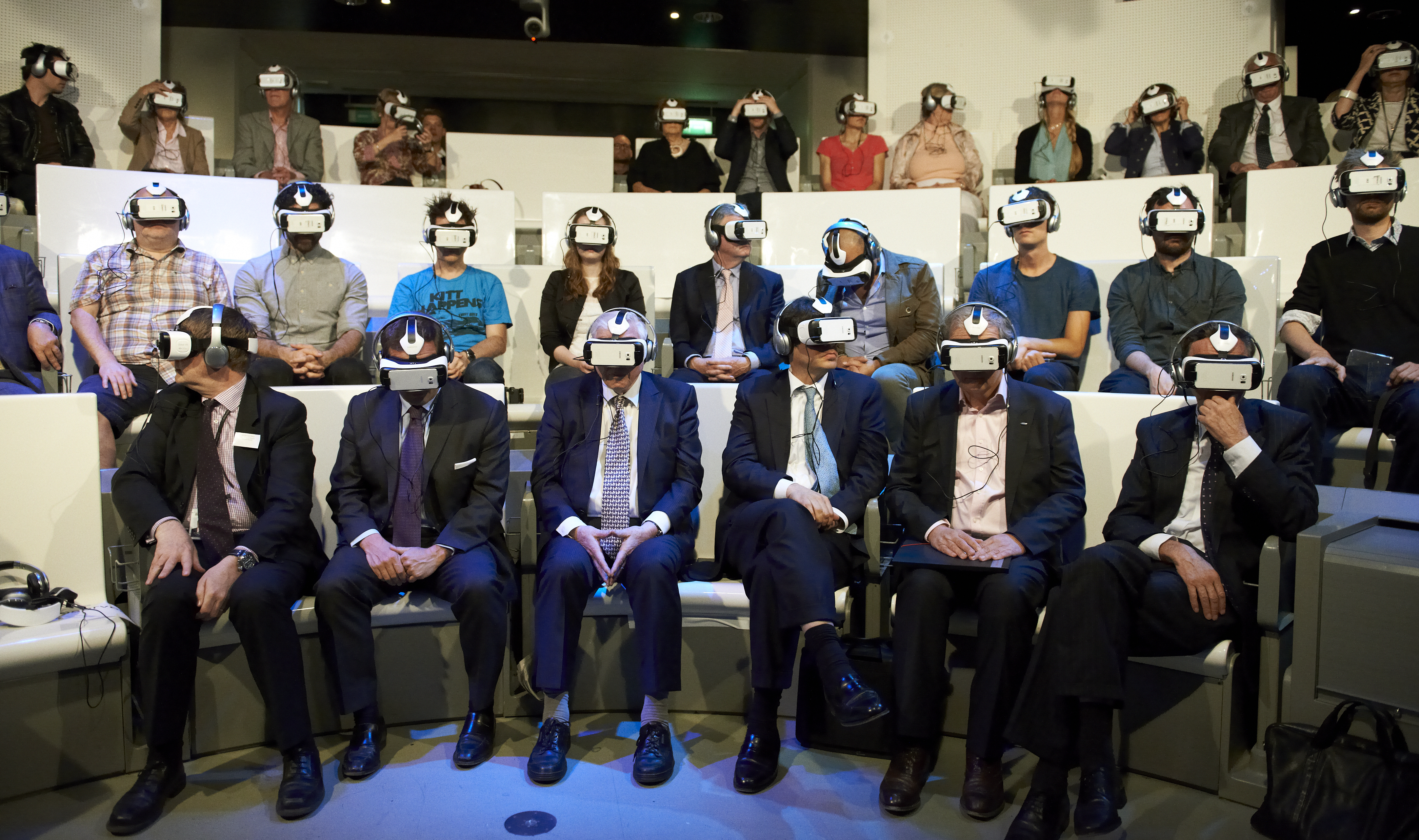
Cover image from alchemyvr
Translated from the original QDaily article. Original publication date retained.