

A Race Where You Run Through Clouds of Colored Powder — What Happened After It Came to China?
The event has another name: "The Happiest 5K on the Planet"
The event has another name: "The Happiest 5K on the Planet"
Francoise Ly came from Paris and is by now an "old Beijing hand" — she has lived here for 10 years. She embraces Chinese culture at every turn, yet she keeps up an "international" lifestyle too, and on weekends she usually looks for things to do on the Beijinger, a community site for foreigners in Beijing. The Color Run was one of her finds there. In August 2013, when the event sailed across the ocean from the US for its Beijing debut, Francoise Ly rounded up a handful of Chinese friends and went to Yuanbo Park in Beijing's Fengtai District. This year she missed the ticket window and couldn't sign up.
The Color Run really has gotten bigger. In the early days Francoise Ly could buy a ticket without trying; this year the Beijing leg went on sale in mid-April and sold out within a week. Three years ago, when the International Management Group (IMG) first brought The Color Run from the US into the Chinese market, the 12,000 tickets for the first Beijing stop took a full three months to sell.
"Our online registration window was open for a month and a half, and only a bit over a thousand people signed up. I was so anxious my head spun — I couldn't sleep at night. It took more than three months to fill the 10,000 spots," says Zhang Hong, a vice president at IMG. Zhang Hong started out as a skydiver; after retiring from the sport he went to the US to study "sports venue operations." At IMG he ran events including the Beijing International Triathlon, and he now heads The Color Run in China.
His fix back then was to ask foreign chambers of commerce in Beijing to help promote it. "The first Beijing Color Run had more foreigners than any of the others. This kind of thing runs on word of mouth — once foreigners signed up, they were especially keen to post about it, so people gradually started joining," Zhang Hong says. Francoise Ly looks like exactly the sort of "foreigner who drives word of mouth and loves to post" he describes. In China, though, the event is hardly a foreigners' world: by IMG's own figures, 99% of Color Run participants are young people, and most are women, who make up 65-70% of the total.


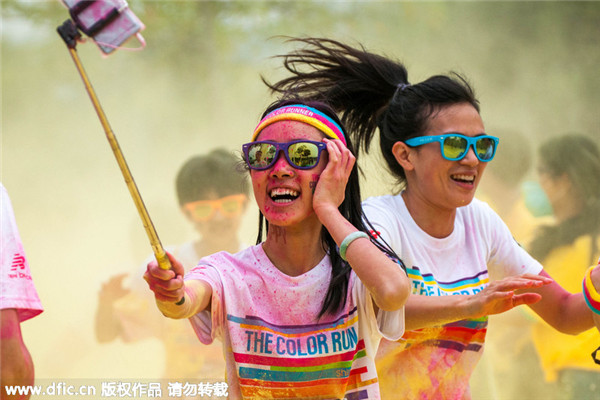
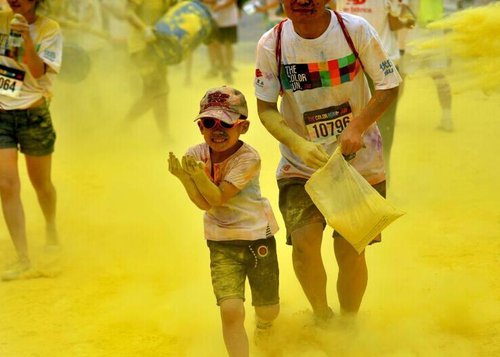
In 2011 Travis Snyder staged the first Color Run in Phoenix, Arizona, and founded The Color Run company. The event is said to have taken its inspiration from India's Holi festival. The rules match the name: runners set off from the start line in white clothes, pass four color stations and a foam station along the way, and at every color station they can pelt each other with colored powder. When they cross the finish line and reach the foam station, a DJ leads one last color-powder party set to music. The first Color Run drew 6,000 people; it then swept the US and was held in more than a hundred cities.
In February 2013 IMG signed an agreement with The Color Run company to organize and promote the event outside the US. Over the next three years IMG held more than 500 Color Run events worldwide — in Abu Dhabi, Paris, Jakarta, Seoul, Amsterdam, Manchester and elsewhere — drawing more than 4 million participants.
"IMG has promoted The Color Run as a global IP, and the event has now become a valuable sports and lifestyle IP," says James Leitz, IMG's senior vice president of sports. "Our digital communications strategy has also succeeded in creating a global community of color runners." Figures from the communications firm Marketwired show that as of April 2015, Color Run content had drawn more than 3,500 likes on Facebook, more than 9 million views on YouTube, and 104,000 followers on Instagram.
As The Color Run climbs in popularity around the world, imitators keep appearing. In the US there is the near-identical Color Me Rad; in China, knockoff color runs such as Glow Run and Rainbow Run are everywhere. Those copycat events give IMG, which holds the rights to the real Color Run, no end of headaches.
Last June a knockoff color run at the Formosa Fun Coast water park in New Taipei, Taiwan, ended in a dust explosion caused by substandard colored powder, burning more than 200 people. After the accident, this way of playing — running, throwing powder and going wild all at once — finally shed its "foreign coat," and the sober objections arrived: powder building up in an open space can explode, and it can affect people's airways. A more abstract question came up too — at some color runs "participants shout obscenities as they chase and hit each other, which brings looting and vandalism to mind," which some said even "makes it look as though Chinese people still don't understand how the structure of public space has changed."
These problems are probably more concrete, and more pressing, than the ones Zhang Hong weighed when he first picked cities for The Color Run. As he tells it, "we chose Beijing, Shanghai, Guangzhou and Shenzhen for the launch because we liked how fashionable and receptive those cities were." Since last June, though, the talk about The Color Run has been all about safety.
IMG's Color Run business was hit as well. "Because of last year we canceled a lot of stops, and for roughly a year there was no news, no updates. For a year we didn't communicate much. This time we want to start communicating with the media and the audience again, more systematically," says Michelle Ku, IMG's Asia-Pacific director, on the event's social media promotion.
This year, just before The Color Run was due to take place, the Public Security Administration Bureau of China's Ministry of Public Security, together with the Beijing Research Center of Urban System Engineering, the Tianjin Fire Research Institute of the Ministry of Public Security and IMG, drafted a document specifically on the subject: Regulations on the Use of Colored Powder at Large-Scale Public Events. Zhang Hong was, of course, one of the standard's nine lead drafters.
The standard defines "colored powder" as "fine particulate matter in various colors used to create atmosphere," and requires that any colored powder used at such events meet the standards of the American Society for Testing and Materials and pass the test methods for material properties of combustible dust.
IMG's own practice is to insist that the colored powder for every Color Run worldwide comes from Indian suppliers; the powder packaging at this year's Beijing stop says plainly, "Made in India."
"Whichever city in the world we hold The Color Run in, we put safety first. What happened in Taiwan sounded an alarm for every event in China, not just for us at The Color Run," Zhang Hong says. "The government has handled this very well — it didn't throw out the baby with the bathwater over one accident. Now there's a standard, and everyone follows it."
IMG's official Color Run is trying hard to do things by the book, but at this year's event you may not see as much decor carrying the New Balance logo. You won't find a white New Balance T-shirt in your gear bag either. Because of the safety concerns, New Balance did not stay on as The Color Run's title sponsor this year.
None of that stopped The Color Run: the Beijing tickets sold out again this year. Search Weibo and you will find people asking for tickets everywhere. For the young people who make up most of this event's audience, it is a rare social occasion where "you can mingle with everyone without the awkwardness of meeting someone's eye." In Michelle Ku's words, "every year somebody proposes at The Color Run, and every so often we get messages on our WeChat account from people saying they met their true love at the event."
That is probably an effect Zhang Hong did not foresee. In 2011, when The Color Run first caught fire in the US, people at IMG headquarters "recommended it strongly," but it was not until early 2013, after Zhang Hong went to the US and watched a Color Run in San Francisco with his own eyes, that he decided to bring it to China.
"It was stunning — it really was an ocean of youth, all kids. One look and I knew this would take off in China," Zhang Hong says. "Thinking about the Chinese market: IMG runs events, we know which events draw which kind of customer, but I couldn't count off on my fingers a single event aimed entirely at kids. Basketball and volleyball are the traditional sports — how many people play basketball? Nobody. The real entertainment option was concerts, and concerts are too old hat. I thought this was a very good opportunity."


In 2013 The Color Run went to Beijing and then Guangzhou; this year the number of host cities has grown to eight. Young people turn up in groups and post their "riot of color" selfies on Weibo and WeChat without being asked. But to make an event that works everywhere in the world fit the Chinese market, IMG has made a few adjustments.
The Color Run's other name is "The Happiest 5K on the Planet." IMG is not entirely sure why the distance was set at 5 kilometers rather than 6 or 4. What is clear is that sites able to meet The Color Run's requirements over 5 kilometers are scarce.
"Finding 3 kilometers is easy; finding 5 kilometers in China is hard. You search for ages, the site is perfect but it's only 4 kilometers — what then? At the very least you loop once through the central area. It takes a lot of racking your brain. It isn't a complete 5 kilometers, but it's basically 5 kilometers," Zhang Hong says. The site also has to be near the city center and near a subway line. Because The Color Run carries an environmental message, the sites IMG settled on — Yuanbo Park in Beijing, Senlan Park in Shanghai, and the National Games Village in Shenyang built for the National Games — were all picked with subway access and green travel in mind. For safety, the plaza for the final party has to be big, the roads about 8 meters wide, and the route cannot cross itself, or it would give away the color of the next station. "So a lot of cities want The Color Run, and I go to a lot of cities and can't find a good spot," Zhang Hong says.
All the colored powder is imported from India, but IMG does adjust the colors somewhat according to feedback from different cities. In Beijing last year a lot of red was used, and some people said there was too much of it — the moment they sweated, the red ran — so IMG switched to a lighter shade of red.
Copying has dogged IMG all along. Following the dust standard may be one deliberate way to set itself apart, but making people understand that the real Color Run has "only one house" in China is a genuine problem. This year Michelle Ku decided to have the event's official social media accounts use photos from Color Runs IMG has held in Germany, the UK and elsewhere. "IMG is licensed; all our props and all our event planning are above board. This is also communication on behalf of the international brand. What we want to say is that we are the authoritative organizer, and safety comes first," Michelle Ku says.
There is another problem: IMG wants to bring The Color Run to China exactly as it is, but some of what Americans get to do at the event is still out of reach for Chinese consumers. In 2014 The Color Run began running a night event in the US, Color Run Night, and IMG has never managed to hold a night run here.
"It's hard to get Chinese police to loosen up the hours for a night run — they usually approve it only until 6 pm. For this event we'd really like the sky to be a bit darker, but the subway shuts sometime after 10 pm," Zhang Hong says.
The Regulations on the Use of Colored Powder at Large-Scale Public Events, issued this year, contains one carefully considered rule: colored powder may not be released at night.
Cover and in-text images from:
funkyrunner.lefunkymamas, thecolorrun.com.au, viralcham, media4.s-nbcnews, chinadaily, thenanfang, womenofchina, sino-us, thecolorrun, idealweddings.sg, and IMG China.




Translated from the original QDaily article. Original publication date retained.