

Keds, the Little Canvas Sneaker, Has Risen and Fallen for 100 Years — Its Story Shows That Business Comes Down to Capturing One Crowd
Otherwise, why did its golden age arrive so many years late, even with Hollywood stars endorsing it?
Otherwise, why did its golden age arrive so many years late, even with Hollywood stars endorsing it?
Calf-high white slouch socks pulled over leggings, an oversized T-shirt, and a pair of white canvas sneakers — a girl dressed like this on an American college campus in the 1980s was, without question, a "trendy girl."
The look turned up in the 1980s TV shows Saved by the Bell and Full House, and in the decade's hit film Dirty Dancing. In every one of them, the white canvas sneakers came from one brand: Keds.

Keds turns 100 this year. In 1916, the U.S. Rubber Company merged more than 30 of its footwear brands into a new company and named it "Peds," Latin for "feet." The name was already trademarked, so Peds became Keds — a name meant to suggest you could move without being heard.
At the start, Keds aimed at nearly everyone. From the 1920s to the 1940s, its posters carried the line "Feel like everyday's a Saturday," pitching the shoes to Americans of every class for sports, leisure, and going out. The products were plain and light — canvas uppers on rubber soles, much like the basic models of China's Warrior (Huili) and Feiyue sneakers — the opposite of the leather high heels then in fashion. In 1952, Marilyn Monroe wore a pair in the film Clash by Night; 15 years later, black flat ankle-height canvas shoes turned up on Audrey Hepburn in Two for the Road.
But not even Hollywood stars carried the brand into a golden age. That came in the 1980s.
American women's place in society and way of living had changed enormously over the 1960s and 1970s: they went to college, went to work, and showed up at more and more of public life. Keds caught on fast with young women and girls across the country.
To some advocates of gender equality, women shedding elaborate long skirts and high heels for casual clothes and joining public leisure activities was itself a mark of progress — and it was a scene Keds' advertising returned to again and again. Casual clothing freed women from heels and corsets, letting them dress comfortably and move as freely as men.
Deirdre Clemente, who studies the history of 20th-century American clothing, says casual wear has two key markers: the fabric must be light, and the garment must be comfortable without clinging to the body. If that definition holds for shoes, Keds plainly belongs — canvas is lighter than leather, and rubber soles are known for walking light, absorbing shock, and gripping the ground better than leather ones.
In the 1950s, more than 70% of American households had a father working outside the home and a mother staying in to raise the children; by the 1980s, only 15% of households still lived that way. Between 1950 and 1990, the share of women earning bachelor's degrees rose from 24% to 53%. Women's views on marriage moved with them from home to workplace: in 1960, 28% of American women aged 20 to 24 were unmarried; by 1985 the figure had passed 58%.
The girls born during the feminist movement of the 1960s were now grown. They wanted freedom and equality more than their mothers had, refused to spend their days trapped in heels and long skirts, and dressed loosely and casually instead.
This was Keds' opening. According to a 1990 report in The New York Times, Keds hired a Rhode Island advertising agency in 1988 and took out large ads in magazines read by young women, pushing its classic white flat and promising shoes for "young women who want a simple sneaker." It was the first time the brand narrowed its target from the general public to women.
What happened next helped again. The Official Preppy Handbook, published in 1980, described the standard kit of prep-school students at America's elite institutions, and the "guide" swept the country for more than a decade. Boys were told to wear white cotton button-downs, V-neck golf sweaters, khakis, and a good leather belt; girls were advised to wear argyle sweaters, Bermuda shorts, knee-length pleated skirts, pearl necklaces and earrings, and a pair of leather boat shoes.
The look, aimed first at college campuses, spread down to American high schoolers, and some high school girls began copying it. But the most popular boat shoes at the time, from K-Swiss, routinely ran $40 to $50; Keds, as cheap as $20, was far more tempting, and it caught on quickly among high school girls. Together with the Keds flats visible in 1980s pop culture like Dirty Dancing, the craze ran from the late 1980s through the mid-1990s, and "slouch socks with white Keds" soon became the standard uniform of campus cheerleaders.
By 1989, Keds' sales had climbed from $60 million in 1986 to $227 million — at $30 a pair, that works out to roughly 7.56 million pairs sold in 1989, or one pair of Keds for every 30 Americans. According to a 2003 report in The New York Times, Keds' market size passed Adidas' in 1990.
Then, after 1995, everything turned again.
People tired of the plain design. The Spice Girls' platform shoes, Skechers' brightly colored sneakers, Doc Martens as grunge shorthand — these styles took off through the mid- and late 1990s, and along with the skate culture Converse and Vans brought to young people, the shift was at least as big as the one in the 1960s. "Retro," "classic" Keds lost its edge. By the late 1990s, women feeling nostalgic were buying Keds again, but it never grew into a national trend.
As its share of the women's market shrank, Keds' ability to adapt and to invent came under pressure fast. Through the late 1990s, apart from adding more colors to the classic white and black flats, it developed no new products for that flagging market.
Even Barbara Bush, wife of George H.W. Bush, sounded a little rueful about the Keds she loved — though the fondness came through anyway. "There are thousands of kinds of sneakers now, but it really isn't easy to find that somewhat old-fashioned Keds," she wrote in her 2003 autobiography.
Through the slump, Keds placed more of its comeback hopes on men. In 2005 it teamed up with the hip-hop producer Damon Dash to restart Pro-Keds, a line the brand had launched for basketball players in the 1940s; a year later it revived Keds Triumph, introduced in 1926 and aimed at men (Leonardo DiCaprio wore the shoes in The Aviator as Howard Hughes).
Both partnerships failed. The Damon Dash collaboration was even named by the sneaker site Sole Collector as one of the "worst hip-hop artist sneaker collaborations."
One of Keds' mistakes was misjudging how crowded the men's market had become. By the time it brought back men's athletic and casual lines after 2005, Adidas, Nike, Converse, Puma, and Vans held every advantage: Nike's SB Dunk, Air Force 1, and Air Jordan; Adidas' collaborations with David Beckham, Neighborhood, and Jeremy Scott; and Converse's Skateboarding CTS (Chuck Taylor Skate) were all hits by then. Keds had spent more than a decade selling to women; it had no footing in this market, and no ability to out-invent the "big companies."
It vanished from pop culture, and the slide showed no sign of reversing until it signed Taylor Swift in 2012.
"Just as people go through identity crises, so do brands." That is how Kristin Kohler Burrows, then Keds' president, described the brand's predicament in 2011. Keds, she said, was counting on marketing to "wake people back up to Keds — this is actually an iconic brand."
A year after she said it, Keds was acquired by Wolverine World Wide, signed Taylor Swift as its new face, and announced an overhaul of its product lines.
Swift was at the height of her fame then (perhaps she still is). The 23-year-old singer had just released her fourth album, Red. She had already won six Grammy Awards, and every one of her albums had sold more than 4 million copies. In the "Q Scores" ratings, the recognized gauge of celebrity popularity, Swift's overall average was 24, 7 points above the average celebrity; among female audiences aged 13 to 24 she scored 26, and among audiences aged 6 to 12, 45.
Keds had in fact run several loud marketing campaigns before signing Swift. In 2010 it launched the "TheOriginalSneaker" website, which laid out its 94-year history; in 2011 it started the nationwide "How Do You Do?" campaign, touring American colleges and inviting students in their twenties to draw on canvas sneakers. "Drawn to creativity, convinced they can make the world different, open-minded, seeking out other cultures" — Burrows hoped these events would attract creative young buyers and reintroduce them to the brand's past.
Keds had also put out a collaboration with Alice + Olivia in 2010, a baseball-inspired sneaker with Opening Ceremony in 2011, and art events with the Whitney Museum. None of them generated the talk Swift did.
Only after Swift signed on did Keds start appearing regularly in outlets whose main audience is teenage girls — Teen, Teen Vogue, MTV — the same group that adored Swift most.
In 2012 Keds and Swift released the Taylor Swift x Keds shoe: a burning red flat with "RED" (the name of Swift's 2012 album) in dark lettering, yellow songbirds printed across the upper, white polka dots, and a cat poking its head out. Next to Keds' plain tradition, that was a break, and closer to what young people then considered fashionable.
In 2013, Keds spent $20 million on a campaign called "Brave Hearts," running lines on its website and in its materials like "Welcome, brave girl, hold your head high, keep your heart open" and "Are you dreaming the impossible dream too?" — narrowing its target further to teenagers and young women. It also set up a scholarship fund and held a large conference built around women's participation.
Behind all of this stood Rick Blackshaw. The professional manager, formerly a vice president and general manager at Converse, joined Keds in 2012 and personally put the Keds-Swift deal together.
"We found that if you have the ability to connect yourself to what consumers are thinking, through great product and great marketing, you can get through any bad business cycle," Blackshaw said in an interview.
The "great marketing" Blackshaw meant is probably the one about women. In the just-launched "Ladies First Since 1916" centennial campaign, "Women Empowerment" has become a phrase Keds repeats at every opportunity.
It shows even in how the company is staffed, which has itself become part of the pitch. In 2015 Keds hired a new CMO, Emily Culp. The executive, who had worked at Rebecca Minkoff, Estée Lauder, and Unilever, has given interview after interview to major media since taking the job. "Ninety percent of Keds' product team members are women," she told The Huffington Post, adding that its senior officers, including the vice presidents of sales and of product, are women too.
All of this recalls the glory Keds won in the 1980s. More than 30 years ago it was women's wish for a freer life and comfortable clothes that gave the brand its opening. Now women's place in society is shifting again. From Washington to Hollywood, the talk of women's rights and gender equality does not stop, and the country has just produced the first female presidential candidate in its history. Dove and Always, among others, have already drawn praise for building marketing around women's issues. Keds is taking the same road: for the centennial campaign it has enlisted Taylor Swift, the actress Allison Williams, and the singer Ciara as its faces. Unlike 30 years ago, though, it now has more rivals. Besides Converse, Vans, Adidas, Nike, and Puma, Keds may also have to fight more casual clothing brands, including fast-fashion chains like H&M and Forever 21, all of them with a far bigger customer base.
On July 6, Ciara posted a photo on Facebook of her feet in classic white Keds. The post drew 461 comments, 504 shares, and 57,000 likes.
Keds is counting on these young ambassadors to start a new wave, but the fact is nobody knows whether this round of marketing will be the second turning point in its history. So far it has announced no plans to change the product. Judging by social media alone, Keds should be worried: on its own Facebook page, a post published on July 7 got 1 share, 1 comment, and 91 likes. The official line down the left side of that page reads a little glaringly now — "The iconic American sneaker brand established in 1916."
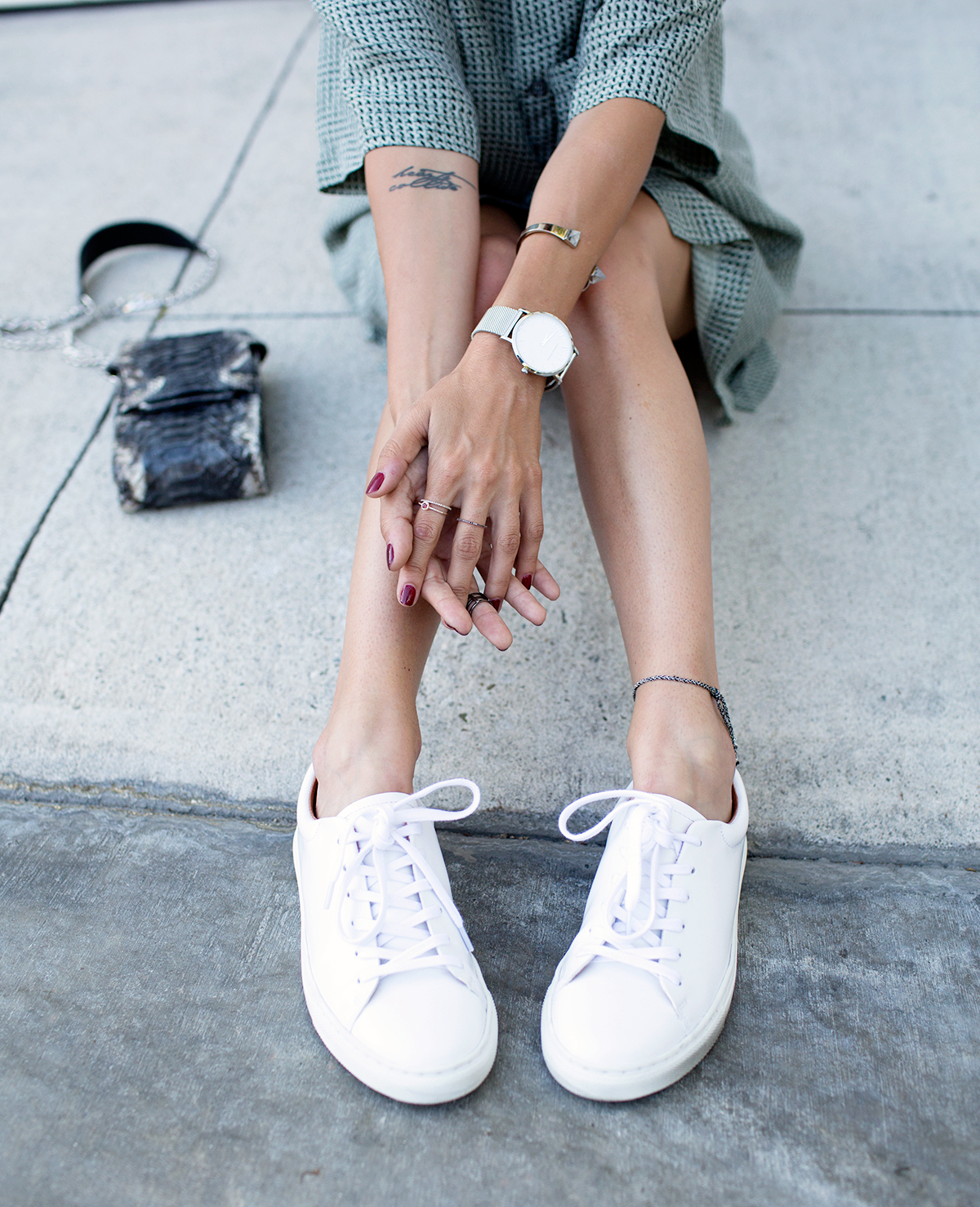
Cover image from: katewaterhouse.com, Lookbook.nu, ella-lapetiteanglaise
Translated from the original QDaily article. Original publication date retained.