

Joe Sutter Is Gone, and the Age of the Boeing 747 Really Is Ending
A textbook case of "the times make the hero, and the hero makes the times"
A textbook case of "the times make the hero, and the hero makes the times"
You don't have to be an aviation buff. Anyone who has flown on a Boeing 747 remembers it. The giant they called the "Queen of the Skies" was the world's first wide-body jet airliner, and besides its sheer size, its most recognizable feature was the hump swelling from the top of the fuselage.
On January 21, 1970, when it carried passengers for the first time from New York's JFK to London Heathrow, London celebrated as if it were a holiday, with "Welcome 747" banners strung across the streets. Children held up by their fathers to watch the behemoth almost always pointed a finger at that strange-looking nose.
For many people of that era, the Boeing 747 made intercontinental flight possible at last. The world shrank, miraculously.
The greater miracle behind that miracle: this invention was finished in just 28 months by a chief engineer in his forties leading several thousand engineers.
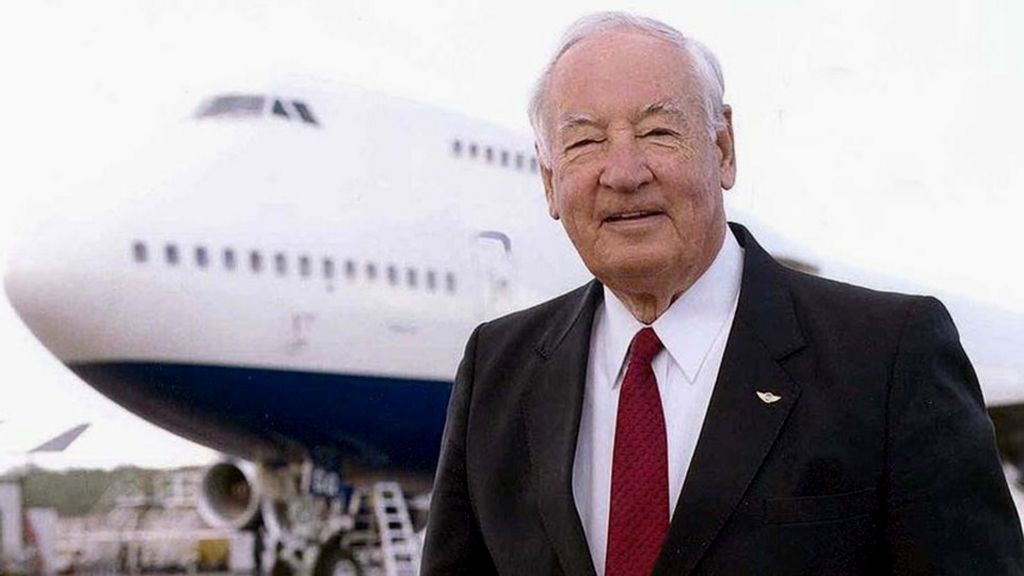
That young chief engineer was Joe Sutter. The 747's success earned him the title "father of the Boeing 747." Born in 1921 in Seattle, where Boeing had its headquarters, he was only five years younger than the company itself, and he would give nearly half his life to the 747 family.
He died in the United States on August 30, 2016, at the age of 95.

The 1960s, when the 747 was born, are remembered as the golden age of air travel. The Boeing 707 and the Douglas DC-8 had already pushed jet travel forward, but small and mid-sized planes carried too few people, and airports filled up with passengers waiting for flights.
There were two ways to handle the growing crowds: fly much faster, or build a cabin twice as big. At the time the United States, the Soviet Union, Britain, and France all saw supersonic flight as the future, and political rivalry sharpened the race. Boeing joined the U.S. government and several other American airlines in a supersonic program, pouring in people and money in the hope of building a plane that flew at three times the speed of sound.
Pan Am, then the world's largest airline, chose the second route. It asked Boeing for an airliner more than twice the size of the 707, ordered 25 of them in April 1966, and demanded delivery within 28 months. Boeing still did not treat the 747 as a priority. The plan was that once the supersonic jet worked, the subsonic 747 would drop to second rank and end its life as a freighter.
When the 747 program was approved, Sutter was working on the Boeing 737. The most experienced engineers had all been moved to the supersonic team, so he was about the only chief-engineer candidate who was both free and qualified.
The engineers assigned to him were, for the most part, men the supersonic program had turned down for one reason or another. Morale was already low, and many of them were veterans, some more than ten years his senior. In the early months Sutter spent a good deal of energy establishing his authority.
Now and then he had to remind them who was in charge. He once joked: "If you don't want to work for me, there's a soft job going in Bangladesh, and I'll send you there."
Two things changed the mood: the hump, and the decision to build a single-deck wide-body cabin.
Because the 747 also had to work as a freighter, its nose had to swing open like a door so that bulk cargo could be loaded and unloaded. That created a problem. If the cockpit stayed where cockpits usually sat, a crash would drive the cargo forward into it and kill the pilots. The same problem had troubled Boeing, Douglas, and Lockheed in the early 1960s, when they were designing the CX-HLS heavy military transport for the U.S. Air Force.
Sutter and his engineers found a way around it: put the cockpit on top of the fuselage. That is how the famous bulge came to be.
The truly hard part was fitting more than 300 passengers into one aircraft.
Pan Am CEO Juan Trippe wanted the 747 built like an ocean liner: two decks, round portholes. That would solve the capacity problem and make passengers think of a ship whenever they saw the plane. Trippe saw no difficulty in any of it, since all he was asking for was the same width with another deck stacked on top.
Plenty of Sutter's own engineers liked Trippe's romantic idea. Partly their sense of what "bigger" could mean was shaped by the double-decker buses they already knew; partly Trippe was a domineering, difficult customer who had walked away from orders with Boeing and other airlines before, and rejecting his concept might well make him tear up the contract. So the first designs followed his two-deck plan.
Sutter and his colleagues soon found the flaw. The deadliest one: in an emergency, passengers would struggle to get out of an upper cabin 25 feet above the ground.
He and a few engineers then proposed widening a single deck and moving the upper-deck seats down to it. The idea drew immediate opposition inside the team. Many engineers argued that reworking the design would set the schedule back so far that the order could never be filled in 28 months. Management's worry was different: defying Trippe would kill the project outright.
Sutter held his ground, and the executives were eventually persuaded. He and his colleagues then built a full mockup of the wide-body cabin and invited Trippe to see it. Trippe said he disliked the new plan when he first heard of it, but after walking through the mockup and satisfying himself that the plane would hold enough passengers, he gave way.
By then Boeing, stretched between two enormous programs, was in serious financial trouble, and the banks were threatening to stop lending. To cut costs, management looked at layoffs.
Sutter had 4,500 people under him, 2,700 of them purely technical staff. The team looked large, but with 28 months on the clock everyone was working overtime, at the limit of what they could do. At one meeting with senior management, Sutter was told to cut 1,000 engineers.
Cutting 1,000 people meant paralyzing the project. Sutter said it was all but impossible.
Boeing's chief financial officer left him with a question on his way out of the room: "Sutter, do you know your engineers are costing us $5 million a day?"
He was then "mercifully" given four weeks to solve the problem. When he came back before the executives, he had not cut a single person; instead he asked for 800 more. One of them walked out on the spot, saying he had a plane to catch.
Sutter thought that would be his last day at Boeing. The week went by with no word from above. Only as more time passed did he conclude that he was still the 747's chief engineer.
After the layoff fight he clashed with management again, this time over engines, and again he expected to be packing his desk. In the end his choice, the Pratt & Whitney JT9D, proved right once more.
In the 1970s, unable to crack the engineering of flight at three times the speed of sound and short of money besides, Boeing's supersonic program collapsed. The 747, once it flew, went on to beat the Anglo-French Concorde and became the most sought-after airliner of its day.
As an earlier QDaily article explained, the 747 flew at less than half the Concorde's speed, but it cost less to build, flew farther, and carried more than three times as many passengers — which was what airlines actually needed. They rushed to order it, and made good money on it.
Ordinary passengers were the other big winner. Intercontinental flight had been a luxury: tickets were expensive and economy seats were narrow, and many people preferred the slower, cheaper ocean liner. The 747's capacity cut airlines' cost per seat, and the wide body meant people paid less for more room — and got there faster. Technology had made travel easy enough that many felt the world had grown smaller.
That virtuous circle also pulled Boeing out of the hole the supersonic program had dug. In the 50 years after the first order in 1966, Boeing delivered more than 1,500 747s of all types. It remains the only wide-body airliner ever to pass 1,500 orders.
Sutter seemed destined for Boeing.
He was born just as the company was finding its feet, and his childhood home stood one small hill away from the Boeing plant.
Like many boys of his time, whenever a Boeing plane roared overhead he dropped whatever he was doing, ran outside, and looked up.
But where the others dreamed of being pilots, he wanted to design the planes.
By the time he entered the aeronautics department at the University of Washington he had studied every model Boeing made, and his bedroom ceiling was hung with model aircraft he had built himself, dangling on fishing line.
After graduating he joined the Navy and served for a time as an ensign. As his tour was ending, both Boeing and Douglas sent him offers. He nearly went to Douglas, which offered $210 a month, $10 more than Boeing.
Sutter came from a blue-collar family and had never had money to spare; an extra $10 a month meant $120 a year, so he accepted Douglas's offer. But his wife, Nancy, was pregnant, and as a Seattle native she did not want to leave home. Sutter chose Boeing.
He joined the company in 1946. From the design of the first 747 to the rollout of the 747-400, he ran the program. In 1985 he received the National Medal of Technology, and before he retired the White House asked him to join the investigation into the Challenger explosion.
Sutter retired in 1986, and Boeing kept him on as a consultant. For more than 20 years afterward, the company kept an office for him.
By the time he was about 90, the 747 that had once ruled intercontinental flying was in decline.
The giant that used to draw every eye on the tarmac now struck many airlines as uneconomical. The 747's body is more than twice the size of any other civil airliner and stands six stories tall, so airports have to build bigger stands for it, rebuild gates, and upgrade other facilities.
Since its first flight in 2011, the newest model, the 747-8I, has taken only about 50 orders. With orders thinning out, Boeing has begun weighing an end to 747 passenger production.
What replaces the four-engine giant are twin-engine mid-size wide-bodies: the Boeing 777 and 787, the Airbus A330 and A350. They carry slightly fewer passengers, but they burn less fuel, fly farther, and don't oblige airports to build anything special. The Boeing 777X, due in 2019 or 2020, will carry 35 more passengers than the first 747 Pan Am flew in the 1970s, and many specialists expect it to draw more buyers than the 747 ever did.
At the end of the documentary Boeing 747: The Plane That Changed the World, the BBC asked a number of experts what they thought the 747's future held. Sutter, the program's chief engineer, appears at nearly every important turn in the film — but not in that closing section.
No one can know what he would have said. But one small detail shows how his pride in the plane he built never wavered.
When the 747-8 was unveiled, the retired Sutter was invited aboard. After talking with several test pilots, he said he was unhappy. "They used to tell me the 747-400 was their favorite. Now they say the 747-8 is their favorite." His own verdict on the 747-8: "You can see how well the original 747 was designed, because the basic structure hasn't changed."
Over the past five years Cathay Pacific, Japan Airlines, Air France, and Qantas have all held retirement ceremonies for their 747s. Starting this September, production has been cut to one aircraft every two months.
No one knows how Sutter felt in his last years. But for a man that confident, that proud, and that stubborn, never having to hear that the 747 was finished may have been the kindest ending of all.
Note: This article draws chiefly on Joe Sutter's autobiography 747: Creating the World's First Jumbo Jet and the BBC documentary Boeing 747: The Plane That Changed the World.
Translated from the original QDaily article. Original publication date retained.