

42 Architects from 15 Countries Came to Beijing. Which of Their Ideas Matter to Us?
A lot to take in. We hope it helps.
A lot to take in. We hope it helps.
On September 27 the Global Habitat Innovation Conference opened in Beijing. Architects from 15 countries — among them the United States, France, Poland, Finland, Slovenia, Japan, Canada and the Netherlands — came for it. The conference is part of the academic program of the seventh Beijing International Design Week.
It was put on by elab, City Window and E-House. The 42 architects brought their best-known buildings and their newest ideas, and through keynote speeches, designer talks and salon discussions they worked through subjects such as "green building and the future of human habitat," "how new cultural and commercial ecosystems take shape, and where their design is headed," "slow living in landscape," "transplanting hybrid cultural buildings into commercial use" and "the N possible futures of human habitat."



The 42 mostly used their own past projects as material, but under these large subjects they kept circling back, without having agreed to, to the same few questions — how people relate to nature, how buildings relate to nature, how buildings relate to the city. Along the way they also talked about their own firms and their projects in China.
And they had not come to Design Week purely for scholarship. They also wanted to be seen in the Chinese market.
"In the United States I've been to plenty of conferences like this for architects, and the organizers invite property developers too, but the developers usually don't want to come. The Global Habitat Innovation Conference is different — Chinese developers are hosting it, and they came here to talk with us face to face," American architect Andrew Philip Heid told QDaily.
The conference ran two days and packed in a great deal. We have boiled down what they said; here are the highlights.
1. What are they all worried about?
1) Joachim H. Faust, president of HPP and a German architect: design has to follow a few basic principles.
HPP is Germany's largest architectural planning and design firm. It does 20% of its business at home and 80% abroad — in Shanghai, Istanbul and elsewhere.

"What we do matters in itself, and our audience matters too, so I think that position is important. When I was still a young designer I came to understand that we don't design for ourselves. We design for the developer, for the owner, for the user — for the people who use a city's spaces and buildings. So the values behind design are fundamental to us."
"One very important part of the value of design is its sense of identity — recognition, distinctiveness. It can reflect a company's identity: what it makes, what business it is in. It can even carry a city's identity, a city's landmark."
2) Stefano Boeri Architetti: as cities spread, natural landscape disappears
"At first cities took up only 10%. Later it was 50%. In the future it may reach 70%, and by then some natural landscape will be gone. Cities are expanding, which means animals are dwindling and facing extinction."
3) French architect Jean Pierre Heim: in China I also put a lot of effort into designing nature reserves

"In China I also put a lot of effort into designing nature reserves. We were in Chongqing recently and found it an enormous city, 30 million people. I want to take a piece of land and bring it back to its original state. What we do is plan the landscape and protect the natural world — and of course raise people's awareness of protecting it. At the same time our projects have to make sure people can live here comfortably, in a good environment."
4) Finnish architect Pekka Salminen: the trouble with China's theaters is that the buildings are expensive and barely used

"Plenty of theaters around the world actually make money. The trouble with China's theaters is that the buildings are expensive and barely used. Most of the time they are shut — shut at night, and usually shut during the day too. A theater or a performance space ought to be more profitable, or at least mind its economics, and mind the environment and ecology, and be easy to use. That is the challenge facing China's cultural complexes."
"Where are the theaters and concert halls that turn a profit? Broadway in New York, say, or London's West End. In China a theater has to be a hybrid. Take the Fuzhou Strait Culture and Art Center I designed: it has five theaters under construction, and the guiding idea was to make it a complex, to fold in more functions and add commercial buildings. It really does hold different functions in the end — theaters, exhibition halls, a film center. In substance it is a cultural and commercial center."
2. The ideas that kept coming up
1) Stefano Boeri Architetti: the Vertical Forest

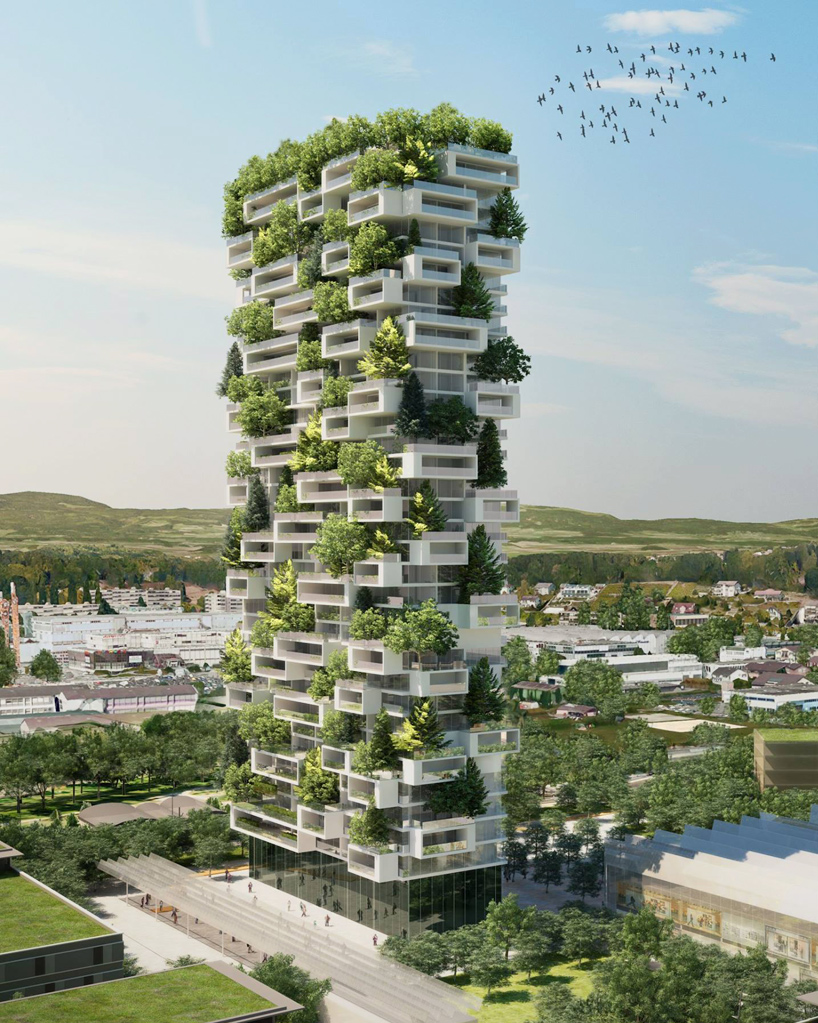
"The Vertical Forest project lets a building grow from the ground up, and it can ease traffic congestion and cut air pollution. That is good for living space and for city space alike; to us, the system makes better use of the city."
"After these two cities and prototypes we began to think about how Chinese cities should plan as a whole, and how they might borrow the Vertical Forest idea. This way you can gather a forest vertically inside a building and improve the quality of the city and the area around it. The facades take in sunlight, insulate, and keep out pollution and noise. We have also started to think these ideas could work in other places. We can build Vertical Forests elsewhere, but we would have to pick different trees, different species, different plants, depending on the local temperature."
2) American architect Andrew Philip Heid: the heat index


"Worldwide, heating and cooling together produce 50% of greenhouse gases. The other half of the energy is burned inside buildings. This is not only a global problem but a problem of cities and of architecture — cities like ours, full of towers, reinforced concrete, highways. We also hold a lot of heat in our cities: during the day you can see urban temperatures climb 9 to 12 degrees, and every degree of increase pushes electricity use up 4.5%."
"We found a very simple idea, a heat index. What we did, in effect, was study humidity, sunlight and wind together."
3) Japanese architect Hisanori Ban: concrete-and-timber hybrid structures
"We stress pairing concrete with wood to make a structure that lasts and gives — designing with the idea of the hybrid structure."
4) An American designer: design driven by experience


"We do structural, geometric interiors, and we are a studio driven by experience. What does that mean? Say you go out for the evening — whether you spend a few hours at dinner or seven days on holiday — we think about how to make that experience perfect. Dinner or resort, we start from your point of view, work out what you need, and design from there."
3. The subjects that started an argument
1) How to keep a city's memory alive through renewal.
Joachim H. Faust: "Memory matters. In a city it stands for development, and it passes from one generation to the next. A city's memory can be what makes you feel at ease in a place. Certain materials, the bark of old trees — these leave you with a comfortable memory of a setting. You also need landmarks that are easy to recognize: a garden, a building, a street, a river. Every one of these has a strong power to call up memory and make people think about where they are."
"So when we design, we ask that the surroundings have some life in them. Take the Shanghai World Expo area: there are residents and hotel apartments nearby, and it used to be a shipyard. We kept some of the gantry cranes and warehouses to hold the memory, to remind local people what stood there before. When we look at the life and activity that were there and set out to improve on them, we should also keep part of the historical memory — and better still if it can carry on."
Slovenian architect Dean Lah: "I come from Europe, where cities are full of historic sites, and keeping that memory is never-ending work. No city changes overnight; it is always gradual. In renovation and development, every step should carry on from the one before. Go slowly and a city's growth stays anchored to the ground beneath it.
"Then there is what residents want and what they are used to — should that stay unchanged? We talk about three kinds of space: private, public and semi-public. Hold those three in mind and you know what to do when you take on urban renovation."
2) The Vertical Forest in practice
Zhou Yanmin, a professor at Tsinghua University's School of Architecture who studies senior-living property: "China has 220 million elderly people, and by 2050 people over 60 will be more than 30% of the population. Anyone building housing and developing residential compounds from now on has to think about what older people need. Green buildings like this are something everyone longs for, and older people need that natural setting more than most — they need to breathe that fresh air."
"In practice we find everyone longs for a house like that, but there are contradictions. A green building like this can't work in the north, for one thing: in winter the leaves all drop. And in the north the balcony has to be glazed in, so even if we get the greenery, there is still glass on the outside. In design we tried leaving a balcony open through two floors, and in the end we still had to build a balcony. There is also a problem with planting on residential buildings: housing is one household per unit, and if a household can't look after its patch, that patch of green ends up looking bad."
3) In urban planning and renewal, how do you balance the economic against the cultural?
Dong Fang, vice president of Shum Yip Group: "Forty years ago Shenzhen was a small city of a few tens of thousands; now it has 20 million people. Shenzhen used to be called a cultural desert, but we think building and shaping a good culture does a lot for our returns. One project we are now developing and selling in Shenzhen sits on a village with roughly 500 years of history, with an old ancestral hall next door. Everyone in the village shares the surname Zhang and the culture is fairly uniform, so in the renovation we paid particular attention to preserving what is distinctive about the village's Zhang clan, keeping some of its symbols. We also talked a great deal with the villagers, hoping they would back some of our ideas for the development."
"We made some 'sacrifices' too, giving up part of the public space so the villagers could hold their particular customs and ceremonies there on the important festivals each year. Now that it is built, we think it has worked well. The villagers have accepted it, and we have done fairly well economically. So we believe that respecting the local culture, and lifting it, helps our returns a great deal.
Feng Jinyi, vice chairman and president of Shenzhou Lvdu Real Estate Group: "The Peninsula Hotel a few years back, and how it carried on from the old British Council building and the Rockefeller buildings behind it — that is a classic. Beijing's 798 can still turn out fine work. But our problem isn't whether fine work exists; you can make something when you build on culture, and foreign architects can be a great help there.
"China's cities are being renewed and replaced faster and faster. Buildings from the 1980s are now up for so-called old-district renovation, or renewal, but after all these years of it, the complexity of urban renewal is beyond imagining, because it involves the original residents, the migrants and the farming population — problems a foreign designer rarely has to face."
4) In building something that truly fits the ecology, how wide is the gap between construction cost and the architecture you want to express?
French architect Jean Pierre Heim: "There are extra costs, of course, but you also save a great deal. Improving people's quality of life, for example, and for children — from that angle you are saving money, and you also raise awareness about protecting the environment.
"For developers, the responsibility is to put their energy and their work into raising that awareness. Many hotels want to serve good food, offer a good spa, a good gym — there may be a lot to bring together."
5. How the developers see it
1) Lin Feng, executive director and CEO of CIFI Group: "Under China's land-transfer and auction system, almost every building has become a commodity. To treat one as a work, as an act of creation, you can only do that with a small share of buildings."
2) Chen Kai, founder of Shanyue Capital: "I think the commercial complex will move back out to the suburbs, to the big transport hubs, where it can be large enough that a family arrives and finds everything — food, drink, entertainment, somewhere for the children to play. So there will still be some volume for complexes downtown — we talk about neighborhood retail doing very well — but for a complex of, say, 200,000 square meters, I don't think there's much room to survive."
3) Gao Yixuan, president of Jingtou Development: "Plenty of department stores have already brought in the co-working idea. The fifth and sixth floors earn less per square meter — the rent might be 1 yuan. Clear out two floors, turn them into co-working space, and the rent comes in higher than what the sixth- and seventh-floor tenants pay. With office workers in the building there is spending to be had, food and drink at the very least, which gives part of the retail a base flow of people. Tie that to what is outside and you have the direction things are going. Then there is retail built directly above rail transit, which in the future will serve a certain radius, root itself in the neighborhood and reach across categories.
"Among people living in a neighborhood like that, 70% choose a proper Chinese meal, 28% choose hotpot, and only 2% choose anything else, so we place the tenants very precisely — an experiential bookstore, an experiential cinema. When people go out for entertainment now, movies come first; you go out, you see a film. What stops them spending is a long trip and parking."
Cover image and in-text images from:
cdn.archinect.net, Visual China Group, designboom, curiousarchitect, archdaily, and official materials from the Global Habitat Innovation Conference.

Translated from the original QDaily article. Original publication date retained.