

Why Do So Many People Dislike Hillary Clinton and Still Think She'd Make a Competent President?
QDaily will keep following the US presidential election — and not just because it keeps getting more dramatic.
QDaily will keep following the US presidential election — and not just because it keeps getting more dramatic.
"You actually went in person? I turned on the TV and couldn't take more than twenty minutes of it." My dentist and I were going over last month's first debate — luckily his hand stayed steady.
He clearly likes neither candidate. As for the second debate, coming up in St. Louis, he hadn't decided whether he would watch.
The reasons to dislike Trump look straightforward — he has too many flaws. The tape The Washington Post has just released, in which he talks about women with contempt, is on its own enough to make people wince. Add his arrogance, his lack of political experience, his steady stream of lies, the sexism that slips out of him unbidden, and none of it matches what people usually picture in a president. And that leaves out the flaws the media has chosen to amplify. If you are against Trump, finding fault with him takes no effort at all.
So why do so many people dislike Hillary Clinton? Across her whole career — first lady, secretary of state, presidential candidate — this is the first time she has faced this much dislike. She is the least-liked Democratic nominee since 1980, and the people who dislike her are not only Trump supporters.
In the first week of October, The New York Times pooled the polls and found that if the vote were held that day, 41 percent would go to Trump. Even at 45 percent he would still trail Clinton. People have long assumed she should win by an overwhelming margin; in some polls, though, the gap between the two has been closing.
Trump habitually describes America as a country in crisis and Clinton always presents herself as a fighter, but their unfavorability ratings are nearly identical. The latest Pew Research Center poll also shows that disliking Clinton has become one of the main reasons people back Trump.
Who dislikes her? Trump supporters, obviously. But also conservatives who oppose abortion and gay rights, and fans of Bernie Sanders. Even people who were willing to vote for her in the primaries will admit, reluctantly, that they don't fully support her either.
It has been a long time since one party held the White House for three consecutive terms, which puts Clinton, and the Democratic Party as a whole, in an unfavorable position.
Proving she can govern may be easy for her. Winning affection is hard — especially once the campaign was truly under way.
Peggy Noonan, a former Republican speechwriter, once put it this way: "Hillary always gives you the sense that she keeps insisting her career has been spotless, implying that anyone who opposes her political ambitions is morally inferior."
That is roughly what we call moral superiority. The irony is that the reason people dislike her now is precisely a moral one — 84 percent of them think "she changes her positions based on which way the political wind is blowing," and 64 percent think she is dishonest or untrustworthy.
She praised the Trans-Pacific Partnership on 45 separate occasions, at one point calling it "the gold standard in trade agreements," then came out against it in an interview with PBS. She did not start voicing support for same-sex marriage until it became a popular topic. Each of those shifts was meant to please voters.
Another 82 percent think she has a "corruption" problem. The foundation she and Bill Clinton run took in enormous sums from foreign governments and businesspeople — something that had never happened before in American political history.
Then there is her age, which no one can avoid. She is 69. To put people's worries about it to rest, Clinton once joked that she would not sit in the Oval Office watching her hair turn white the way most male presidents do, because she hasn't dyed it in years.
Hiding her illness and reversing herself on policy have both made her look too much like a politician. Her political career has run a long time, much of it under public scrutiny. Dissatisfaction with her is nothing new. As far back as 1996, The New Yorker ran a piece called "Hating Hillary," which said: "Like horse racing, hating Hillary has become a pastime that unites the elite and the ordinary."

To some people, Clinton's biggest problem is Clinton. You have no idea, for instance, what she is like in daily life — or perhaps she genuinely doesn't have much of one. Apart from recently becoming a grandmother, she rarely mentions her family. On this point Trump is her exact opposite.
The Democratic primary results showed she had strong support among minorities. The people who stand with Obama — professional women, the highly educated — think well of her. They may not care whether she has a private life, but not everyone feels that way.
"What strikes me most about her is how scripted she is, like a robot," Brian Greene told Slate. He is a 49-year-old accountant and financial analyst who lives in the Chicago suburbs, and he has trouble accepting this less traditional image of a woman.
Susan Fiske, a professor at Princeton, has run a series of studies showing that the more traditionally feminine images — a stay-at-home mother, say — always come across as warm, but neither capable nor worth taking seriously. The less traditional ones (lesbians, athletes, feminists, career women) never come across as warm, but do come across as capable. The trouble is that a capable woman can almost never also be seen as "warm." Women get typecast this way far more than men do.
Jennifer Lawless, who directs the Women & Politics Institute at American University, found that whenever Clinton reached for some kind of breakthrough her approval ratings fell, and once she had it, they rose again. The pollster Anna Greenberg has noticed the same pattern: Clinton is most popular when she plays a traditional gender role — first lady fighting for women's rights, wife standing firmly beside her husband through the Lewinsky affair, secretary of state loyally serving Obama. The moment she breaks with those expectations, people like her less: going after the job of secretary of state, leading the push for healthcare reform, serving in the Senate.
Ambition is a requirement for anyone who wants to be president. In Clinton's case it keeps getting counted as a flaw. Someone is always pointing out that something about her isn't quite right: her smile, her voice, her hair, her clothes, her marriage, her health. Jeff Weaver, Sanders's campaign manager, once said that Sanders "used his own relaxed, respectful manner to face a candidate who works extremely hard and wants very badly to win."
She is indeed very disciplined. Monica Shie, who worked with Clinton and is fond of her, once told me that Clinton would cancel internal appointments simply to give herself more time to read the newspapers and keep track of what was going on outside. "A lot of her speeches are off the cuff, because she doesn't need a script." As for the emails that have dogged her for so long: "It really isn't a big deal — all of us check our personal inboxes by accident sometimes."
Clinton also keeps a delicate relationship with the press. When she ran eight years ago, the first-generation iPhone had only just come out. In today's era of social networks, Trump is a media outlet all by himself, desperate to make every sentence public. "I'm genuinely afraid that one of these days my finger will slip and I'll like one of Trump's tweets," said a reporter who has covered two presidential elections in a row.
"In a sense, negative impressions of Clinton are fixed, which is entirely different from Trump's situation," The New York Times once observed. "Negative impressions of Trump, in fact, are driven mostly by his erratic words and behavior, not by people having grasped particular facts about his past or about what he would do as president."
One not especially logical objection came from an American friend of mine: "How can you imagine a country where two people from the same family are elected president one after the other?" Notice that nobody said this when the Bush family produced two male presidents.
Go through Clinton's and Trump's policy positions and some of the "hatred" starts to look more concrete.
Many people still cannot accept her support for the invasion of Iraq in 2003, however often she points out that it was a long time ago.
If not for the 2016 election, hardly anyone would pay attention to West Virginia, a state covered in mountains. Over the past year or so it has become a place reporters love to visit. Trying to work out why so many people support Trump, they keep coming here for answers.
This place, which split off from Virginia during the Civil War, is now covered in abandoned coal mines. Today it is thoroughly Republican. Before 2000 it was stubbornly deep blue — Democratic — back when abortion and homosexuality were not yet the hot topics of political debate they are now.
Logan is famous as a gathering place for Trump supporters. The turning point may have come when Al Gore's environmental agenda hit the local coal industry. These people cannot stand another Democratic term. It is not only that they dislike her; they feel she doesn't care about them at all, that their situation has been forgotten. On top of that, Clinton said publicly earlier in the year, "We're going to put a lot of coal miners and coal companies out of business" by creating jobs in clean energy.
Elaine Lacaria, from West Virginia, has been a Democrat her whole life and even voted for Clinton eight years ago. Not anymore. "I will not vote for her. No, absolutely not," she told CNN. She opened a clothing store here in 2008, the year Obama was elected. In the eight years since, she thinks things have only gotten worse. "There are fewer and fewer jobs, and once people leave, they rarely come back."
Many people, after generations of family tradition, have begun rethinking where they stand politically. They are concentrated in places like this, in the middle of the country, once prosperous and now in decline. A specific term has even emerged for Trump's supporters: angry white men.
Clinton and Trump really do differ deeply: whether America should treat undocumented immigrants kindly or shut them out, whether peace comes from projecting strength abroad or building a wall at home, whether Washington's most intractable problems should be untangled one at a time or given a course of shock therapy. Clinton dislikes debt, while Trump's budget and spending proposals are mathematically impossible.
Set against all of that, Clinton looks like the better choice. Judging by the issues under debate, she may not be able to promise a wholesale transformation of America, but she can at least show, over the long run, that the country is capable of transforming itself. Hamilton offers one reinterpretation of history; one poll found that among Americans who have seen the musical or listened to the soundtrack, Clinton supporters outnumber Trump supporters by more than two to one.
With unemployment at 4.9 percent, America does not look, by any measure, like a country in a bad way. Even in declining "Rust Belt" states like Michigan and Ohio, unemployment has fallen quickly since the financial crisis of 2008. Immigrants, undocumented and legal alike, have not taken all the jobs or dragged down wages. The number of undocumented immigrants from Mexico is already falling. History always depends on who tells the story, but at the very least this is not the America Trump describes.
Nate Silver, the founder of FiveThirtyEight, who used data to predict the last election correctly four years ago, put it this way at Advertising Week in New York the day after the first debate: "If everyone in this country ends up voting, Hillary wins — by a lot. If only Trump's supporters vote — older, white, conservative — Trump has a good chance of winning. So the job is to get a lot of people to vote."
If all of these complicated questions had to be summed up quickly, it might come to this: faced with a man who is out of control, many people would rather choose one who is insincere. In an election this thoroughly given over to entertainment, plenty of people can reach that conclusion on feeling alone — provided they don't object to a woman becoming president.
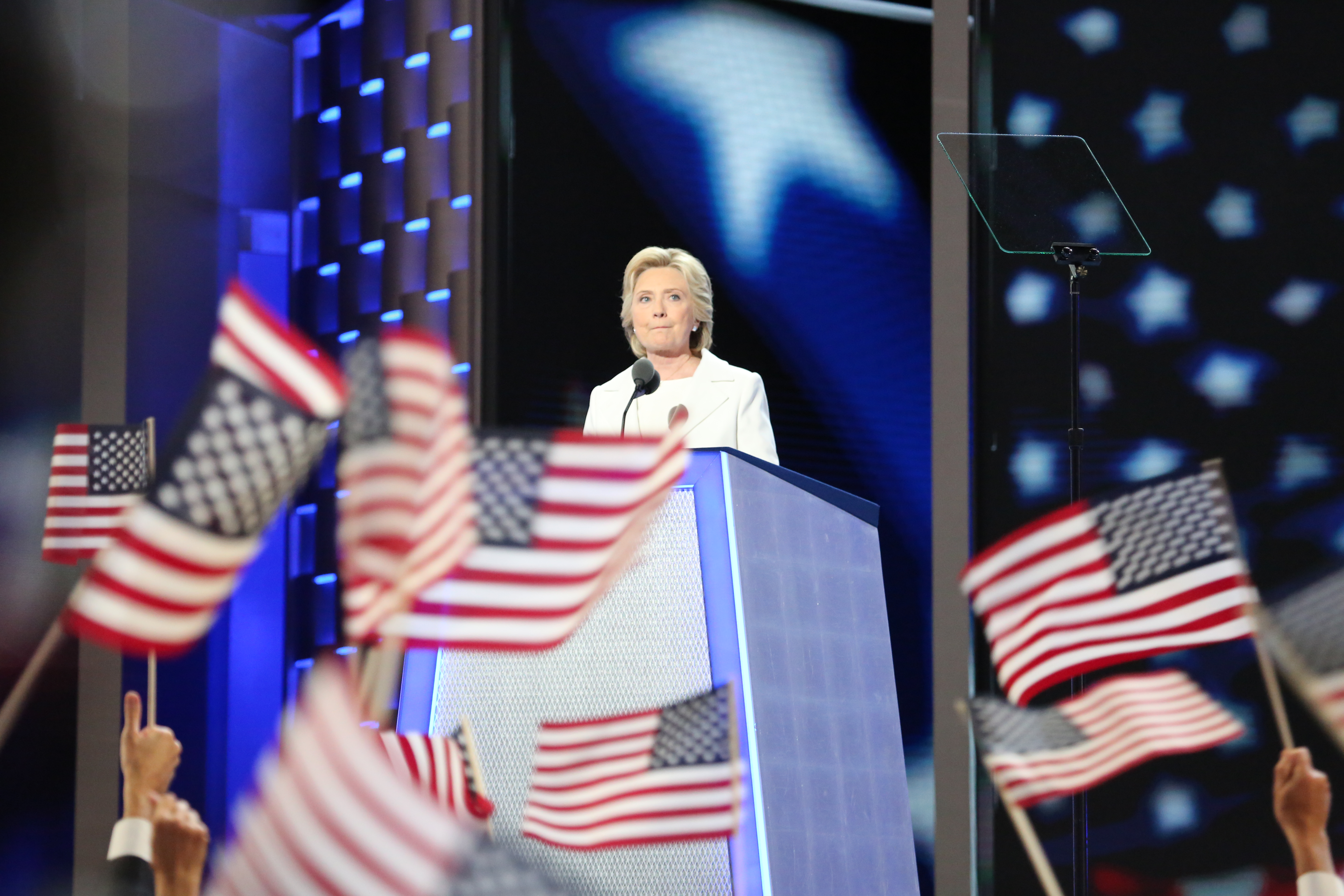
Cover image credit: Wikimedia, commons.wikimedia.org, voanews


Translated from the original QDaily article. Original publication date retained.