

The Idea He Had 200 Years Ago Made Everything “Standardized” | This Is How Our Lives Are Designed
In a farming society that ran on human labor, he used machines to solve the problem of efficiency; in an age when industrial manufacturing depended on highly skilled workers, the production model he proposed let ordinary people do the job, making mass production possible.
In a farming society that ran on human labor, he used machines to solve the problem of efficiency; in an age when industrial manufacturing depended on highly skilled workers, the production model he proposed let ordinary people do the job, making mass production possible.
Eli Whitney's life holds at least two contradictions.
He dreamed of studying law, and couldn't afford to — and then the law failed to protect the patent on what he invented. He created the manufacturing idea of interchangeable parts, the foundation of mass production and of modern industry, yet he died at 52, too soon to enjoy the material abundance that mass production would bring.
Those two contradictions later won him a place in American history, and both trace back to the two most important inventions of his life.
One ties Whitney to the Civil War, which broke out 36 years after his death. The other makes him the man credited with founding the American manufacturing system. In the words of the historian Daniel Boorstin, Whitney set off a “know-how revolution.”
Americans like to call Whitney “the father of American technology” and “the father of American mass production.” They put him in high school history textbooks; in the 2006 book They Made America: From the Steam Engine to the Search Engine: Two Centuries of Innovators, he is one of the “heroes who moved America forward.”

Whitney's era is a long way from ours. His first important invention, the cotton gin, was born in 1793, when he was 28. He would soon feel the fame it brought him, and the frustration and contradiction that came with it.
In 1792 this Yale graduate, who had grown up on a farm, traveled from the northeastern United States down to Georgia, where he met Catherine Green, the owner of a plantation there. On Green's plantation Whitney found that the local cotton was extremely hard to clean because it held so many seeds: before picked cotton could go into production, the seeds had to be pulled out by hand, which ate up time and labor.
Whitney, who loved tinkering with machines, thought of a way to solve it. That winter he built a device he called the cotton gin. It was a set of rollers linked to a crank, each roller fitted with metal hooks that looked like a circular saw blade. As the rollers turned, the hooks caught the cotton and dragged it through a screen of fine slits, while a brush inside swept the cotton at intervals, separating clean cotton from seed.
By 1793 Whitney and his business partner, Phineas Miller, were producing the machine; one gin could clean 50 pounds of cotton a day. But the technology of the day was limited — every gin had to be built by hand, so there was no way to make them in quantity. Seeing that limit, Whitney and Miller decided not to sell the gins at all, and to charge a service fee for their use instead. Their terms: for every batch of cotton the gin cleaned, the planter handed over two-fifths of the clean cotton as payment.
The arrangement was soon challenged. Planters thought the “service fee” too dear and started setting up on their own, copying Whitney's gin and turning out all sorts of similar machines. They could do it because Whitney did not apply for and receive his patent until 1794; he brought more than 60 infringement suits, but the courts worked through them far more slowly than the gin was being copied.
By 1797 the cost of the lawsuits and a gin-rental business people openly mocked had bankrupted him. In the same stretch of years his gin workshop burned down, destroying all 20 machines, and his partner left him.
Whitney's gin business never came back, but its effects were starting to show. Planters across the American South began growing cotton on a huge scale; after 1800 the cotton crop doubled every year, and by 1805 annual output had gone from 2 million pounds before the gin to 60 million pounds. By 1850 the South carried three-fifths of the country's agricultural exports, cotton most of all. All of it thanks to Whitney's invention.
At roughly the same time, Britain's mechanized industrial revolution was also under way. The textile worker James Hargreaves invented the spinning jenny in 1765. Like Whitney's cotton gin, it was revolutionary for the same reason: both freed people from labor-intensive work and handed it to machines that did it faster.
By 1785 Watt's improved steam engine was in use, and in 1814 Stephenson invented the steam locomotive. Britain became, in every real sense, the world's first industrial nation. The revolution swelled the ranks of the British working class; the same thing happened in the United States at least 50 years later.
That is understandable. America declared independence in 1776, but the war of independence did not end until 1783, when the British finally recognized it. By then — counting from 1765, the year the spinning jenny was born — Britain's industrial revolution had been running for nearly 20 years. The fates of Englishmen and Americans born in the same years diverged sharply: Whitney happened to be born in the first year of Britain's industrial revolution, and while British industrial society advanced quickly, American society stayed in upheaval for a long time.
In a sense, Whitney's cotton gin mattered so much to American industry precisely because it was one of the few industrial inventions America produced in the 18th century.
But, as you will see, America soon caught up with Britain. That had everything to do with Whitney's second invention.
While he was suing the planters who copied his gin, Whitney signed a contract with the U.S. government, promising to produce 10,000 to 15,000 muskets in two years. At the time the entire U.S. military could turn out only a little over 300 muskets a year.
Some read Whitney's confident promise as a show of strong patriotism, but the real reason he grabbed the order was money: the gin lawsuits had already stripped him of everything. And the government order was tempting — under the agreement, the manufacturer would receive $5,000 the moment he took it.
Making more than 10,000 guns in two years, though, was close to impossible. Gunmaking then demanded very fine craftsmanship and was done entirely by hand, so the speed of production depended entirely on how many workers a shop had. There was another headache: because each gun was made by one worker, each had its own integrated design. If a gun broke, repairing it meant filing and fitting the parts all over again, which took forever.
Whitney thought of a standardized production system in which any part could be swapped for another. In his design, every part came out of the same mold, so if one failed, another from that same mold could take its place. The idea could not look more obvious today, but before Whitney no one had put it into practice on a shop floor.
In 1799, in a letter to the U.S. government, Whitney described the method publicly: let the tools do the shaping and give every component its correct proportions — once those tools are made, they will plainly speed up the work and make every product more precise and more uniform. The tools, he said, were a bit like copperplate engraving: “A plate can print off large numbers of identical impressions; my tools can likewise turn out components exactly alike.”
Whitney set up a base in Connecticut and hired workers to build machines that could cut metal to a mold, working toward the “precise and uniform” parts he had described.
The process simply took too long. By 1801 the delivery date had passed and Whitney had not made a single musket. His contract survived only because of support from President Thomas Jefferson, the founding father Alexander Hamilton, and Treasury Secretary Oliver Wolcott. They saw that the production model Whitney proposed would raise efficiency and cut costs, and that it meant a revolution in industrial manufacturing.
In September 1801 Whitney at last delivered the first 500 guns. Not until 1809 — about nine years after the contract's original delivery date — was the whole order complete.

The standardized, interchangeable-parts model stayed. Its core is to give every part the same properties so that any one of them can be replaced at any time, and to do that, people first had to make molds and grinding machines in quantity, which pushed the precision of machine-building further still. America's mechanized industrial age was showing its first signs.
The model also eased the shortage of skilled labor. The old requirement that trained craftsmen make things by hand fell away: as long as a small number of highly skilled workers built the standardized tools, less-skilled workers could take over the rest. It gave Henry Ford the foundation for the assembly line he invented 88 years later, and for that reason it is taken as the mark of the American manufacturing system's birth.
It is worth saying that some historical research questions whether the “standardized, interchangeable-parts model” was Whitney's own. Letters suggest the French gunmaker Honoré Le Blanc and the British mechanical engineer Samuel Bentham had both had similar ideas, and as early as the 1720s the Swede Christopher Polhem had tried using machines to make high-precision clock parts that could be swapped at will. Either way, Whitney was the one who put the idea to work (though large-scale use did not really begin until the 1820s), and he was the first to make government officials see why it mattered.
Ten years after Whitney's death, Samuel Colt carried out the first large-scale production run of revolvers in American history; three years after that, Chauncey Jerome gave the world its first mass-produced, affordable brass clock.
Europeans paid little attention to Whitney's method at first. Not until after the 1850s did the British discover that, with Whitney's system, Americans were making guns faster than they were. That sense of crisis grew sharper after 1900: in 1913 Henry Ford invented assembly-line production, and a car every 24 seconds carried Americans from the horse-drawn carriage into the automobile. That, too, rested on the standardized, interchangeable-parts model Whitney had proposed.
Today everything from the pen or the phone in your hand to cars and airplanes uses the standardized, interchangeable-parts model Whitney proposed. If people wanted to, they could build houses this way.
In 1825 Whitney died of prostate cancer, at 52.
When his cotton gin was being copied, Whitney once said: “An invention can be so valuable as to be worthless to the inventor” — because the patent brought him nothing.
What he could not know was that his other invention would make him one of the most important inventors in the world, and change the way people live.
Still less could he know that the gin he built in a few weeks on a Georgia farm, while raising production efficiency, also raised planters' demand for slaves. Between 1790 and 1860 the number of American states using slave labor grew from 6 to 15, and one in every three Southerners was an enslaved person from Africa. Some historians believe Whitney's cotton gin helped push the country into the Civil War.
It seems to confirm that innovation, especially the foundational, revolutionary kind, often comes with the breaking of an old order, and that new questions of business ethics may arrive alongside it. But who can say for sure: perhaps forgiving the ethical costs no one could foresee is exactly what lets humanity keep moving forward.
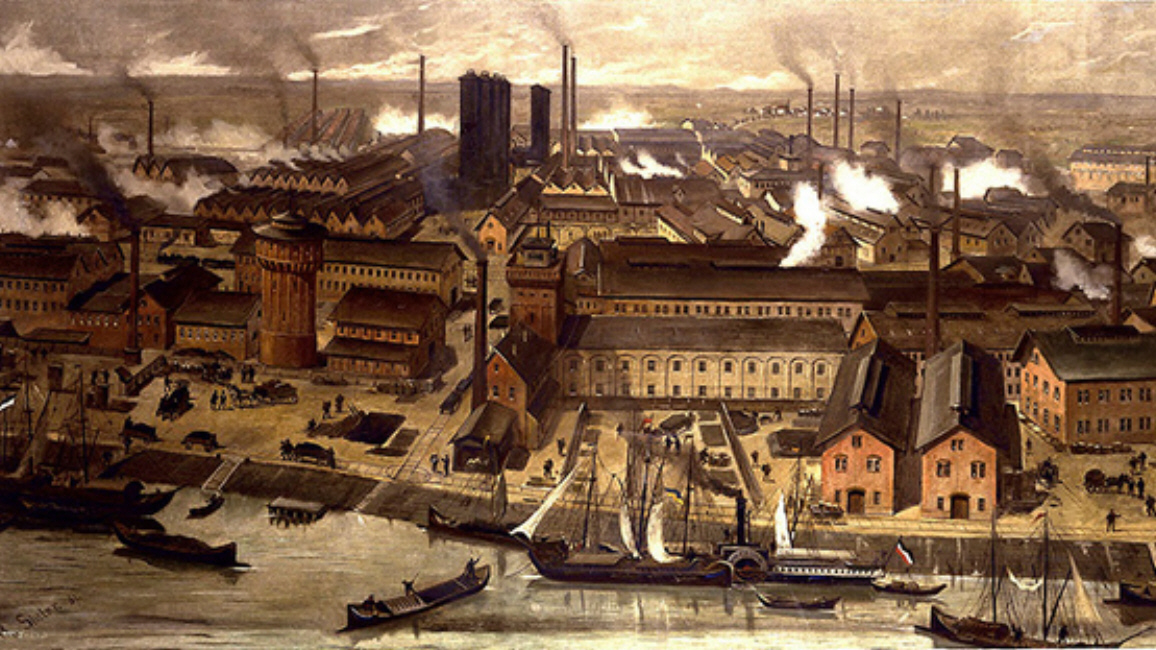
Cover image from Wikimedia
Translated from the original QDaily article. Original publication date retained.