

What kept a department store innovating for 90 years — and what killed it over the 40 that followed?
Sears's 130-year rise and fall may hold a lesson for the American department stores in trouble today. PS: this one will cost you a little reading time.
Sears's 130-year rise and fall may hold a lesson for the American department stores in trouble today. PS: this one will cost you a little reading time.
For America's department-store giants, last winter ran unusually long. Macy's, Walmart, Kohl's, Target — almost every big chain closed a hundred stores or more.
None of this is surprising, analysts say. Overseas tourists are thinning out because of exchange rates and policy; a new generation of shoppers expects more from experience and service; and department stores still carry the same undifferentiated goods, making money only by discounting. The United States also has more retail floor space per person than any country in the world — 23.5 square feet, about 2.2 square meters. The market was saturated long ago, and big shopping venues are shifting to small-footprint stores.
As the new year opened, Macy's and its peers began various awkward attempts at self-rescue. On January 6, Neiman Marcus withdrew the IPO application it had filed a year and a half earlier. At the end of January, Macy's said it would close 68 of its 730 stores and cut more than 10,000 management jobs, and it spent February in talks with the Canadian chain Hudson's Bay Company about a sale. Barneys began liquidating its assets last June.
But for Sears, which turned 130 last year, this winter has already lasted nearly a decade.


Between 2000 and 2015, Sears's sales fell from $41 billion — third in the country — to $15 billion. It has not made a profit in the five years since 2011, and has lost $8 billion in all. In April 2007 its shares reached $142.51. Lately the number is $8.90.
CEO Eddie Lampert put $500 million of his own money into Sears in January and announced 150 store closures to save the company, but most analysts still expect it to be gone within two years at the most.
What you are watching is not one more also-ran sinking into business history. It is the dusk of a giant that held first place in American retail for 91 straight years.

Sears started in mail-order retail at the end of the 19th century and went on to invent one practice after another that retailers everywhere still depend on: supply-chain management, store brands, buying on credit. At its peak it had 41 private-label brands and 4,010 stores, produced 1% of American GNP by itself, and sold as much as the next four retail brands combined. In the 1960s, one in every 200 American workers worked for Sears. In 1972, when it finished the Sears Tower in Chicago, then the tallest building in the world, half of American households carried a Sears credit card and three out of every four Americans shopped at its stores — more than the total ticket sales of The Wizard of Oz.
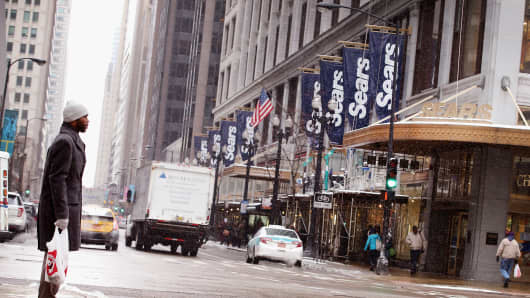
That scene is gone. Two years ago, at the first Sears store, opened on State Street in Chicago in 1932, you would have met William Taylor, who had worked there for decades. He looked mournful, a sign hung around his neck: "Sears closing, up to 75% off, act now."
Retail fashions turn less predictably than in any other business. What kept Sears innovating for 90 years, and what makes that impossible now? The answer may say something about the trouble department stores are in today.
1. A winner in the age of information asymmetry, the "consumer's Bible," and the making of a national market
Sears's story begins with the railroad.
In 1886, Richard Warren Sears, 23, was an agent at the train station in Redwood Falls, Minnesota. He bought a batch of watches a local jeweler had refused, paying a Chicago wholesaler $10 apiece, and sold them for $14 to farmers who had no way to tell time but the sun, clearing $5,000 in six months. With that money he started his own mail-order goods company.
Ambitious retailers set their sights on national, even global markets. But the United States of that time had no single market. Its population was 56 million, spread across 38 states, and 70% of it lived in the countryside, where everyday shopping meant the small store nearby. That hurt both sides: information asymmetry left shoppers with few goods and high prices, while retailers could barely forecast even local demand, so shortages and dead stock were normal.
Only one business could cross those distances: mail-order retail. Aaron Montgomery Ward of Chicago invented the model in 1872. Think of it as the first draft of Amazon or Taobao: hand out catalogs full of pictures and detailed descriptions to draw in orders, skip the cost of opening stores and hiring salespeople, and reach a rural market that was huge but scattered.
More important, mail order caught America's shift from water transport to rail: before 1871 the country had laid only 45,000 miles of track in all; in the 29 years from 1871 to 1900 it added 170,000 miles more, and five transcontinental lines now ran from coast to coast.


Sears arrived nearly 14 years after Montgomery Ward. Like Ward, he aimed at farmers — a huge population that bought mainly staples and daily necessities, the goods easiest to standardize and best suited to mail order.
But Richard Warren Sears was the better marketer. Knowing that farmers stacked their catalogs on the little coffee tables on the porch, he deliberately made the Sears catalog a size smaller, so it always sat on top and was opened first. When local retailers pushed back, he turned his regular customers in each district into catalog distributors, and rewarded whoever brought in the most orders with a sewing machine or a stove. Meanwhile he built trust in the Sears name with flyers, advertisements and visits to communities.
On service, Sears was also readier than Montgomery Ward to take on risk. Friendly agreements with station agents let it offer cash on delivery, money-back guarantees and repairs; the largest line in its catalog read "satisfaction guaranteed or money back." After the U.S. government started Rural Free Delivery in 1896, farmers no longer had to travel to the station to collect their goods, and free delivery became another way to win customers.
After moving the company in 1893 to Chicago, the hub of the rail network, Richard Sears and his partner Alvah Roebuck founded Sears, Roebuck & Company, with a still wider range of goods. Eyeglasses to lawn mowers, clothing to furniture: one Sears catalog could supply everything an ordinary farming family needed. People called it the consumer's Bible, and the special edition that came out each Christmas had a prettier name — the Wish Book.
None of that sounds new — useful goods at low prices, convenient shopping, good service — but it worked. By 1894 the Sears mail-order catalog ran to 700 pages and carried more than 6,000 items at half the price of ordinary stores. That year its sales passed $750,000.


In turn, mail order gradually brought a vast national market into being. It was made of countless rural consumer communities, and what they shared was not values but nearly identical buying behavior.
Historians treat Sears's 1900 slogan as one of the marks of American consumerism's birth: "goods for the millionaire, at prices in reach of the millions." Working through the catalog, that commercial logic standardized American tastes and desires before film and television ever did. The German scholar Lofgren went so far as to call the Sears mail-order catalog the key medium in making the rural population alike: "isolated villages and individuals were tied very closely to the emerging cities, and this process of modernization also made the whole country into one."
In 1900, Sears's sales reached $10 million, passing Montgomery Ward to make it America's largest retailer. Six years later it became the first retailer in American financial history to go public.
2. Cars, shopping malls and the rise of the middle class
But change came fast. From the Roaring Twenties to the eve of the Second World War, another way of getting around appeared and spread: the car.
We used these numbers when we reviewed a century of rise and fall in American department stores: in 1921, sales of the Ford Model T passed 5 million. From 1921 to 1935, newly paved roads in the U.S. grew from 620,000 kilometers to 1.62 million kilometers. By 1930 there were 23 million registered cars in the country, nearly three times the 1920 figure.
The car, together with the war that broke out in the 1940s, reshaped the American population and its cities twice over: before the war people poured out of the countryside into the cities; after it, high urban land prices, families swollen by the baby boom, and the mortgage benefits the government gave veterans drew them back out of the cities again.
Through both shifts, Sears's managers stayed alert. As its customers moved from the countryside to the city, it opened its first Sears department store inside its Chicago mail-order plant in 1925, and had 319 stores four years later. In 1931, retail passed mail order for the first time, at 53.4% of total sales ($180 million).
Its diversified businesses grew alongside the stores. In that same year, 1931, seeing how much Americans wanted cars, Sears set up Allstate Insurance Co., a subsidiary selling auto insurance, and put its counters inside the stores. By creating and buying brands, it also raised private labels to 90% of its goods, which held costs down and gave it merchandise no one else carried.


More important still was the postwar move to suburban shopping malls. Robert Wood, then chairman of the board, believed the new retail opportunity lay outside the cities, so between 1946 and 1952 Sears opened 92 new stores with mall developers and enlarged or moved more than 200 existing ones to the suburbs.
Just as the consumer's Bible had made rural buying uniform, the rise of the suburban mall gave the rising middle class a standardized American Dream. This was an enormous group with enormous spending power; by the late 20th century it made up 70-80% of the population.
The freelance writer Tim Krohn still remembers what shopping at Sears was like in the 1960s and '70s. He wrote in a Forbes column: "It was a place where the whole family could shop at leisure together. On one side the handbags, jewelry and clothes wives loved; on the other the Craftsman tools and grills husbands favored; and a 16-year-old daughter could go pick out cosmetics. You could even order a house by mail — a three-bedroom with plumbing and lighting for just $1,800."
For today's shoppers, who want above all to be unlike one another, it is hard to picture everyone reading the same catalog and buying at the same chain store. But back then, the template for living that Sears built was exactly what people wanted. Matthew Weiner, the writer of Mad Men, the series set in the 1960s, told salon.com that to keep the show true to the period the team "would look not only at Vogue covers to understand how people dressed, but also borrow a great deal from the Sears mail-order catalog."
According to The New York Times, at an internal merchandising meeting in the 1970s, a Sears executive named the company's target customer and its traits with unusual bluntness: "Sears is the family department store for homeowning, middle-class America. We are not a fashion store. We serve neither the unconventional nor the wealthy. We don't live off discounts, and we don't lead trends. We simply and faithfully reflect all of the desires, concerns, problems and fallacies of the American middle class."



Changes in the Sears mail-order catalog, 1910 to 1970
3. The innovator's dilemma
The executive's words turned out to be a prophecy.
Two years after the Sears Tower (now renamed the Willis Tower) was finished, the symbol of the company's peak, the United States fell into the slump brought on by the 1974 Middle East oil crisis. Sears's profit dropped by $170 million that year.
For much the same reasons the American economy stalled in the 1970s, the slump also hit the blue-collar middle class Sears lived on: their average wage peaked at $341 in 1973, then kept falling for decades. Their buying power weakened, they grew older, and they bought less than before.
The bigger threat came from Walmart. Like Sears, which began in rural markets and made its first fortune on scale, Sam Walton opened his first store in 1962 in Rogers, a town of fewer than 6,000 people in Arkansas, in the middle of the country, and kept expanding into towns of under 10,000. It went on to rewrite the pricing rules of the whole retail industry with low prices, and used the newly arrived communications and computer technology to multiply the efficiency of its supply chain.
The changing of the guard seemed to take a moment. Walmart's sales jumped from $1 billion in 1980 to $32 billion in 1990, passing Sears to become the largest retailer in the world. By 2001 it was selling six times as much as Sears.
"Sears didn't treat Walmart as a competitor until the 1980s, and didn't even know what it was doing," Steve Kirn, a former Sears employee, said in a 2012 interview with a Chicago outlet. "It was just some people down in Arkansas. Then suddenly Walmart was right beside us, and then it was past us."
Even at the moment it was overtaken, in fact, Sears's executives were not especially worried. According to a 1991 Chicago Tribune report, the company spokesman Gordon Jonews replied that Sears's business was different from Walmart's and Kmart's — only 30% of it competed with them directly — so being passed was no cause for concern. Against the low-price positioning of the other two, Sears said its own aim was not low prices but "to be a strong specialty brand in every line of business."
Why does a company that has succeeded for a long time miss new markets and new chances? Clayton Christensen of Harvard Business School opened The Innovator's Dilemma with this very pair, Sears and Walmart, and gave three reasons: companies get used to deciding on the basis of what their existing customers tell them; they get used to defending their lead in existing markets, while important innovation tends to start in smaller markets that at first cannot satisfy a big company's need to grow; and big-company market analysts are good at analyzing data that already exists, which makes it hard for them to foresee business that has not appeared yet.
Through the whole of the 1980s, while Walmart closed the gap, Sears never put retail innovation at the center. Edward Brennan, then CEO, thought retail margins could not match the rising financial-services business, so Sears bought the stock brokerage Dean Witter Reynolds and the property insurer Coldwell Banker. In 1986 it also launched the Discover credit card, hoping finance would draw a wider range of middle-class customers than clothing and home appliances could.
The shift brought a brief rise in revenue, but it left the core retail business untended and out of step with the times, and by 1988 Walmart's giant supercenters were taking its customers away. Sears listed or sold Dean Witter, Allstate Insurance, Coldwell Banker and its other financial businesses through the 1990s, and even put sears.com online in 1999 to get back into the retail fight, but it was already too late.
4. The internet rises, Sears loses its way
In 2005, Eddie Lampert — the investor Wall Street's press called "the second Buffett" — bought Sears for $15 billion through his firm ESL Investments, having already bought Kmart. It was the biggest merger in the history of American retail, and Kmart Holdings was renamed Sears Holdings.
Lampert had no retail experience before this, but 20 years of investment returns above 20% a year. The direction he set for the company: attract young people, become an asset-light technology company, and sell user data as a new source of profit.
It sounds like what any company hoping to catch the internet boom would say, and it has little to do with what a retailer should be doing.
Over the past 20 years the company that has remade retail again is Amazon. We have described its innovations in detail; its logic of expansion arrives at the same place Walmart's did — build outlets everywhere so you are always within reach — except that in e-commerce the outlets became fulfillment centers.
Besides lowering prices and making shopping easier, Amazon, together with social media, changed what people buy. According to data from Johnson of Customer Growth, in the mid-1980s consumers spent 45% of their money on goods and 55% on services; by 2016 the split was 31% and 69%. And where department stores took 10% of spending on goods in the 1980s, by 2016 they took 1.7%.
Spending moved from goods to services and experiences. In the way people shop, no one wanted to drive out to a distant suburban mall anymore; they either ordered online with one click or preferred the distinctive shops in the commercial district near home. For Sears this was fatal: the malls that had driven its fast growth from the 1930s to the 1960s turned from prime assets into dead weight.

Closing stores to cut costs therefore became a reasonably sensible item on the agenda for Eddie Lampert and many chains like his. Sears halved its store count in five years: in 2011 it had 4,010 (1,338 of them spun off that same year as Sears Hometown and Sears Outlet). By 2015 the number was 1,672.
American society as a whole was splitting at the same time. In 1975 an ordinary employee and his boss might both buy shirts and ties at Sears; not now. The employee goes to Amazon, which is cheaper, while the boss may choose a more upscale store like Nordstrom or Saks Fifth Avenue. "If you're going to run a restaurant chain or be a retailer, you either go high-end niche or low-end mass market. Getting stuck in the middle is not a good place to be," said John G. Maxwell, PwC's global retail and consumer sector leader, in a 2014 interview with The New York Times.
For mass consumers who now want to be individuals, Sears, the emblem of standard middle-class life, is no longer tempting. What they want is value for money and variety. In Chicago, Sears's home city, the hottest shopping district is no longer a department store but Howard Street, a commercial strip of bars, pawnshops, dental clinics, sneaker boutiques, phone shops, dollar stores and discount furniture outlets. It sells much what Sears sells, only cheaper.
Facing that change, the new questions for the management team Eddie Lampert led were: who should Sears's core customers be? What should its core assets be? Neither has any direct connection to whether or not to go digital.
5. Why Sears's digital push was bound to fail
In 2016, Forbes commissioned a consulting firm to run a Sears index survey. It found that over the past decade the group Sears lost most of was its old core: people over 55. Losses among 18-to-34s and 35-to-54s made things worse still.
Compared with ten years earlier, Sears's share of consumers in softlines (clothing, footwear) and hardlines (sporting goods, bedding, home-improvement products, electronics) had each fallen by at least 40%. Softlines fell hardest: in women's clothing alone — the category Walmart, Kohl's and Macy's fight over most fiercely — preference for Sears dropped 53% between January 2006 and January 2016.
For Kenmore, its own home-appliance brand (refrigerators, dishwashers and the like), more than 20% of consumers still named Sears first.
Which means Sears's core customers should still be the people over 55, and its core assets should be the private-label brands that had spent years earning a reputation in its traditional strengths: home appliances, home improvement, and so on.
Over the past 20 years, Sears got both answers wrong.

By this year Sears's debt had reached $16 billion. To raise cash and pay it down, selling off what it owned became the main strategy. Orchard Supply Hardware, its own home-goods chain, was spun off and sold in 2011. Craftsman tools, a 90-year-old household-tool brand, went on January 5 this year for $900 million to a competitor worth $18 billion, Stanley Black & Decker Inc. Two more core brands — the appliance brand Kenmore and the battery brand DieHard — are each up for sale.
Clothing, the most fiercely contested category of all, became the one Sears cared about most instead. From the 1990s on, "Sears began moving away from its core blue-collar customers, hoping to attract a more upscale crowd". One conspicuous case was the upscale cosmetics brand Circle of Beauty, brought in during the 1990s and pitched "three tiers above Sears's existing customers"; another was the $1.9 billion purchase in 2002 of the mid-to-upscale sportswear brand Lands' End, sold again in 2014. Eddie would even sell Sears's stores to Sefrigate, a property company he also controlled, lease part of the space back to Sears, and rent the rest to sporting-goods and apparel brands like Dick's Sporting Goods and Primark.
It only made things worse. Walter Loeb, the Forbes reporter who has followed Sears since the 1970s, wrote after visiting the stores in 2012: "Fashion merchandise has to be fashionable enough. Sears's own clothing brand, Lands' End, is too conservative — it looks dull."

To turn a retailer into an "asset-light technology company," Eddie Lampert launched three digital programs in a row starting in 2009. They showed that Sears had not worked out who its core customers were, and the results never reached the financial statements. From the third quarter of 2014, Sears stopped disclosing its e-commerce revenue or any concrete progress; that quarter, online sales had grown 18% year on year. Since then every earnings call has said roughly the same thing — cutting physical stores, emphasizing e-commerce — and mentioned only one e-commerce program, the Shop Your Way membership scheme.
The Shop My Way membership program launched in 2016, somewhat like MySears.com, aimed at young people: earn points, post updates, ask for or review products. But The Wall Street Journal soon reported that one of the site's most active users was Eddie Lampert himself. From Business Insider's interviews with shoppers, cashiers pushed the program so persistently at checkout that checkout took longer and satisfaction went down instead.
"The truth is, when your main retail business keeps shrinking and your core customers are middle-aged people who only know how to shop in a store, spending heavily on digitization will accomplish nothing," a former executive told the business outlet Business Insider.
Even if Sears had really meant to go digital, its core team did not necessarily include anyone who could think the way the internet thinks. You can see it in how rarely the company updated anything based on how people used it. In Apple's iOS store the Sears app scores only 1.5; reviewers say "it responds slowly and often fails to log in to membership accounts."

Walk into any Sears store today and the reasons for its failure are plain: dim lighting, a leaking ceiling, dejected sales staff, out-of-date clothes, nothing you can only buy here, and prices no better than Walmart's or Amazon's.
"I'm 65 now, and I'm full of feeling for Sears, because most of my life's memories are attached to things bought here. But however many times I walk around, I can't find one thing worth buying," one shopper told Business Insider.
On what it means for Sears to sell off Craftsman, its household-tool brand, Bob Phibbs, CEO of The Retail Doctor, said something to Forbes that probably sums up how Americans over 55 feel about letting this great company go.
"Think what it would be like if Apple sold off the iPhone; that's about where Sears is now. When Kmart and Sears merged in 2005, some people predicted that the biggest merger in retail history must have a grand plan behind it. Clearly no such plan exists. It's sad."
Cover image from cnbc.com, other images from photobucket.com, pinterest.com, businessinsider.com

Translated from the original QDaily article. Original publication date retained.