

What Have Sneakers Stood For Over the Past 200 Years?
"The cultural meaning of sneakers changes as the relationship between makers and buyers changes"
"The cultural meaning of sneakers changes as the relationship between makers and buyers changes"
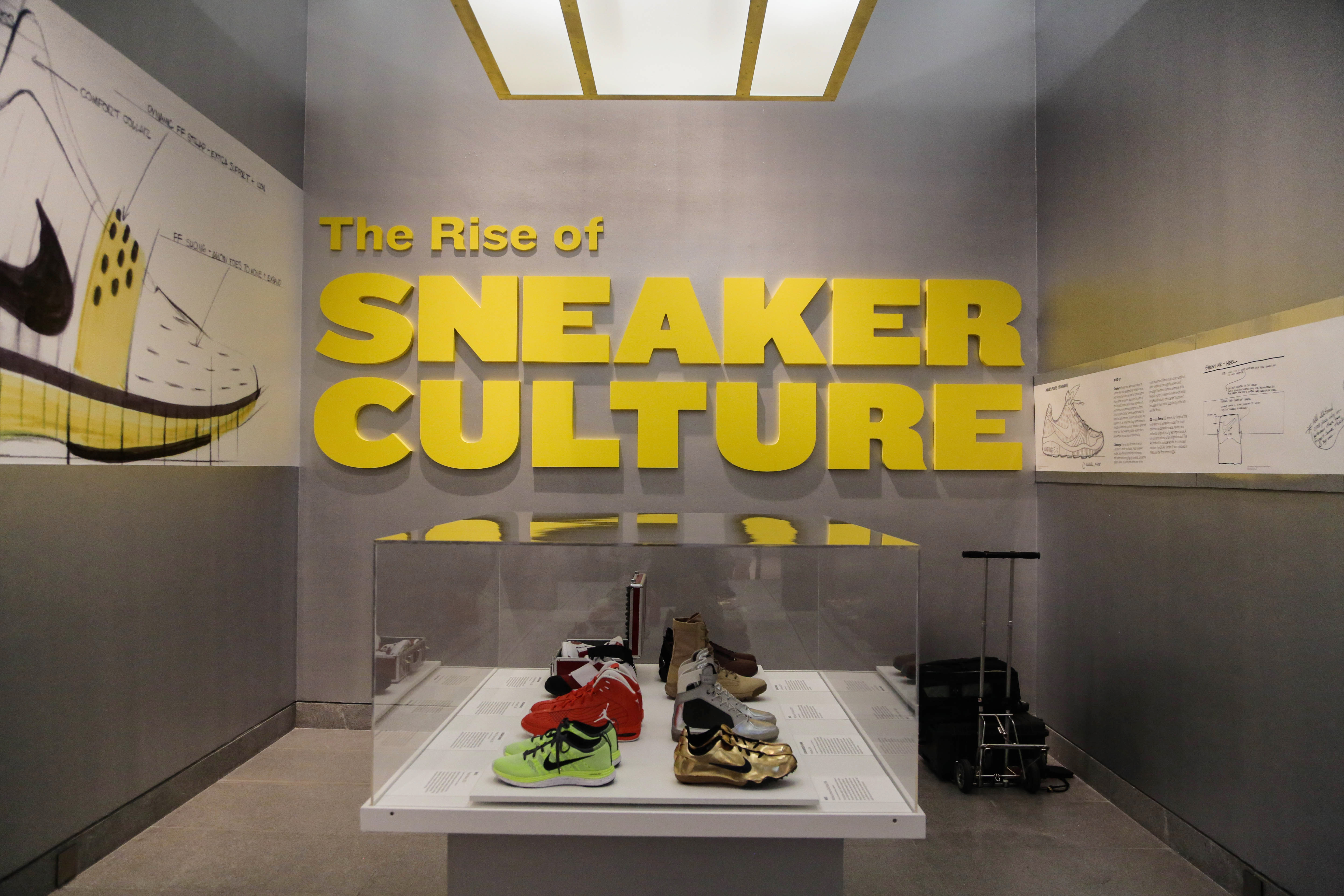
In 2013, an exhibition called Out of the Box: The Rise of Sneaker Culture set out from Toronto on tour. Last year it reached the Oakland Museum of California and the Brooklyn Museum in New York.
By sketching a short history of the sneaker, the show also traces how sneaker culture has changed. Its subject isn't what sneakers look like, though, but the sneaker's "identity" — in other words, the labels human society has stuck on it over time.
That is not a safe angle to take. Sneakers are still selling briskly all over the world, alongside yoga pants and sports bras; it is far too early for a final verdict. To keep up with the moment, for instance, the show also displays two pairs of New Balance sneakers. Since the U.S. election in November 2016, the American shoe company has publicly backed Donald Trump. Some people were furious enough to throw their New Balance sneakers into trash cans and burn them, then post the photos on Twitter.
"The cultural meaning of sneakers changes as the relationship between makers and buyers changes," said Elizabeth Semmelhack, the show's curator. Whether the exhibition keeps the New Balance shoes on display, she added, depends on how visitors react to what the company did in November.


That is exactly the standard behind what the show puts in its cases. Over the past 200 years, sneakers have been tied to class, nationalism, American identity, the civil rights movement, masculinity, fitness culture, youth culture and the cult of the individual hero.
The rubber sneaker could only be born after 1839, when the American Charles Goodyear invented vulcanized rubber. In the mid-1870s someone fitted rubber soles to croquet shoes. Those shoes were called "daps," "sandshoes" or "gutties"; the most authoritative name was "plimsoll," not yet today's "sneaker."
What does "plimsoll" mean? In sailors' slang it is the waterline. The edge of the rubber sole carried a similar line, and if the water rose above it, your shoes got wet.
Judging by that plain metaphor, the social identity of this new object was not complicated. It was still only a modern little product the rich used for sport and leisure.
In 1916 the American rubber company U.S. Rubber started making plimsolls and set up the Keds brand to sell them. Because the shoes made no sound when you walked, the advertising agent Henry Nelson McKinney used the word "sneaker" to market them. From then on, "sneaker" was the general term for athletic shoes.
By the 1920s, industrial mass production put sneakers on the assembly line, and a shoe that had once run only on tennis courts moved smoothly into basketball. The Converse Rubber Shoe Company, founded in 1908, signed the famous basketball player Chuck Taylor and asked him to help improve the design of its basketball shoes; in 1921 it launched the All-Star canvas line.
At the same time, on the eve of World War I, the world sat in a fragile peace, and every country took an intense interest in sporting culture — raising sport to the level of nationalism and eugenics. Governments urged their citizens into sport not to perfect their bodies but to prepare for the next world war. In Germany, Japan and Italy, mass exercise became a craze.
"Ironically, under the shadow of fascism the sneaker turned into one of the most democratic things there is," said Elizabeth Semmelhack.
Then came the famous 11th Summer Olympic Games, hosted by Germany in 1936. Adolf Hitler, the Führer of Nazi Germany, wanted the Games to prove to the world how strong his country was. He and other senior German officials expected a great deal from the German athletes. Meanwhile the Nazi propaganda machine pushed the "superiority of the Aryan race" and painted Black people as an inferior one.
In the event, the African American track and field athlete Jesse Owens, from the United States, took four Olympic gold medals — the men's 100 meters, 200 meters, long jump and 4x100-meter relay. Hitler was furious, and had the nerve to say that "people who came out of the jungle are primitive, their bodies are stronger than those of civilized whites, and therefore they should be excluded from future competitions."
The Dassler shoes Owens wore that day went into the record too. (You may never have heard of the company: the two brothers who ran the family business later split, and it became Puma and Adidas.) Like him, those sneakers won the applause of 110,000 spectators at the Olympiastadion Berlin, and became a symbol of resistance.


By World War II, once the U.S. government rationed rubber, wearing rubber shoes as an act of defiance cost too much. But from there the story of this cheap, practical shoe moved to the United States and stayed for a long time. There, sneakers would turn up against the backdrop of the civil rights movement, Hollywood, hip-hop, the NBA and the spread of the suburbs. Soon they would become a badge of American identity.
Back then sneakers were worn mostly on the field and seldom in daily life. The rise of television in the 1950s made star athletes and teenagers the leading voices in how people talked about sneakers. Marlon Brando wore them on screen. James Dean soon repackaged the Chuck Taylor and caught the attention of rebellious young people all over again.
Nike was founded in 1964, at first as a distributor for Onitsuka Tiger, the company behind the famous basketball shoe.
Sneakers also became a footnote to the American civil rights movement, most visibly in I Spy, the hit 1965 television series starring the Black actor Bill Cosby. His character was a CIA agent posing as a tennis coach, and he liked to wear white Adidas.
In 1968 sneakers had another moment at the Mexico City Olympics. The American sprinter Tommie Smith won gold and his teammate John Carlos took bronze; they took off their Puma Suedes and mounted the podium in their socks, hoping to turn the world's attention to poverty among African Americans.
As American cities spread outward into the suburbs and jogging took hold, more and more people in those cities — New York above all — started playing basketball. Like breakdancing, schoolyard basketball grew popular and moved into the mainstream.
The jogging boom sweeping the country also made low-top, high-performance running shoes popular. These shoes weren't really built for running: they came in loud colors and sat close to fashion. In 1977 Vogue declared that the "real running shoe" had become a symbol of style. People wanted many pairs of sneakers now, a different style for each activity. Shoe companies embraced women's liberation as well, aiming their ads at women's bodies and women's lives.
"In the 1970s, New Yorkers' obsession with basketball and hip-hop culture also moved the sneaker out of pure athletics and into cultural expression," the sneaker historian Bobbito Garcia wrote in the foreword to Out of the Box.
Then came the rockers and the skaters. They chose canvas shoes not necessarily because the shoes were more comfortable or cooler, but because they were cheap and carried no logo. For making Converse, Keds and Vans famous on the street, thank acts like the Ramones, Sid Vicious and Kurt Cobain.
After aerobics caught on, sneaker sales slumped for a while. Then, in 1984, Nike signed Michael Jordan and released the Air Jordan, the first sneaker in the modern sense.
At first, NBA rules requiring white shoes meant Jordan could not play in the red-and-black pair. To get the advertising, Nike paid a $5,000 fine per game so the star could "wear the shoes he wanted to wear." Nike's copy at the time: the NBA can't stop you from loving them.
"He became a synonym for individualism and rebellion, and the shoes he wore became, overnight, the thing everyone wanted," said Elizabeth Semmelhack.
The public release of the Air Jordan in 1985 is widely seen as the catalyst for modern sneakerhead culture. Just as some people lose themselves in collecting vintage cars and Swiss watches, these fans chase and hoard every new release.
Adidas was not idle either. In 1986 the rap group Run-DMC put out the single My Adidas, whose lyrics turned on a pun: "I wore my sneakers, but I'm not a sneak." The song won them an endorsement deal with Adidas and made them the first act to have its name printed on a shoe.


Besides selling things, sneakers have also been used to say something.
In 2005, while working on a "cross-border art exhibition," the artist Judi Werthein designed a shoe for Mexicans trying to cross illegally into the United States from San Diego. Since people usually try to get past the U.S. checkpoint at night, she built a compass and a flashing beacon into the shoe. Werthein said she did it to speak for migrants, and to get society arguing about "whether the U.S. really needs this much cheap labor."
There was a similar gesture in 2013, when the Brazilian architect Oscar Niemeyer worked with Converse to hide human-rights slogans and symbols on the classic Chuck Taylor, hoping it would start a political conversation.
Britain's Guardian remarked at the time: "One wonders what the workers in a contract factory far away in Indonesia think as they make these shoes."
Beyond these weightier meanings, Out of the Box: The Rise of Sneaker Culture also marks a few other dates: the 1984 Gucci tennis shoe that opened the era of the luxury sneaker; the 1985 Air Jordan that opened the era of sneaker obsession; the 2002 Adidas x Jeremy Scott shoe that opened the era of designer collaborations; and, of course, the Yeezy 750 Boost that Kanye West designed for Adidas in 2015.
That covers just about every field the sneaker has touched. And its recent arrival in high fashion supplies one more footnote to 200-plus years of shifting identity — a meaning freer than the blunt statements of the past, but also more prone to contradict itself, and to say very little.
Cover and inline images from: theguardian.com, highsnobiety.com, images.tate.org.uk, nssdata.s3-website-eu-west-1.amazonaws.com, www.slamonline.com, theatlantic.com.


Translated from the original QDaily article. Original publication date retained.