

Buffett Spent $15 Billion on Apple Stock in Six Months, But Apple May Lack the “Moat” He Loves Most
Coca-Cola can make money on a recipe that hasn't changed in 100 years. Apple can't.
Coca-Cola can make money on a recipe that hasn't changed in 100 years. Apple can't.
“I like businesses that are like solid castles, surrounded by wide moats, with fierce alligators in the water.”
Warren Buffett, U.S. News & World Report, June 1994.

The latest castle the Oracle of Omaha has set his sights on is Apple.
In the first two months of this year alone, he bought about $8.5 billion worth of Apple stock. Add the roughly $6.7 billion he bought before the end of last year, and Buffett has spent $15.2 billion on Apple shares.
He has always been cautious about tech companies. Apple is only the third one he has invested in across a career of more than 60 years.
But he is clearly bullish on this bet. The Apple shares held by his investment company, Berkshire Hathaway, are now worth $18 billion. Leaving out Kraft Heinz, which has already been consolidated onto Berkshire Hathaway's balance sheet, Apple ranks second by value among Buffett's 46 holdings, behind only Wells Fargo.

What exactly is the moat Buffett talks about?
Buffett's investment logic is not complicated. He once worked under Benjamin Graham, the pioneer of American value investing, and his philosophy grew directly out of Graham's: look for companies the market has undervalued, the kind whose stock-market value often sits below their book value.
So how does he pick them out?
By his own repeated account, what he cares about most is whether a company has a moat. Once he has found one, he buys hundreds of millions — sometimes more than ten billion — dollars' worth of its stock and holds it for the long run, usually about ten years.
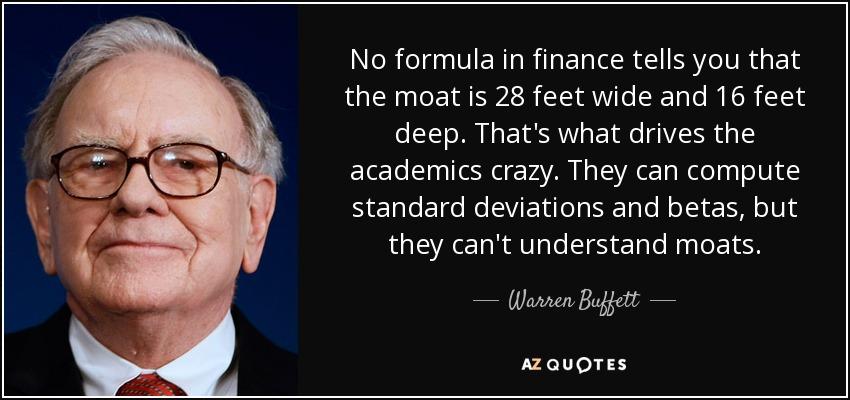
While investment firms roll out one algorithm and one mathematical model after another, and hire straight out of economics programs, Buffett says, “There's no formula in finance that tells you the moat is 28 feet wide and 16 feet deep. That's what drives the academics crazy. They can compute standard deviations and betas, but they can't understand what a moat is.”

The “moat” he means is plainly a company's unusually strong defense against competition. Buffett has described the traits of such companies on many occasions.
The first is brand. Coca-Cola is his favorite example when he talks about a brand as a “moat.”
He first bought 6.3% of Coca-Cola for $1 billion in 1988, then bought more in 1989 and again in 1994 — about $1.3 billion worth in total. As of the end of last year he had not sold a single share.
Those shares are worth about $16.8 billion today. Dividends aside, the investment has returned $15.5 billion.
He has held on that firmly because he believes Coca-Cola has a moat no competitor can cross.
“All over the world, people link happiness with Coca-Cola. Everywhere — Disneyland, the World Cup, the Olympics — wherever people are happy, Coca-Cola is there. Happiness and Coca-Cola are tied together. If you handed me a pile of money right now — I don't care how much — and told me to start an RC Cola company and make all 5 billion people on earth fall in love with RC Cola, I couldn't do it. You could hype it, try everything you can think of, discounts, weekend promotions, and none of it would shake Coca-Cola's position,” Buffett said of Coca-Cola in a 1998 speech to MBA students. “That's the kind of business we're looking for. That's a moat. We want to make that moat wider and wider.”

That year Coca-Cola sold 20 million bottles of its drinks worldwide. No other company in the industry sold even half as much in a year.
For decades, Coca-Cola has not had to renew its product generation after generation the way most consumer brands do. It kept reinforcing the brand of happiness with scale, factories, marketing and advertising instead.
Disney, in Buffett's view, works the same way: a brand that makes children happy, with animated films and theme parks that delight adults and children alike. As early as 1966, Buffett spent $4 million on 5% of Disney. But Buffett, then 36, sold every Disney share a year later for $6 million.

That is what brand value looks like when it becomes a company's moat. Hear the name and something comes to mind.
Lower operating costs than the competition are a moat too.
“The moat around our auto insurer GEICO is low cost.” When an MBA student asked Buffett what kind of company deserved his favor, he pointed to GEICO.
GEICO mostly sells car insurance. Founded in 1936, it started out serving groups with low accident rates — government employees, senior enlisted soldiers, military officers. It sold policies directly by mail, with no agents, which kept its sales costs about 30% below insurers that used agents and its underwriting margins about 15-20% above the industry average.
“Car insurance is something you have to buy — one policy per car. I can't get someone to buy 20 car-insurance policies, but they have to buy one. What do people look at when they buy car insurance? Service and price. To most people the service from different insurers looks much the same, so in the end they buy on price. That's why we have to be low-cost. That's our moat,” Buffett explained.
For consumer and retail companies, a tight enough grip on distribution can also become a “moat.”
Buffett has bought many companies that make and sell packaged food and household goods. Every one of them controls its distribution channels tightly.
They include Gillette, Procter & Gamble, Heinz, Kraft and Wrigley. Walk into a supermarket, a mall or a big-box store today and most of what sits on the shelves and in the display cases belongs to them: L'Oréal, Safeguard, Head & Shoulders, Chips Ahoy!, Oreo, Heinz ketchup.
Buffett once called Procter & Gamble an excellent business, because it has a powerful distribution network and a long list of well-known brands: “If I could only invest in one company for the next twenty years, I could live with P&G. P&G would make my top 5% of favorite companies. P&G won't be knocked down by competitors.”
It is hard to name a technological breakthrough at P&G. But pushing new products from dozens of product lines onto hundreds of thousands of supermarket shelves around the world is itself a barrier to entry.

Some companies, either because they entered an industry early or because they hold a technical edge, make it so expensive for users to switch that a rival's comparable product or service still can't pull them away. That is another kind of “moat.”
Buffett prefers companies with simple business models and little technology, because he thinks the future of tech companies is hard to predict. He bought IBM stock anyway — one of his rare tech investments.
According to CNBC, Buffett talked over the case for investing in IBM with the IT departments of several Berkshire subsidiaries, and drew on his own professional experience from decades earlier.
IBM, he said, helps IT departments do their jobs better. For a large company, changing auditors or law firms is a big deal, and getting an IT department to stop using IBM products is just as big a deal. “There's a consistency to it, and I should have noticed it years ago.”
IBM's moat in enterprise services makes customers hard to pry loose, because it has sales channels built over years of work with large companies and holds the credentials required to sell them services. New rivals have trouble taking its customers.
IBM can no longer innovate the way sharper young tech companies do, but with that moat in place it can buy its way back into a race it has lost. A recent example: in 2013 IBM paid $2 billion for the cloud-computing company SoftLayer. Its cloud business has now passed Google's, even though it started years later.
All these companies share one trait. Once they build a lead, they entrench it and push competitors back. Put simply, they make money in their sleep.
Apple's 40 years, by contrast, have mostly been spent filling in its own moat
Life at Apple has never been easy.
Apple was founded in 1976 as a computer company. Its first commercial success was the Apple II, which had a finished case and a keyboard built into the machine. Over the next 16 years, Apple II models sold nearly 6 million units between them, and that directly led to Apple's IPO in 1980.

Right after that, IBM brought out a computer of its own in 1981, and its corporate sales channels pushed IBM PC sales past Apple's within a year.
In 1984, the Mac became the first computer that freed ordinary people from typing command-line code and gave them a graphical user interface (GUI). That is what kept Apple alive for the following decade.
After Steve Jobs came back, he cut most of the product lines and launched the candy-colored iMac, and the core Mac business pulled back from the brink. But Apple itself never came close to dominating that market.
In the 2000s, Apple's history as a computer company ended. The iPod, which could “put 1,000 songs in your pocket,” remade the company: from a computer maker selling just over 3 million machines a year into a global consumer-electronics giant selling more than 50 million iPods a year.

The iPod took off in 2003, but Jobs did not stop there. Even then he told the board that phones could replace the iPod. In 2004, Apple began developing the iPhone.
When the first iPhone launched in 2007, Jobs said outright that it was there to replace the iPod: “We're going to release a phone, an iPod, and a device to access the internet... are you getting it? These are not three separate devices. It's one device, and we are calling it iPhone.”

So Apple changed identity again, into a phone company. In 2007, Jobs dropped “Computer” from Apple Computer Inc. and renamed the company “Apple Inc.”
In 2010 Apple produced another new product line, the iPad, also treated at the time as a major breakthrough.
Across 40 years, Apple's growth has depended on putting out an era-defining product every few years and walking into a new industry.
Each time, Apple opened a new market with a product it had polished. And each time, it declined to follow up by blanketing that market with cheap versions. From the start, the iPhone never chased scale in order to corner the market. The highest priority has always been margin.
One new phone model a year, Apple Stores designed like luxury boutiques, an obsession with design and experience — all of it exists to make the iPhone the phone with “the best experience.” The best product, the highest profit, and never a grip held on an old market.
That is rare even among tech companies. Google's core business has not changed since 1998; search advertising still brings in nearly 90% of its revenue.
It faces almost no competition in search, but it has never found a second business as dominant or as profitable.
Facebook cornered another advertising market on the back of one enormous social network. Baidu, Alibaba and Tencent in China are no different.
Microsoft is the same. From the 1980s to today, the money it makes rests entirely on Windows and Office.
Apple has not had an easy time even with the iPhone, its most successful product. After it beat the old giants Nokia and BlackBerry, Samsung and HTC took share with Android phones. Now three Chinese makers — Huawei, OPPO and Vivo — have squeezed into the global top five by shipments. They are fighting Apple in China over its future users, and they have moved into India and Southeast Asia as well.
So what exactly did Buffett see in Apple?
Brand value may be the closest thing Apple has to a moat, and even that isn't unbreakable
One part of it is that Tim Cook is willing to pay dividends. At Apple's 2016 payout rate, Buffett's 133 million shares would earn him about $210 million. That is 1/70th of the value of the stock he already holds — icing on the cake.
What matters more is Apple's future growth. Buffett thinks Apple has one moat: users remain extremely loyal to the iPhone.
“What impresses me about Apple is how sticky the product is with users,” Buffett said in a CNBC interview on Monday. He asks the iPhone owners around him, and the answer he gets is, “I'll buy another iPhone.”
Buffett himself has never used one. During the interview he pulled an old flip phone out of his jacket pocket.
Apple does have enormous brand power, and it may be the closest thing to a “moat” the company has. Apple still holds the highest brand value in the world.
Work out how much revenue an average Mac, iPhone or iPad user brings Apple each day, and the iPhone turns out to be the steadiest of the three. That means iPhone users really are loyal, which matches Buffett's read.

Apple is built to throw the whole company behind a handful of products a year. It has 20,000 employees, and you can count the products it ships each year on one hand.
That is extremely rare in a large company. Samsung alone releases more than a hundred low-end phone models a year.
The trust built by consistently good products lets Apple take the high end of the market at lower cost. Apple spent $1.8 billion on advertising in 2015; Samsung Electronics spent $4.3 billion in 2012.
Apple also does not lean on carriers and other sales channels. Android makers hand distributors large subsidies in exchange for volume, but Apple, protecting its margins, pays out far smaller sales commissions than its competitors.
This is why Apple is worth more than $700 billion today. Every other phone maker's market value, added together, comes to about half that.
But the iPhone's lead is shrinking. Look back at the first iPhone in 2007: among the button phones of the day, nothing else had an all-touch screen. Now every phone is the same glass slab doing much the same things.


Competitors find it hard to take iPhone users away. The reverse is just as true.
As the gap narrows, longtime users — especially British and American ones used to Apple's whole ecosystem of apps and services — will keep buying Apple. But what about younger users? Users in emerging markets? When a young buyer who knows little about the Apple brand is choosing a phone, why would they pay more for an iPhone?


In 2016 Apple posted its first overall revenue decline in 13 years, because iPhone sales fell. The damage was huge: the $18 billion hole in revenue was bigger than the combined annual profits of Baidu, Tencent and Alibaba, and about equal to Twitter's entire market value.
After the iPhone 7 arrived, Apple returned to growth in its traditional strongholds — the UK, the US, Japan — but kept sliding in China.
Apple's answer to this problem has always been to move into the next market, and Cook is doing it now. The health-minded Apple Watch, the big-screen iPad recast as a work tool, more internet services, television programming, the rumored self-driving technology — all of it is Apple looking for its next future. These attempts have cost a great deal and so far produced little.
In 2004, Coca-Cola decided to change the formula and the taste, and launched a new generation of cola. “New Coke” failed badly, and Coca-Cola went back to guarding its century-old recipe.
Apple can't do that. What people believe about the Apple brand is not only that the quality holds up. The brand also promises surprise.
No other company manages what Apple manages: every launch becomes a worldwide event, discussed for weeks beforehand. As Cook put it, an Apple launch gives you “the feeling of unwrapping a present.”
The iPhone experience is good; it is still a sound product. But it is getting harder and harder for a phone to produce surprise.
Meanwhile Apple's failures in new markets keep denting its image.
The Apple Maps fiasco of 2012 ended with Cook apologizing in public and firing an executive. The first Apple Watch's software was too complicated, and within a year it was rebuilt from scratch.
The new MacBook Pro in 2016 angered Apple's traditional power users. Apple clearly minded: it rushed to cut accessory prices after the launch.
Apple's spending on design and research keeps rising year after year. Cook will not stop and live off past glory. He can't. What draws people to this team rests entirely on turning out new things and changing one new market after another.
From a user's point of view, a company like Apple — one that can never rest, that has to keep breaking new ground and entering new markets — is exactly what a good company looks like. But breaking new ground means taking risks.
If attempt after attempt to find the next iPhone-sized market ends in failure, it will wear down the belief that you can never go wrong buying Apple.
Then there is the permanent question in technology: when a new technology arrives to replace the smartphone, can the reigning champion keep up in time? Usually it can't.
In the end it may come down to what Buffett's partner Charlie Munger said in 2013: “BNSF [Burlington Northern Santa Fe, the American railroad] will have a competitive advantage ten years from now. We don't know whether Apple or the oil companies will.”
Cover image from SaaStr and Pixabay.

Translated from the original QDaily article. Original publication date retained.