

From an Agreement Under a Buttonwood Tree to the World's Largest Securities Market: How the NYSE Made It Through 200 Years
On March 8, 1817, the New York Stock and Exchange Board was founded — the predecessor of the New York Stock Exchange.
On March 8, 1817, the New York Stock and Exchange Board was founded — the predecessor of the New York Stock Exchange.
In May 1792, under a buttonwood tree at 68 Wall Street in New York, 24 stockbrokers signed an agreement:
"We the Subscribers, Brokers for the Purchase and Sale of Public Stock, do hereby solemnly promise and pledge ourselves to each other that we will not buy or sell from this day for any person whatsoever any kind of Public Stock at a rate less than one quarter of one percent Commission on the Specie value, and that we will give a preference to each other in our Negotiations."
That agreement, only a few lines long, is known as the Buttonwood Agreement, and it eventually led to the founding of the New York Stock and Exchange Board on March 8, 1817. After a long run of reforms and mergers, it is now the world's largest securities market: the New York Stock Exchange (NYSE).
Which means that today the NYSE turns a full 200 years old.

It all began with an economic crisis.
In 18th-century New York, anyone could become a stockbroker. There were no quote boards and no fixed place to trade; deals were often struck on the street. In that disorderly market, William Duer, a former assistant secretary of the Treasury, poured large sums into speculation, and other speculators, sure he had inside information, piled in behind him.
Duer's bets finally collapsed, and he went to prison for embezzling public funds. The day after he was jailed, 25 people in New York went bankrupt as a result. By the reckoning of Thomas Jefferson, then secretary of state, speculators lost $5 million in total — as much as all the real estate in New York was worth at the time.
The 24 brokers who signed the agreement were among the more successful and wealthy of their trade. They wanted no part in crises like that one, and preferred to deal only with people who had real experience and real money. At first they traded among themselves at the Tontine Coffee House. After the War of 1812 broke out, federal securities were issued in far greater volume and trading rose with them, so the brokers decided to build a more formal organization — the New York Stock and Exchange Board — to handle the new conditions.

The Board ran on membership. When it was first founded, joining cost $25 — and money alone was not enough. A new member had to be nominated by an existing one and needed at least a year of experience buying and selling stock.
The Board kept adjusting its terms of entry to suit its own situation and the state of the American economy. The membership fee shows this most clearly: $150 in 1833, $400 by 1848. Count in the deflation of those years and the rise looks steeper still — the US cost of living fell 17 percent between 1820 and 1848.
Even so, the Board's membership grew rather than shrank: 39 members in 1820, 50 in 1836, 75 in 1848. The reason is simple — this was a profitable business.
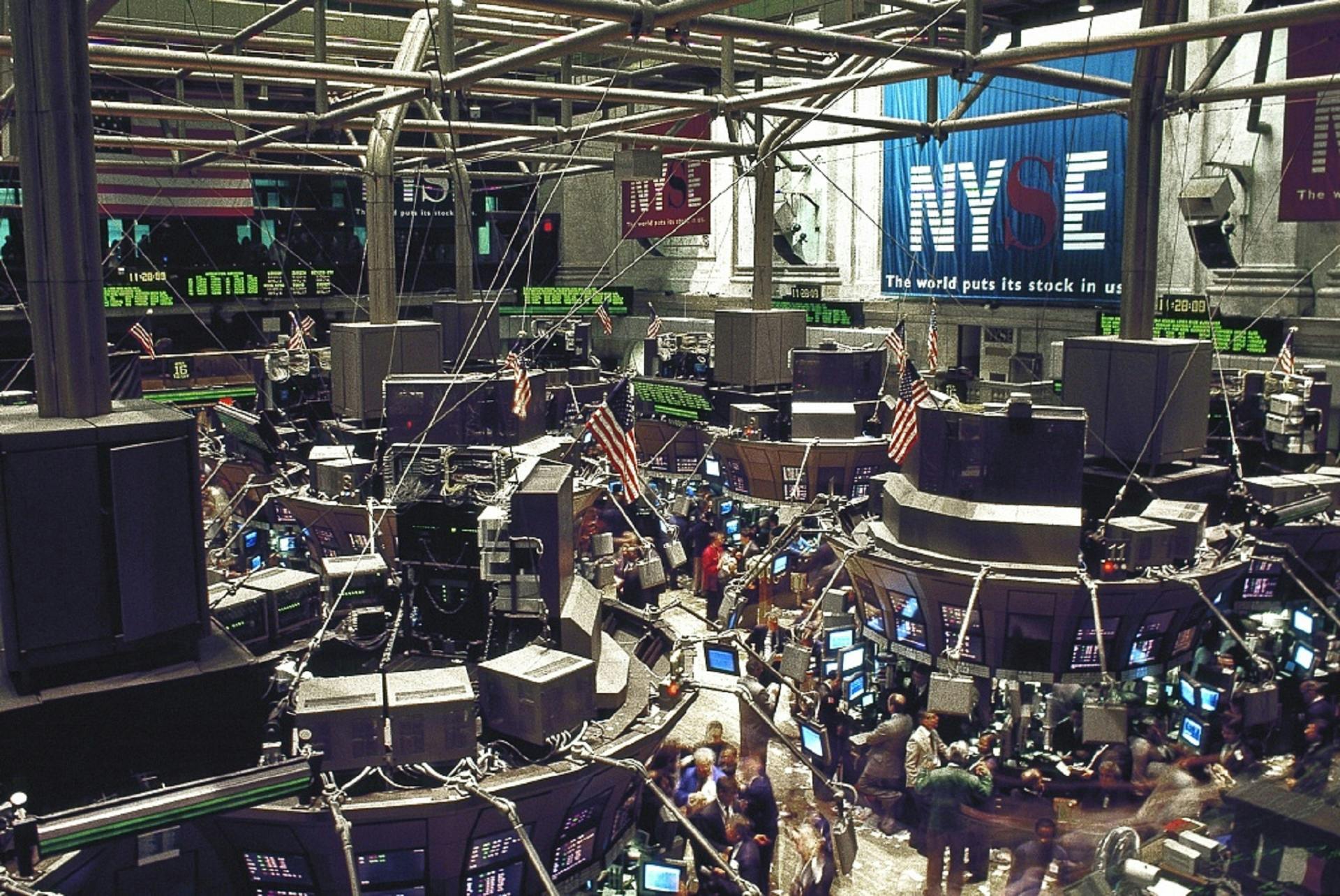
The Board's daily trading all happened in one large room. The chairman read out, one after another, the names of the securities registered with the Board. When a name was called, everyone present could begin bargaining over it — buyers and sellers quoting to each other and closing deals, round after round.

Next to trading on the street, the Board — organized, with a fixed venue — clearly made it easier to find a buyer or a seller, and trading was more efficient. Its members were also more trustworthy, which made clients easier to attract.
On top of that, although the Board's secretary recorded closing prices, the Board did not at first give the figures to the press; only years later did it start publishing them once a week. That meant Board members knew more than traders outside it.

The Board quickly became the center of securities trading in New York, though for the moment its reach stopped at the city limits. It was not even the first stock exchange in the country: the Philadelphia Stock Exchange came 22 years earlier and was better known.
But by the end of the 19th century, geography had gradually made New York the trading hub of the United States. New York State's Hudson River was better suited to navigation than Philadelphia's Delaware or Boston's Charles, and less likely to freeze in winter. The Erie Canal, opened in 1825, deepened that advantage further and turned the city into a center of commerce and trade; companies that needed capital were glad to list there.

The immigrants who arrived in large numbers also gave New York a name for innovation and appetite for risk, while Philadelphia's investment culture stayed more cautious. At the same time, the Second Bank of the United States — the institution that had made Philadelphia a financial center — failed to have its charter renewed in 1836 and lost its operating privileges, weakening the city's financial weight further.
All of this pushed New York past Philadelphia to become the economic center of the country, and the Board naturally gained from it. But the Board owed its place at the center of American securities trading to something else as well: the arrival of the telegraph in the 1830s.
By 1845 New Yorkers could already reach many cities by wire, and the Board was always quick to try any tool that could make its trading more efficient. It was among the telegraph's earliest customers, and when the stock ticker arrived in 1867 and the telephone in 1878, it took those up at once.
The telegraph carried New York's closing prices to other places the moment they were set. By the 1850s the country had laid more than 10,000 miles of cable, and stock prices in every large American city took New York's as their benchmark.

As the center of American securities trading, the Board grew into an ever-larger institution and its daily volume climbed fast. Day to day, it lived on high membership fees and commissions.
Just as the Buttonwood Agreement laid down, the Board took a commission at a fixed rate on every trade — a transaction fee that members and non-members alike had to pay, with non-members paying more. The 0.25 percent rate held for half a century, after which it was adjusted again and again to fit economic conditions; any broker who charged less than the set rate risked being thrown out of the exchange. One thing worth noting: in 1863 the New York Stock and Exchange Board renamed itself the New York Stock Exchange.
The system lasted more than a hundred years. Then, in September 1973, the US Securities and Exchange Commission (SEC) said it intended to abolish fixed commissions a year and a half later.
The NYSE, which had made enormous sums under fixed commissions, protested. It threatened to sue the federal government, and its chairman at the time, James Needham, said that flexible pricing of commissions would be "a disaster for most people." Brokers mocked the SEC for meddling in how the exchange ran by joking that its initials stood for Soviet Economic Committee.
But against Wall Street's expectations, the formal end of fixed commissions on May 1, 1975 was not doomsday for brokers. It brought them more business. The new system cut brokers' commissions by 50 percent, which lowered the cost of trading sharply and left investors willing to trade more often.
One simple example shows the difference between the two regimes. Buy 100 shares of a $25 stock on April 30, 1975, and the fixed rate then in force would have cost you at least $49 in commission. Buy the same 100 shares of a $25 stock today and an online broker charges $10. Count in inflation and the gap between the two widens further.

Outside regulation aside, the NYSE also reformed itself repeatedly — to keep trading orderly, to lower its risk, and to protect its members' interests. Those reforms look ordinary in the rulebooks of exchanges around the world today, but at the time every one of them broke new ground.
Among the many kinds of trades done at the NYSE was one called a "time bargain" — what we now call a futures trade, in which the two sides agree to exchange a certain quantity of stock at a certain price at some point in the future. Back then, whether such a trade actually happened depended entirely on whether both sides kept their word.
Traders naturally did not want to end up facing someone who would not honor a bargain, so each kept a private blacklist drawn from his own experience and the rumors he had heard. In 1834 the Board began keeping an official one, the Black Book: every member was required to report defaulters openly to the Board, and their names went into the book as a warning to others not to trade with them.
The Board added another rule in 1856: a company that wanted to list had to file an application, which members would then examine and vote on. This is the process we now know as the IPO. Before that, a company could be riddled with problems and still list easily, with nothing to vet it, and take investors' money.
By the 1960s, though, the NYSE had stopped keeping up with the times.
In 1968 it ran into a crisis it had never faced before. Average daily trading volume had more than doubled in three years, reaching 12 million shares a day.
The exchange was still recording, settling, and clearing trades on paper, and it is not hard to imagine how much paperwork that volume produced. That year's "paperwork crisis" forced the NYSE, in the worst months, to cut trading to four days a week and close on Wednesdays. In easier stretches it simply ended trading early.

The crisis was not the exchange's alone. Every firm trading there was probably hurt by it, because none of them could get a complete record of their trades. "The unrelenting paperwork problem became a disaster … in the sense that many firms lost control of their records and their costs," said Wyatt Wells, a history professor at Auburn University.
Across 1969 and 1970, more than 100 NYSE member firms stopped operating, through merger or liquidation; the number of non-member firms that went under is hard to count but was substantial too. All of it was bound up with the paperwork crisis.
In the confusion, more than $400 million worth of securities were stolen. In 1971 NYSE president Robert W. Haack called the paperwork problem a "painful" lesson.
The crisis forced the exchange to change. In 1976 it began installing the designated order turnaround system (DOT), improved to Super-DOT in 1984, giving up paper records of trades in favor of orders sent electronically. Between 1982 and 1995 the NYSE spent more than $1 billion keeping up with fast-rising volume.
And that was only the beginning.
Record trading volume was not the hardest problem the NYSE faced. The NASDAQ Stock Market, founded in 1971, quickly became its strongest competitor.
Unlike the NYSE, Nasdaq was fully electronic and had no physical trading floor. It used market makers, who supplied large numbers of bid and ask prices; computers handled those prices automatically and showed the best quotes electronically to investors everywhere. Buyers and sellers no longer had to wait for a suitable counterparty to appear before they could trade.

In the 1990s Nasdaq argued that its market-maker system beat the floor-trader system of the traditional exchanges, and that once every market went electronic it would be the future of securities trading. As late as 2005, only about 10 percent of the NYSE's huge trading volume was matched electronically.
The best-known technology companies tended to pick Nasdaq for their IPOs — Intel in 1971, Oracle and Microsoft in 1986, Google in 2004 — and the Nasdaq index kept climbing. Whether it could attract big listings mattered a great deal to the NYSE: not only for the fees those companies paid to go public, but for the trading that would follow for years afterward, and for how much attention the public paid the exchange, which usually tracks volume too.
So the NYSE changed accordingly, to show it was a readier adopter of new technology: modernizing the trading floor in 1979, and from 1995 improving the equipment its traders used, replacing it as technology advanced with handheld terminals, fiber optics, mobile phones, high-definition screens and more.
From 2008 the NYSE also built a set of listing requirements friendlier to startups, lowering the market-value bar for listed companies and dropping the requirement that a company be profitable for two years. At the same time it kept strengthening its electronic trading systems to make itself more appealing to technology companies.
The effort worked. Plenty of technology companies were willing to list on the NYSE — Twitter and Alibaba among them. By 2012 the number of technology companies listed on the NYSE finally passed Nasdaq's.
But changing itself from the inside was nowhere near enough, and commissions and membership fees no longer covered the bills. The NYSE began looking at other companies, and looking for outside money.
So, after brokers and floor traders had resisted electronic trading for decades, the NYSE announced in November 2005 that early the next year it would buy the electronic trading firm Archipelago and become a publicly listed company itself. It also launched its own electronic trading system to make trading more precise and faster.
What followed was one acquisition after another, in both directions.
In 2007 the NYSE merged with Euronext NV, creating the first transatlantic market for stocks and derivatives; the new company, NYSE Euronext, was worth $20 billion. In 2008 NYSE Euronext bought the American Stock Exchange, making it the third-largest options market in the country.
In 2013 the online futures trading platform Intercontinental Exchange (ICE) bought NYSE Euronext for $8.2 billion. By the time that deal was announced, the NYSE's years of embracing electronic trading had paid off: its famous trading floor handled only 20 percent of total stock volume.
"The trading floor is going to be like the Roman Forum. It's a great place to visit, but there's not much going on there anymore," is how Wall Street historian Charles Geisst summed up the state of the floor.
The NYSE has indeed become far less important than it once was.
In 1914, because of the First World War, it halted trading for nearly half a year, and securities trading across the whole country nearly stopped as a result.
On July 8, 2015, a technical failure suspended NYSE trading from 11:32 a.m. to 3:10 p.m. But the NYSE now handles only 14 percent of American stock trading; investors no longer depend on the traditional exchanges to trade, and some trading firms did not even notice anything was wrong.
"The only thing that was affected was the exchange itself," said Larry Tabb, founder of the financial markets research firm Tabb Group.
Graphics: Feng Xiuxia
Translated from the original QDaily article. Original publication date retained.