

One Bag Shape, Hundreds of Versions: Affordable Luxury Is Being Written Off, but a Brand Called Furla Is Doing Fine
Never mind the 90-year history it advertises. This affordable-luxury brand's real commercial life began in 2011.
Never mind the 90-year history it advertises. This affordable-luxury brand's real commercial life began in 2011.
Furla, the brand people keep mentioning in the same breath as Michael Kors and Coach, has spent recent weeks celebrating its 90th birthday on a grand scale.
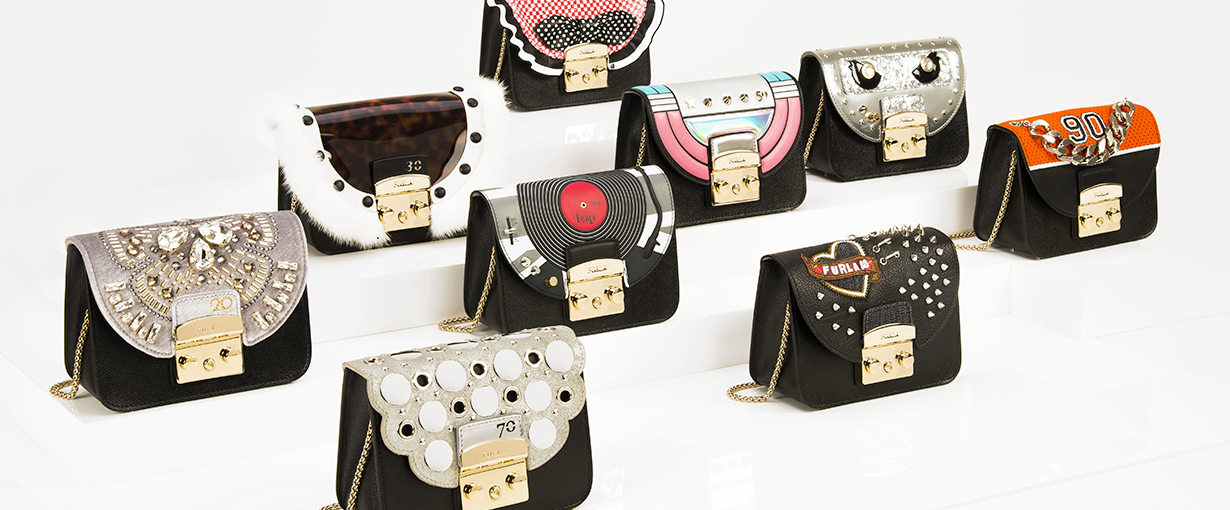
In March, Furla worked with the well-known Japanese paper-cutting artist Mikito Ozeki on a limited-edition 90th-anniversary collection of shoulder bags and wallets. The same month, it released Play, a capsule collection built on its hit Metropolis chain bag. Counting from the 1920s, the collection took the signature musical style of nine different eras — the Jazz Age, the Swing Era, the Rock and Roll Era and others — as the inspiration for nine themed designs.
For the occasion, Furla also sent a group of dancers carrying Play bags into the streets of Milan for a flash-mob tap routine, and put on a static exhibition. Chinese celebrities Ouyang Nana and Ivy Chen both flew in to show their support.

But six years ago none of this noise existed. A brand that claims 90 years of history became a household name entirely on the strength of the last six.
In 2007, when Furla first entered the Chinese market, group chairman Michele Furlanetto came to the Kunlun Hotel on Beijing's East Third Ring Road for the China Fashion Forum. His speech was titled “A Brand's Experience in the Chinese Market,” and in it he explained, plainly, where Furla came from, how it was doing, what its products were meant to be and how it advertised — the posture of a brand nobody knew, introducing itself from the beginning.
Furla had also made a limited-edition bag that year to mark its 80th anniversary. However good your memory, you probably can't picture it. Like Michele Furlanetto's turn at the China Fashion Forum, there was nothing much to say about it.
Everything had to wait until 2011, when Furla's Candy Bag and chain bag swept the market.
The 90-year history counts for nothing. Two bags did all the work
The Furlanetto family founded Furla in 1927, with headquarters in Bologna, Italy. It was just after World War I, and to serve the newly liberated, independent woman, founders Aldo and Margherita Furlanetto set out to sell women every kind of leather accessory. In 1955, Aldo opened Furla's first store on Via Ugo Bassi, in the center of Bologna.
Furla did not make its own goods, though — it was a wholesaler of fashion products. Only in the 1970s, when the second generation of the family took over, did Furla start building a brand of its own.
So strictly speaking, Furla has been a handbag brand for a little over 40 years. Its early bags were aimed at working women, and the colors were on the conservative side; even the limited edition it made for its 80th anniversary looked neither young nor especially appealing. For years afterward Furla made no big moves in design or marketing. It was the kind of brand that could keep the lights on but was, on the whole, dull — so dull that before 2011 it barely registered.
Then, in June 2010, Furla hired a new chief executive, Eraldo Poletto, to fix all of that.
After Poletto arrived, the obscure Furla began to change, and its annual revenue rose every year: up 7% in 2013, 13% in 2014, and as much as 30% in 2015.
More important, Furla now had hit products, and people started to notice it.
The 2011 Candy Bag broke Furla out of its stuck-in-the-middle rut. Made of PVC neatly stitched to leather in fresh, bright colors, the bag had a simple shape and an enormous range of color combinations. The moment it launched, it excited both the handbag market and young shoppers.
The Candy Bag was the first hit in Furla's history, and it lifted global sales that year by 20%.
In 2014 came the second hit, the Metropolis chain bag. The two bags look nothing alike, but Metropolis followed the Candy Bag's method: colors, and lots of them.
Metropolis came in nearly a hundred colorways, with about ten shades of pink alone, and every year Furla added special editions timed to holidays and trends — pop art, graffiti, Valentine's Day — to keep people talking about it. In 2015 the bag drove a 30% year-on-year rise in Furla's full-year sales.
If the Candy Bag was Furla dropping its conservative image to get closer to young people, the Metropolis chain bag was Furla keeping up with fashion.
For a while the key word in handbags was “big”: how stylish a bag looked came down to how big it was. Phillip Lim made an oversized Pashli, YSL had an unusually large Cabas, and Céline simply described its big bags as “luggage.”
Then the big-bag wave reversed. Around 2012 brands started making their bags smaller and smaller. Hermès, Mulberry, Moschino, Valentino, Rebecca Minkoff, DVF, Marc Jacobs, Chloé, Nina Ricci and Céline all turned their classics into mini versions.
Besides guaranteeing a rainbow of colors, Furla's Metropolis had a shape that fit the global taste for small bags.
Small bags really did sell. Michael Kors, the other affordable-luxury brand people like to compare with Furla, made a point in its fiscal 2016 second-quarter results of saying that small bags had been selling well lately, that it would take the trend seriously in order to compete with its peers, and that it planned to put more into small-bag design.
Once the two hits arrived, Poletto used the momentum to widen Furla's product lines. It added men's accessories, women's shoes and a watch division one after another; signed a specialist company to make its eyewear; teamed up with Ratti on men's and women's ready-to-wear; and this year will launch a leather customization service while developing its first perfume. Furla wants to be a lifestyle brand.
The real question: with the best-known affordable-luxury brands all being written off, what lets Furla keep saying it is doing fine?
When Loewe brought in Jonathan Anderson as creative director, he at first only reworked classics from the brand's past — but the handsome designer and the good-looking bags still got promoted everywhere, together.
In 2015, when Mulberry hired Johnny Coca, the former Céline accessories designer behind the so-called smiley bag, as creative director, it told that designer's story in full as well.
Luxury houses sell bags by telling designers' stories. Affordable-luxury brands sell looks and value for money. They usually have no dream to sell, so they tell shoppers two things instead: the bags are as well made as luxury goods, and they cost less than luxury goods (with luxury as the yardstick).
Like Michael Kors and Coach, Furla places itself in affordable luxury. Its genes are a little different: it has always stressed that it is Italian, and of course the sense of history that comes with an “80th anniversary” or a “90th anniversary.” But that is certainly not the main reason Furla is riding high while the rest of affordable luxury is being written off.
In the years when Furla's sales were climbing fast, Michael Kors and Coach had just come through fast growth of their own.
Michael Kors's problem was that it got too popular. Its bags became “street bags,” and the brand risked sliding from affordable luxury into a mass-market label.
It has lately tried to change course by expanding beyond handbags and putting more weight on digital marketing, but its results keep falling. Its first-three-quarters results for fiscal 2017, released on February 7, showed total revenue for the three quarters ended December 31 of last year down 3.2%, to $1.35 billion.
Coach, before its own turnaround, had the same “too popular” problem, plus a set of its own: designs that looked dated, logos that were too many and too large, discounts that were too deep and too frequent, and a reputation as a badly overpriced brand.
Furla seems to treat Michael Kors and Coach as cautionary tales. It has opened far fewer stores than Michael Kors, and it has copied Coach's emphasis on travel retail.
Coach's 2016 annual report says travel retail is the largest part of its international retail channel. Coach did not say how many international airports it has stores in, but three of the five “most important” international retail partners it named — DFS Group, True Alliance, Al Tayer Insignia, Lotte Group and Everrich DFS Corp — run travel-retail channels.
Furla also does not want to repeat what Michael Kors and Coach used to like doing: opening stores in discount outlet malls and moving product through markdowns. According to data from BNP Paribas, 22.7% of Michael Kors's stores were in outlets in 2015, and 18.4% of Coach's. The industry average then was 6.9%.
Furla has put its attention on airports instead.
Poletto takes travel retail seriously. In his words, “it's about identifying the consumer who sets off from Tokyo, may pass through Frankfurt, and ends up spending in Milan.”
When he joined Furla in 2010, the brand had only 33 stores across 44 airports worldwide; by 2016 Furla had 262 stores in 63 countries. In travel retail alone, Furla's sales grew 40% over 2015.
“You also have to open stores in Japan, in order to be close to Chinese consumers,” Poletto said. “We use the concept of the ‘Silk Road.’ That means Furla has stores in London, Paris, Milan, Florence, Rome, Dubai and Singapore. Those stores can account for 35% to 40% of the brand's total sales. If you connect the stores in those cities with the stores in airports, you get consumers worldwide,” Eraldo Poletto said.
Furla also has its own method in product design.
Retailers today all run their businesses like fast fashion, working out how to put new products on the shelf as fast as possible and how to attract shoppers with the most variety, or the most personalization.
To win over young buyers, even Bulgari now offers personalized versions of its classic Serpenti watch: pick a different strap, dial and type of stone and you can build 312 different products.
Furla has worked just as hard on variety. Its most impressive achievements so far are the two hits, the Candy Bag and Metropolis. Both were designed from the start with many colorways, which makes it unlikely you will run into someone carrying exactly your bag.
Look at this year's 90th-anniversary Play collection. It is presented as nine musical styles used as inspiration, but what Furla actually offers is nine flaps and five bag bodies, which combine freely into 45 different bags. However Furla sells them, in other words, these two hits still come across as individual. This kind of free combination is largely how Furla avoids the embarrassment Michael Kors and Coach ran into so quickly — bags everywhere, and everyone carrying the same one.
Even now, Furla is not a big business
In early March, Furla published its 2016 results. Sales grew 24.5% from 2015 to €422 million (about $456 million). The numbers look good; “rising” is a fair word for them.
But $456 million is not a large business. Take Michael Kors's first three quarters of fiscal 2017 (that is, the period ending December 31, 2016): its total revenue fell 3.2%, and it still came to $1.35 billion.
And Coach, in the middle of its turnaround, reported in its 2016 results (for the fiscal year ended July 2, 2016) that even excluding its sub-brand Stuart Weitzman, total sales for the Coach brand reached $4.741 billion.
Which shows that Furla is still quite small. Its clever product design and store-opening strategies have carried it into a steep climb for an affordable-luxury brand. But once it catches up with Michael Kors and Coach on sales, those big yearly jumps may well start to slow.
There is another problem. Plenty of small labels that grew up on the internet can now stand next to Michael Kors, Coach and Furla: Britain's Zatchels; the plain, cool A.P.C. and Everlane; Cath Kidston, with its sweet prints; the Spanish label Adaism, whose bags look like soft kraft-paper sacks; Salar Milano, which makes something close to Chloé's piggy bag; the London label Matter Matters, with its geometric shapes; Strathberry, which makes bags with metal bar handles — and more.
In fact there are too many to list, and more keep coming. The internet has dug up the long tail that lets small labels survive. Their designs are distinctive, the quality is decent, each has its own selling point, and they look nothing like affordable-luxury brands such as Michael Kors, Coach and Furla — which satisfies the shopper's appetite for something new, at a price that is still acceptable.
Any one of them is slight, but their growth rate is striking and so is their variety. Treat all these small labels as a single population and they are an enormous challenge to anything positioned as traditional affordable luxury.
Put another way: if Furla goes on treating Coach and Michael Kors as its competitors, it will probably not get a second golden run.
Cover and in-body images from:
natavyshnivska.com, www.pinterest.com, youtube.com, hshw.com, falicious.com, notjustalabel.com, s-media-cache-ak0.pinimg.com, asia.media.fashionnetwork.com, media.fashionnetwork.com.


Translated from the original QDaily article. Original publication date retained.