

Old-Fashioned Train Travel Is Hot Again — as a New Kind of Luxury Trip
Japan is adding two luxury train routes this year. China is adding one too.
Japan is adding two luxury train routes this year. China is adding one too.
Every year the ad agency J. Walter Thompson Intelligence publishes a forecast called The Future 100. Its 2017 edition named this the "Year of the Train."
"In many parts of the world, train travel is ready for an upgrade," the report said. "Why is this interesting? Luxury consumers are rediscovering the appeal of a way of travelling that keeps them close to the land. It reflects a market demand for nostalgia mixed with contemporary design."
New train routes have kept appearing over the past few years, and they have a lot in common: a luxury positioning, high prices, star-hotel service, carriages that look both classic and singular, and more buyers than seats.
Japan alone added two trains this year: the Train Suite Shiki-shima and the Twilight Express Mizukaze.
The Train Suite took three years and 5 billion yen to build. It has 10 carriages, among them an observation lounge, a dining car and hot-spring baths. Its chefs are Katsuhiro Nakamura, a French-cuisine chef who won a Michelin star in Paris, and his student Hitoshi Iwasaki. The first route is a four-day, three-night round trip between Tokyo and Hokkaido; depending on the season, it also runs a two-day, one-night trip from Ueno to Aizuwakamatsu.
Here is the nice touch: just as the Hogwarts Express in Harry Potter has Platform Nine and Three-Quarters, the Shiki-shima has a platform of its own — Platform 13.5 at Tokyo's Ueno Station.
Thirty-three passengers rode the Train Suite Shiki-shima's first trip. Tickets, priced between $3,000 and $10,000, are sold out through next March.

The other train, the Twilight Express Mizukaze, due to start running in June, has been just as popular. So many people applied that its single-passenger tickets — 250,000 to 1.25 million yen, or roughly 15,000 to 75,000 yuan — will be sold by lottery. Like the Train Suite, it has 10 carriages, with a dining car, a balcony, an observation car, a bath and star chefs, and it calls itself "a hotel that travels through the Japanese landscape."
Train travel goes back a long way. The modern travel agency was born on the railway.
In 1841 the Englishman Thomas Cook chartered a train and took 570 people from Leicester to Loughborough for a temperance rally. Four years later he founded a travel agency under his own name and began organising guided sightseeing trips at a fixed price — a new way of travelling, and one generally recognised as the start of modern tourism.
After 1865 the big railway companies began upgrading their services one after another, each with its own flagship luxury train.
Steve Barry, whom The New York Times has called a "railroad expert," described the scene aboard the world's first luxury trains in his book The Golden Age of Train Travel: perfume for the ladies, carnations for the gentlemen. With their elegant air and attentive service, these trains carried passengers through America's grandest landscapes. Led by the Santa Fe Railway's Super Chief and the New York Central Railroad's 20th Century Limited, those cars were legends in their day, and stayed legends for decades after they stopped running.
One famous example is the Orient Express, first run by the International Sleeping Car Company.
The first Orient Express left Paris's Gare de l'Est in 1883 and ran through Munich and Vienna to Giurgiu, Romania. There passengers crossed the Danube by boat, changed to another train at Ruse, Bulgaria, to reach Varna, then took a boat to Istanbul. Railway operators later ran "Orient trains" on other routes, most of them east–west, usually ending in the Near East or Turkey. Because popular novels liked to use luxury trains as a setting, the "Orient Express" became shorthand for passionate, exotic luxury travel.
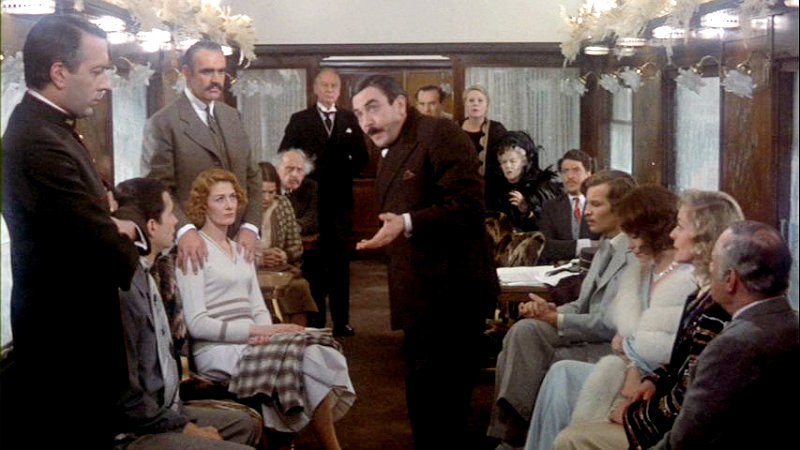
In the 1930s the British mystery writer Agatha Christie wrote The Mystery of the Blue Train and Murder on the Orient Express, two murder mysteries modelled on South Africa's luxury Blue Train and on the Orient Express.
The stories mix a thrilling killing with a puzzle to work out — the hunt for a missing jewel, say — and set it all in the exotic places these trains passed through. That gave train travel a legendary air, which is why its appeal has lasted.
Besides the Train Suite Shiki-shima and the Twilight Express Mizukaze added in Japan this year, at least 10 classic luxury train routes still run around the world: the Royal Scotsman, from London to the Scottish Highlands; the Pride of Africa, which crosses Africa; the Sierra Madre Express, which crosses Mexico's Copper Canyon; the Great South Pacific Express, from Sydney to Cairns; the Eastern & Oriental Express, opened in 1993 between Bangkok and Singapore; and the Blue Train that Agatha Christie turned into fiction.
"Private luxury trains let adventurous travellers explore and stay comfortable at the same time. The growth of train travel is also tied to the rise of slow travel. Exploring at ground level brings train passengers closer to the place they are visiting," said Andy Brain, founder of Railbookers, a travel agency that books train trips.
Annie Lucas, vice president of MIR Corporation, said: "New routes like the Silk Road and Persia are deeply mysterious to travellers. Because of the terrain or border restrictions, the train is the only way to explore them."
"There is a subtlety to train travel. On board you have lively staff, and the way they deal with guests creates a family feeling that matters a great deal. When a group of strangers travels together, we want to create a sense of joy and closeness," said Arnaud Champenois, senior vice president of marketing and brand at Belmond. He also thinks train travel builds the sense of community that a 24/7 society lacks.
Belmond has earned the right to speak on train travel. Its predecessor was Orient-Express Hotels Ltd. — the Orient Express group — which, besides running 48 hotels and luxury cruise ships in 23 countries, has luxury train routes as its other main business.
Its position differs from that of Japan's two new luxury trains and South Africa's Blue Train. The Train Suite Shiki-shima was developed by East Japan Railway Company and the Twilight Express Mizukaze by West Japan Railway Company, both of them products of the break-up and privatisation of Japan's state-run national railway. The Blue Train was developed and is operated by the rail freight arm of Spoornet, South Africa's state transport group. All three of those luxury routes have the state behind them. Belmond is private: when it was founded in 1976 it first bought the Belmond Hotel Cipriani in Venice, then bought two Orient Express carriages that had run in the 1920s and restored them.
Belmond's annual report for the 2016 financial year, published on April 21, says it now has seven trains, on routes spread mainly across Asia, Europe and South America.
After buying Las Casitas in Peru this May, Belmond launched South America's first luxury train route, the Belmond Andean Explorer. It starts at Cusco in south-eastern Peru and ends at Arequipa, one day and two nights later. Under a huge sky the train runs past an unbroken line of snow-capped mountains, through the Sacred Valley of the Incas, past the beautiful villages of the Andes, and finally reaches the ancient Inca city.
The other well-known luxury train operator is the 30-year-old Rovos Rail, which owns the Pride of Africa.
Rovos Rail was founded by Rohan Vos, a British-South African in the auto parts trade who loved steam trains. He bought his first old carriage at an auction held by a local club that preserves traditional trains.
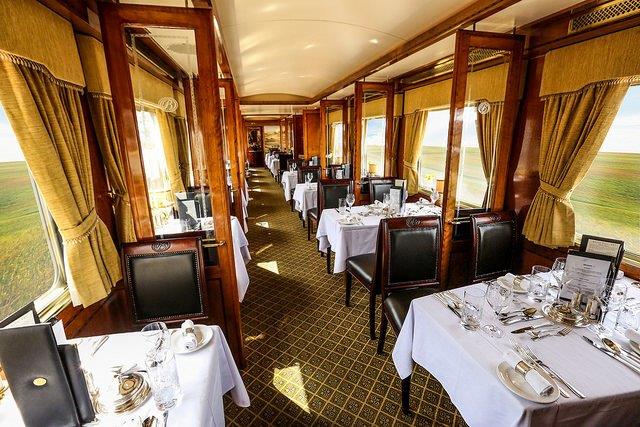
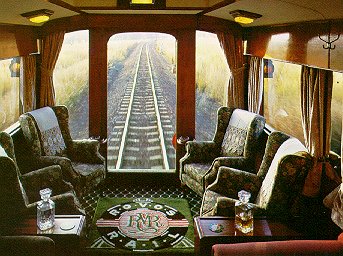
In 1986, in Nelspruit, Mpumalanga province, he found another old carriage about to be chopped up for firewood; it turned out to be an antique built in 1903. That gave him a business idea. The Pride of Africa is deliberately retro: every carriage is a restored and rebuilt old one, kept in the Victorian style. Its private station is Victorian too, with a platform designed to look like the 19th century, and trains that pull in slowly, breathing steam.
Working from a book called South African Railway Dining Cars, Rohan Vos combed scrapyards, private companies and clubs across the country for carriages famous in railway history.
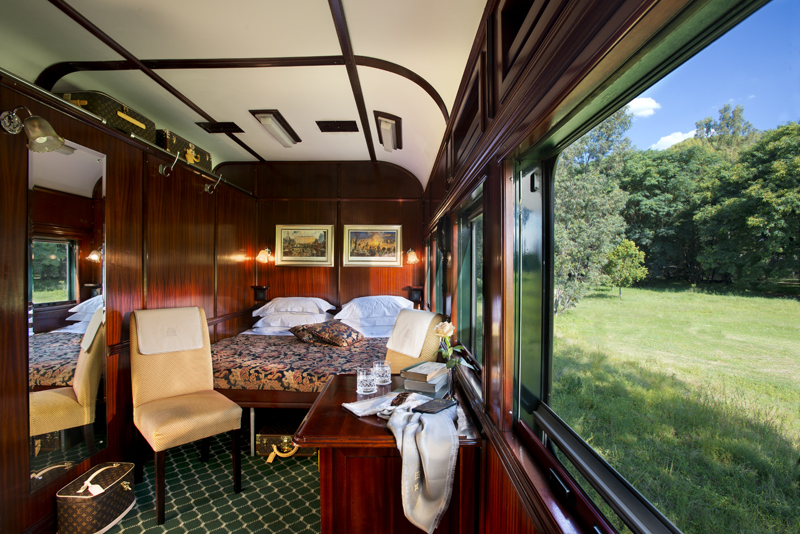
The Pride of Africa has ideas of its own; it did not simply copy other luxury trains. Rohan Vos is a tall man, so he wanted wide private space and comfort on board, and the Pride of Africa pushed the size of its private quarters to the limit. Its rooms are the largest on any luxury train in the world.
In 1989 Rohan Vos set up the private train company Rovos Rail, named after his initials, and made its first commercial run. By 2000 the company's staff had gathered 60 carriages. Over the next three years, one old carriage was refurbished every month.
One Pride of Africa itinerary takes 15 days, leaving Cape Town, South Africa, for Dar es Salaam, the capital of Tanzania. It passes Victoria Falls, Botswana, Zimbabwe and Zambia, and stops at several wildlife reserves that can only be reached by this train or by light aircraft.
In October, China will add a luxury train route of its own, developed by Golden Eagle, a company that does nothing but luxury trains. Golden Eagle flies you to Lhasa first and lets you see the city; the train then leaves Lhasa for Xining, Jiayuguan and Dunhuang, then Turpan, Kashgar and finally Urumqi. It will be the highest railway line in the world, at 16,640 feet.
Golden Eagle has already built one luxury route inside China, using its Shangri-La Express — from Beijing along the Silk Road to the Chinese border.
Cover and in-text images from: aceshowbiz.com, heriodistasviajeros.com, img.likejapan.com, bluetrain.co.za, theluxuryeditor.com, faresfairtravel.com, hackwriters.com, trainsafaris.com, rovos.com, South-african-hotels.com.




.jpg)
Translated from the original QDaily article. Original publication date retained.