

MP3 Reaches the End of the Line. A Technology Born for Telephones and Radio Ended Up Remaking the Music Industry | QDaily Business History
Its most important early backer was the European Union, an institution better known for its bureaucracy.
Its most important early backer was the European Union, an institution better known for its bureaucracy.
Do you still remember using MP3s to listen to music, to the radio, to study English?
Now this "old friend" is leaving us. In a sense.
The announcement came from MP3's inventor and patent holder, Germany's Fraunhofer Institute for Integrated Circuits (Fraunhofer IIS). The institute said in a statement that every MP3 patent had expired as of April 16, 2017, that it had ended patent licensing for MP3-related software, and that it now recommends the public switch to formats that are more efficient and sound better.
The move was read as a sign that MP3 technology is dead.
That does not mean MP3 has ceased to exist — you can still download and play MP3 files. What changed is that some MP3 software development used to require patent fees, and now it is a fully open-source project. It may keep evolving, or other technologies may simply retire it. A good share of internet services have already dropped MP3.
In other words, MP3 will not vanish any time soon. This invention from the 1980s is still the most widely used audio format in the world. Even so, its inventors have made their position plain: MP3 is outdated, and it ought to be retired.
From vinyl records to cassettes to CDs and then to digital music, every technical shift has changed how people experience music, and how the public consumes it.
MP3's role in that history was unlike anything before it. Fully open, it changed the shape of the music market. The whole industry's way of doing business was turned upside down, and the power that once belonged to record labels passed to the tech companies holding the technology and the digital channels.
MP3 has also been fiercely contested. Its admirers see it as a kind of democratic movement, putting music within everyone's quick and easy reach. Its opponents see a monster that devoured the copyright the music business lived on, and the record industry's golden age with it.
Counting from Thomas Edison's phonograph, humans have been recording, hearing and transmitting sound for nearly 140 years. But the enormous change MP3 brought took place only in the last 20.
And it was in those 20 years, beginning with the MP3 format, that the music industry was rebuilt from the ground up and music became a mass-market product within everyone's reach.
The original idea behind MP3 had nothing to do with music

In the early 1970s, Dieter Seitzer, a professor at the University of Erlangen-Nuremberg in Germany, was bothered by how poor voices sounded over telephone lines, and set out to improve the signal. His first patent for audio coding was rejected. The research went on anyway.
By the late 1970s, fiber-optic cable had transformed sound quality in telecommunications, and better voice coding no longer looked so necessary. Seitzer turned his research to music signals instead.
In 1979 Seitzer built the first digital signal processor that could compress audio. His student Karlheinz Brandenburg, then 25, began applying psychoacoustics to the scheme: throw away the parts of the audio data that human hearing pays no attention to, so the brain registers no real loss. The value of the approach was the balance it struck between file size and sound quality.
Brandenburg later became known as "the father of MP3," a title he says he "doesn't like", since the finished MP3 was the work of a whole team.
By Brandenburg's own account, his research only made real progress in 1986, when computers finally became powerful enough to help him refine the algorithm.
In 1987 the European Union's EUREKA program agreed to fund the project, code-named EU147, under Professor Heinz Gerhäuser of Fraunhofer IIS. Counting him and Brandenburg, the research group had eight members.
The project's original goal was a workable compression scheme for the broadcast industry. Nobody imagined the result would change music.
The official name arrived in 1988, the year an international body called MPEG (Moving Picture Experts Group) was founded to set audio and video compression and coding standards for broadcasting. Working through different stages and models, Fraunhofer IIS published the MPEG-1 Audio Layer 1, MPEG-1 Audio Layer 2 and MPEG-1 Audio Layer 3 standards before 1994 — MP1, MP2 and MP3. In the end MP3 could encode music down to 10% of its original size with no audible drop against the uncompressed original.
Nothing like it had been done before. A single CD at the time held little more than a dozen songs; the compression meant the same disc could now hold more than a hundred.
July 14, 1995 is MP3's real birthday, the day Fraunhofer IIS settled on ".mp3" as the file extension. You know the rest. Music compressed and stored in the format became MP3 music, and software that played it became an MP3 player.
MP3 licensing, though, was a mess from the start. In September 1998 Fraunhofer IIS wrote to several MP3 software developers to say that "distributing or selling an encoder or decoder" required a license.
The patent question slowed MP3 software development for a time, and some developers built rival compression schemes. At the user end, though, nobody cared about the arguments; people went on choosing the format that was convenient.
Fraunhofer IIS was not the only holder of MP3 patents. Other companies and institutions held separate patents they said the codec required, and not all of them charged for a license. MP3's rights grew scattered and tangled, and in practice the format had long been all but free.
MP3's patent situation is still complicated even now, but the expirations have ended all of it. MP3 is in the public domain.
Messier than the fight over patents was the copyright war MP3 set off.
The balance of power in music starts to shift

Before the 1990s, the medium that ruled how people heard music kept changing.
- The 1960s: the record player. A round turntable spun a large disc — nothing you could carry.
- The 1970s: the 8-track tape, forerunner of the cassette, and the first step toward portable audio.
- The 1980s: the cassette, smaller and longer-playing. Sony later brought out the smaller MD.
- The 1990s: the CD, which played music non-linearly — no rewinding or fast-forwarding, you could jump straight to the next track.
What these tools had in common was that the power to make and distribute music sat with the record industry. Cassette or CD, the labels handled recording, distribution and sales, and kept the profits that came with them.
MP3 showed a frightening ability to spread on its own. The files were small and easy to copy and pass around. More important, a player on your computer was all you needed to decode and listen.
MP3 music spread like a virus, and it started with a music site called Napster, founded in June 1999 by Sean Parker, a 20-year-old college student, and two others his own age. (Parker later became a Facebook investor and its first president.)

Napster was a P2P site — peer-to-peer sharing. A user searched for a song title and Napster pulled the MP3 down from someone else's private computer. The "torrents" you know today work the same way.
From then on people could download and share albums and songs online for nothing, and within a year Napster had more than 10 million users.
Free music hit the physical record business hard. At the end of 1999 the Recording Industry Association of America (RIAA) sued Napster, demanding $100,000 for every pirated song. Napster's servers held more than 200,000 songs at the time, which put the bill at $20 billion.
The case ran nearly two years. In 2001 Napster was ordered to shut down its P2P service, then won the right to keep operating on appeal. By then it claimed to have built technology that blocked 99.4% of infringing file sharing.
In September 2001 Napster settled with the RIAA. Damages came down to $26 million, on top of $10 million in licensing fees it still owed. To pay, Napster had to turn itself into a paid subscription service, and users did not follow. In 2008 Best Buy bought it for $121 million.
Napster vanished; the digitization of music did not stop. MP3 became a common music format, the technology kept improving, and smaller, lighter MP3 players appeared. The physical record industry's best years ended there.
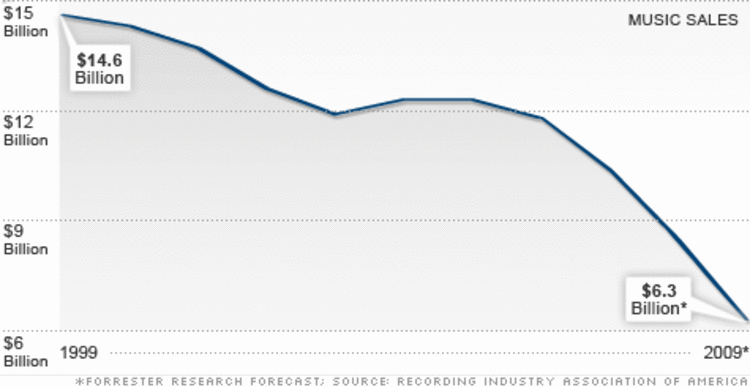
Global CD sales grew for 17 straight years after 1983, peaking at 2.45 billion discs in 2000, then slid and never recovered. By 2009 the U.S. music industry had shrunk from $14.6 billion in 1999 to $6.3 billion.
The iPod arrives, music sites spread, and tech companies replace the labels as the link between musicians and listeners
The other thing that carried MP3 music into the mainstream was the player.
Into the early 2000s the computer was still the main tool for playing MP3s. Samsung was the first to think of a portable one. The story that gets told is that in 1997 a Samsung manager, on a flight, watched a passenger use an MD player and came away with the idea of a portable MP3 device.
But Asia was in the middle of its financial crisis, Samsung was under siege and reorganizing, and no one had time for a new idea. The manager was eventually laid off, and he took his proposal to Saehan, a company spun out of Samsung.
In 1998 Saehan released a player called the MPMan. It played MP3 files downloaded from a computer, was no bigger than a floppy disk, stored music on flash memory and weighed 65 grams. Unlike a CD Walkman it had no moving parts, so it was steadier and took a knock better, and it read and wrote songs faster.

The American manufacturer Diamond soon released one of its own. The RIAA, which would later sue Napster, tangled with Diamond too. Diamond won.
None of them could withstand Apple's barrage. In 2001 Apple released the first iPod, with a screen of just 160x128 pixels and 5GB of storage. The story goes that the iPod came out of a line Steve Jobs used to win over his daughter Lisa: "I'll put a thousand songs in your pocket, because I can't stand that ugly Walkman."
That is only a scene from a movie. The man actually responsible for the thousand songs was Tony Fadell. Jobs had just built the first iTunes by buying SoundJam, and he wanted Apple to design a music player to go with the iTunes Store, one that made listening simple.

That was the iPod's biggest change: Apple used legitimate, licensed music on iTunes to talk record companies into licensing their digital rights, and then took a cut of the proceeds.
It was a complete, closed system. iPod owners could buy and download music only from the iTunes Store, at $0.99 a song (three price tiers from 2009), and the files were encrypted so they could not be copied or passed on.
The labels signed with Apple and took 70% of the revenue from music sales. It looked like a good deal — no more free piracy to worry about.
But the labels mattered less and less, while Apple, a tech company, became the largest distributor of digital music in the world. By February 2010 the iTunes Store had sold 10 billion songs, more than 70% of online music sales worldwide.
The iPod brought in far more than music revenue; most of the money came from the hardware itself. The record industry got none of it.
In 2003 the third-generation iPod and a Windows version of iTunes made the device take off. By January 2004 the iPod was the most popular digital music player in the United States, with more than half the market. By October 2004 it had all but taken over: 92% of MP3 player sales in the U.S. were Apple's.
iPod owners never saw the music files themselves, but the ease of the MP3 format was the single biggest reason the iPod became a hit. Sony, which had ruled music players for more than 20 years, brought out a digital product of its own around then, the Network Walkman. To stay clear of piracy fights, Sony's digital Walkman supported only a format called ATRAC3. Every time users wanted to load a song, they had to run it through a Sony-only application that converted the MP3 into that strange format.

The openness, friendliness and convenience MP3 stood for turned out to be the winning combination. The iPod, which benefited from it, found a balance among the labels, its users and itself.
The Chinese market of the same years found no such balance.
The iTunes Store never opened in China. Through the 2000s the name most closely tied to "downloading music" there was Baidu.
In 2004, ahead of its IPO, Baidu launched an MP3 search service. Type in a song title and you got a streaming preview and a download; Baidu itself had no rights from any label — exactly like Napster.
In the copyright suits that followed, the courts ruled for Baidu every time. Baidu's MP3 search then climbed steadily in China, at one point reaching 92.8% of the Chinese-language music search market.
But as far as MP3's spread went, China was not so different from the United States. Like Napster, Baidu carried MP3 across the country, moving music off cassettes and CDs and into a format far easier to get hold of.
MP3 files pulled from Baidu and sites like it went onto music players made in Guangdong, or onto iPods. Apple never brought the iTunes Music Store to China, but the iPod arrived early.
The public took up a more convenient music format, and that changed how the whole industry worked. Tech companies like Apple held the channels and the distribution; the role the labels once played was taken over, and they slid to the margins.
The industry's profits were now shared with tech companies, and the labels had little leverage. Unhappy that Apple split the revenue from online music content but not from iPod sales, Universal Music once broke off its partnership with Apple and went to Microsoft instead. Even giving up a slice of profit, though, would not have changed the fact that Apple had replaced the labels as the link between artists and listeners.
Artists, meanwhile, drew closer to the tech companies. After the iPod appeared, Bob Dylan's work with Apple still ran through a record label: Apple had him shoot a commercial and put out a boxed Dylan collection on the iTunes Store with more than 700 songs, then worked with his label to open up a younger audience for him. His album sales afterward "reached a level not seen since the Ford administration."
Apple Music's recent work with artists, by contrast, is simply about selling digital albums. The commercial in which Taylor Swift takes a fall drove sales of Drake's Jumpman on iTunes up fourfold. Swift's relationship with Apple Music grew warmer from there, and she put her "1989" tour film on the service as well.
Like every cultural product that mass distribution makes popular, music went from a relatively small thing to cheap mass consumption, and then tilted toward entertainment. As with the street tabloids of the 19th century, music itself grew more formulaic — the interchangeable, sticky hits that, without MP3, would probably never have traveled so far.
All of it followed from MP3 being open, easy and friendly. It is no exaggeration to say that MP3 is what let tech companies into the music industry for good.
Digital music has stayed, but the file format no longer matters
By now new ways of competing in music have appeared.
Spotify went live in 2008 as a licensed streaming service. It started a new subscription model: pay $9.99 a month, or listen free with ads. Either way Spotify earned money, which it used to buy rights from the labels.
This year Spotify said its paying subscribers had passed 50 million, up 25% from six months earlier.
Apple joined the streaming fight too, launching its Apple Music subscription in 2015; by the end of last year it had more than 20 million users.
China's tangled digital music rights were also sorted out by competition among the big companies. In 2015 the National Copyright Administration issued a directive, after which no online music could be listed without a license. Tencent, Alibaba, Baidu and NetEase each went out to line up content partners.
Free pirated music faded, and people began paying for music online. According to figures from iResearch, China's paid online music market was worth 1.05 billion yuan in 2015, up 121.8% from the year before.
Downloading an MP3 and loading it onto a player to enjoy is long past. Most people now listen on their phones.
The music file does get cached on the phone along the way. But it is close to invisible — you don't have to find it and click it to listen, and what format it is in no longer matters.
Even where the format still matters — television, radio, video sites — MP3 is old and dated. AAC (Advanced Audio Coding) saves more bandwidth and data, which means lower costs.
Apple's iTunes Store pushed AAC from the beginning. As a rule, AAC delivers better sound than MP3 in a file 30% smaller.
Most iTunes users probably could not tell you whether what they are listening to is an MP3.
Even so, MP3 remains the most widely used and most compatible audio format in the world. And it seems to be having a small revival: beyond music, there are audiobooks, podcasts, the audio behind paid knowledge products. The new sound content still travels on MP3's legacy.
Thirty years ago, Karlheinz Brandenburg did not foresee any of this: "Our dream was an electronic broadcast with a million users and listeners, but today billions of machines are using this format, far beyond what we dreamed of back then."
Cover image from Pixabay
Translated from the original QDaily article. Original publication date retained.