

Ikea Could Barely Dent Japan's Furniture Market. How Did a Company Called NITORI Take It? | Market Inventors
It's not just about low prices.
It's not just about low prices.
"Too abnormal."
That's how Japanese media described the record of the furniture brand NITORI: 30 straight years of growth in both sales and profit since fiscal 1987 — all the more striking given how much Japan's economy lurched up and down over that stretch.
Japan's largest furniture brand drew fresh attention on June 9, when it announced a recall of about 10,000 dining cabinets whose glass panels could come loose and injure someone. Since recruiting a Honda quality-control executive in 2004, NITORI has cut its defect rate from 3.3% to 0.7%, and the recall barely registered in its results. What the media discussed more was what the incident brought back into view: a startling growth curve and an equally startling share price.
In fiscal 2016, which ended February 20, NITORI's sales reached 512.9 billion yen (about US$4.6 billion) — nearly seven times Ikea Japan's. Since January the stock has risen 21%, four times its level at the end of 2012. That confidence from investors has made NITORI, with 488 stores, the third most valuable retailer in Japan, behind Seven & I Holdings, parent of the 7-Eleven convenience chain, and Fast Retailing, parent of Uniqlo.


"Only a Wholesale Price Counts as Cheap" — Yet NITORI's Margin Is Far Above the Industry Average
"Beyond the price, NITORI" — that's the company's slogan, and cheapness is exactly how NITORI took the market.
Take the legged mattress popular with young Japanese living alone. Shipping included, NITORI sells it for 19,900 yen. Muji sells a similar model for 31,000 yen, and that price doesn't include the legs, which cost another 1,800 yen, plus 540 yen for shipping. For a comparable bed, in other words, NITORI can come in 13,440 yen (about 874 yuan) below Muji.

Like Aeon and Ito-Yokado, the chain retailers best known for selling cheap goods, NITORI was born out of the "distribution revolution" of the 1960s — the name for a then-new way of selling that broke with Japan's traditional wholesale system. That was also just when Japan's economy entered its period of high-speed growth.
In 1967, fresh out of university, Akio Nitori borrowed 1 million yen from his parents and opened a furniture shop of just over 100 square meters in his hometown, Sapporo, in Hokkaido. Looking for room to grow, he moved the shop four years later to a spot near a national highway in Sapporo and expanded it to 825 square meters. But competitors soon clustered along the same highway, and his furniture business fell into the worst crisis it had faced.
The turning point came in 1972, on a research trip to the American department store Sears. Nitori was struck by how uniform the design was across every piece of furniture in the showroom, but what shocked him more was the price: a third of what the same thing cost in Japan. From then on he chased low prices.
"Only a price as low as what you'd charge a wholesaler counts as cheap." That was the decision Nitori made.

NITORI began hunting for contract furniture factories across Japan, but Japanese labor was expensive and the company soon hit the limit of what it could cut. So it turned to China and Southeast Asia. That search did not go smoothly: humidity in Southeast Asian countries is high, and plenty of furniture warped by the time it reached Japan. The processing skills of foreign workers also lagged behind the fine craftsmanship of Japanese artisans.
To bring the defect rate down, NITORI later built wholly owned plants in Indonesia and Vietnam, where quality is easier to control, while keeping the contract-manufacturing system in Thailand, Malaysia, China and India. Today everything NITORI makes is shipped first to overseas logistics centers in Shanghai and Huizhou, in Guangdong province, then on to logistics centers around Japan, and finally allocated and shipped out according to what each store actually needs.
This SPA model — products, manufacturing, logistics and retail all under one roof — gives NITORI a 16% profit margin, far above the 5% average in Japan's furniture industry.
Beyond manufacturing costs, NITORI has squeezed logistics costs wherever it can. In March 2016 it unveiled Auto Store, a robotic warehouse in Kawasaki, Kanagawa Prefecture. The warehouse is divided into a grid of compartments, and robots drop goods in or pull them out from above at fixed points. Dedicated to the online store, it ships 3.75 times faster than an ordinary warehouse and does away with 40% of the wasted floor space.
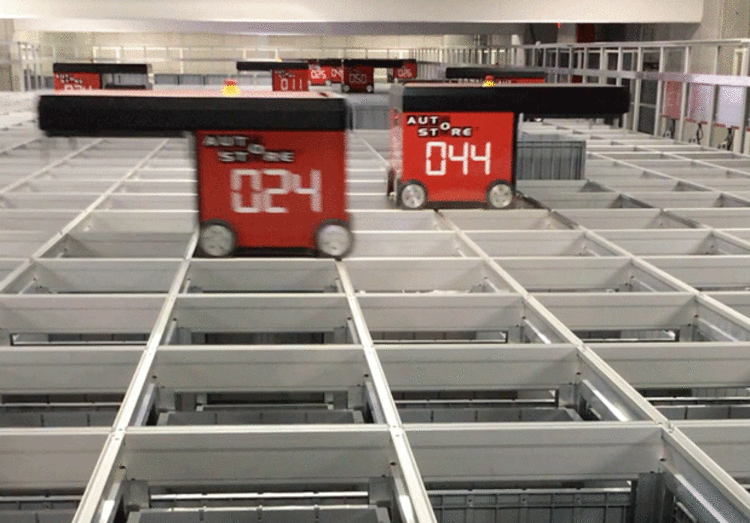
NITORI has also brought in BOX ON DEMAND, a corrugated-cardboard machine that cuts packaging to fit each product, saving another 30-60%. In fiscal 2015, selling and general administrative expenses ate up 37.2% of sales; in the first quarter of the next fiscal year, March to May 2016, that figure dropped to 34.6%.
Ikea Is Just as Cheap. Why Couldn't It Shake NITORI After Entering Japan?
On price, Ikea is a formidable competitor. It first entered Japan back in 1974. But its cheap, self-assembly furniture won little acceptance in the Japanese market at the time, and a joint venture with Tokyu Department Store, Yukawa Furniture and Mitsui & Co. left Ikea with little say in the business. In 1986 it announced its withdrawal from Japan.
In 2002 Ikea set up a Japanese entity, Ikea Japan, and in 2006 opened its first store in Funabashi, Chiba Prefecture, on the outskirts of Tokyo — the marker of its return.

Look only at product prices and Ikea and NITORI are much the same. But Hiroshi Saito, 31, told QDaily that Ikea's delivery fees are too high. Since April 2017, Ikea Japan has run a promotion with a flat delivery fee of 3,990 yen (about 259 yuan) for online orders and 3,000 yen (about 195 yuan) for in-store purchases. NITORI delivers free. Saito also finds Ikea too far away.
When NITORI pushed out of Hokkaido into the national market in the 1990s, it did so on exactly the strength of suburban stores — outlets of 4,950 to 6,600 square meters, plus smaller neighborhood shops of 1,980 to 3,300 square meters.
Things have changed since. Car ownership among households in central Tokyo has fallen to 47.7%, while the numbers of single people and dual-income households keep rising. People living in the city no longer drive out to a suburban store on the weekend to pick furniture the way they once did. So NITORI has started opening inside department stores downtown, where transport is easy and foot traffic is heavy.
In April 2015 NITORI opened its first department-store outlet in what was then Printemps Ginza (now MARRONNIER GATE Ginza). Stores in Ueno Marui and Shinjuku Takashimaya followed in October and December 2016. In 2017 it has kept expanding fast into central Tokyo department stores, moving into Ikebukuro Tobu and atré Meguro; on June 30, its largest store in central Tokyo, in Shibuya's Shidax building, is due to open.

Since NITORI arrived at Ikebukuro Tobu, Cheng Yun, a Chinese student living in Ikebukuro, has gone there often to hunt for odds and ends. "I've bought bedding, rugs and slippers there. And if you buy enough, they'll deliver it to your door for free."
Ikea, by comparison, now has nine stores in Japan, most of them in the suburbs. Its second entry clearly came too late: NITORI had already planted its feet through two downturns, the collapse of the bubble economy and the Lehman crisis.
"Seizing Opportunities in Hard Times Is the Key to Growth"
Through the 1970s and '80s, NITORI was only feeling its way toward the SPA model. It was the whole of the 1990s, when Japan's bubble burst, that proved decisive for its cheap, rapid expansion across the country. "Seizing opportunities in hard times is the key to growth," Nitori said in one interview.
NITORI began expanding nationally on its suburban-store model in 1993, and built its own logistics network to keep up. Since more than a third of sales came from the Kanto region, it put up large logistics warehouses there in 1995 and 2002. In the same period it shipped furniture-making machinery developed in Japan to its overseas plants and tightened quality control, pulling the customer-complaint rate down from 6-7% to 2-3%.
Over the four years from 2008 to 2012, which spanned the Lehman crisis, NITORI cut prices 12 times, keeping customers coming with the slogan "more than worth the price." Japan's economy then sank into a long slump. Akira Iwasaki, an analyst at Iwai Cosmo Securities, said NITORI aims mainly at households earning 4 million to 5 million yen a year: "Average household income in Japan has been trending down, so that choice of target customer is just about right."
NITORI's flexible pricing system is how it has come through such different economic cycles. In an interview with Bloomberg, Nitori said the company replaces 50% of the merchandise in its stores every year, while sorting products into two groups — those ready for a price cut and those that need better performance first — so that "creating a gap between the two" pulls customers in to shop.
It Reads Demand on Price. It Also Reads Shifts in What People Want to Buy
NITORI has led the way in Japanese furniture and home life. In the 1970s, Japanese still slept on tatami in the traditional style, and Japanese-style wardrobes were a fixture in every furniture store. But after his trip to Sears, Nitori sensed that Japanese life would gradually turn Western. He cut back on Japanese-style wardrobes and started trying to sell Western furniture on legs — a bold decision in Japan at the time.
He also saw that the company couldn't sell furniture alone. Like American furniture brands, it should sell curtains, rugs, bedding and other home goods too — a complete way of living at home. In 1988, furniture accounted for about 70% of NITORI's sales; that share is now down to around 44%.
The department-store outlets it has opened downtown in recent years answer new demand as well. Those stores carry fewer cheap goods and lean toward mid-priced housewares. The Printemps Ginza store, aimed at women aged 20 to 39, offers young women samples of the latest ways to put an interior together. The Shinjuku Takashimaya store sits in a prime location, and NITORI hopes it can become a place where office workers grab housewares on their way home.

In March 2017 NITORI launched a new format, NITORI EXPRESS. Besides bedding and housewares, it takes custom curtain orders and orders for furniture its large stores don't stock. NITORI EXPRESS has become a new tool for filling the gaps the big stores leave and pushing into the city.
Opening downtown has brought problems of its own. City-center stores hold less stock, and because they are positioned differently — some lean toward housewares, others mainly sell large furniture — NITORI struggles to draw on several stores' inventory at once and ship to a customer together. To fix that, it has decided to break ground in 2018 on a new logistics center in Saitama Prefecture, meant to lift the low logistics efficiency of its city stores.
NITORI keeps adding brands. In 2016 it launched the cheaper DAY Value line; the price gap between NITORI and DAY Value is roughly that between Uniqlo and GU. In the DAY Value showroom, 21 pieces — sofas, dining tables, cabinets and more — were displayed for less than 350,000 yen (about 22,750 yuan) in total, an average of 19,000 yen (about 1,235 yuan) each. The other feature of DAY Value is that the design and colors are unified across everything, from the living room to the bedroom to kitchen odds and ends. The idea is to let a customer furnish a whole matching home without spending much.
NITORI has a problem: the number of items each customer buys has stopped growing. DAY Value is meant to keep widening the cheap end of the range to pull more people in. To make its existing core customers want to buy more, NITORI plans to launch a brand called & Style in the fall of 2017, positioned for a "grown-up, stylish feel." It will sit at mid-range prices and stress better quality, and NITORI hopes it will lift the average spend per customer.

"Japan has been through long deflation, and it will take time for people to shift out of a deflationary mindset," Bank of Japan Governor Haruhiko Kuroda said at a meeting the other day.
Overseas Expansion — but Taking On Ikea in China Won't Be So Easy
"Rather than call it a miracle, I'd say I'm full of feeling about it. If possible, I'd like to keep raising revenue and profit for 50 years, 60 years, forever," Nitori said. To keep the profits coming, NITORI turned to markets abroad. After Taiwan and the United States, it opened its first mainland China store in Wuhan in 2014, with a plan for 100 stores in mainland China by 2020.
Given that NITORI has only seven stores in China today, that plan counts as ambitious. But every problem Ikea ran into against NITORI in Japan is a problem NITORI now runs into against Ikea in China. China's furniture market is highly fragmented and Ikea's share is under 2%, yet Ikea remains, for now, the furniture brand with the strongest pull among young Chinese consumers.
NITORI's problem is that not enough people can tell it apart. Next to Ikea's Scandinavian look and Muji's Japanese minimalism, NITORI's stores in China look more like a big discount general store selling cheap furniture. As Chinese consumers trade up, cheapness without a way of life behind it may not pull as hard.
Worse, NITORI doesn't seem to have sorted out even the basics. It has no single international name: in the United States it is aki-home, in Taiwan it is known as Yideli, and in China it goes by more names still — NITORI, Nidali or Siniao, take your pick. Open NITORI China's official website and the friendly notice reads: "The official website is being redesigned, please stay tuned. We apologize for the inconvenience this brings you."
"What he does isn't a sexy business, but he knows how to make money." That's how Hitotsubashi University professor Ken Kusunoki once described founder Akio Nitori — who by now must know that outside Japan the money doesn't come so easily.
And Nitori has a bigger goal still: 3,000 stores worldwide by 2032.
Cover image from Wikipedia
Graphics by Feng Xiuxia
Translated from the original QDaily article. Original publication date retained.