

“We did it step by step, on our own — from the shikumen, to the new public housing, to the big apartment we have now” | Housing and Our Lives ①
Housing is the largest commodity a person can consume, and it is also a witness to the changes in an individual life. QDaily is running a series of reports that take housing as their thread, to look at what happened in the years behind us.
Housing is the largest commodity a person can consume, and it is also one of the witnesses to the changes in an individual life. QDaily is running a series of reports that take housing as their thread, to look at what happened in the years behind us.
It is time to sum up a stretch of history.
Most of our readers lived only through the tail end of it. Most of the story was written by the generation before us.
What we want to pass on is the part of it most worth keeping: the belief in progress and development; the conviction that society will keep giving individuals better and bigger room; that effort earns its due reward; that freedom can be fought for, and that we will get there in the end.
These are, in fact, universal values.
When a word like “history” is set in front of us, it tends to get buried under grand narrative. We hope to sort out what we can, through interviews pitched at a smaller scale.
We are starting this record with the thing that draws the most attention in a person's life: housing.

Zhang Zhijian, who grew up in Shanghai's Hongkou District, is 57 this year. He has worked at a Japanese company in Shanghai for 22 years and now heads its R&D design center. Most of his peers have already retired.
The place where Zhang Zhijian grew up is now called the North Bund. Ten minutes on foot is Waibaidu Bridge; cross that landmark and you reach the even more famous Bund. Closer still is 1933 Old Millfun, a well-known Shanghai building — a slaughterhouse put up in 1933 by the British designer Balfours.
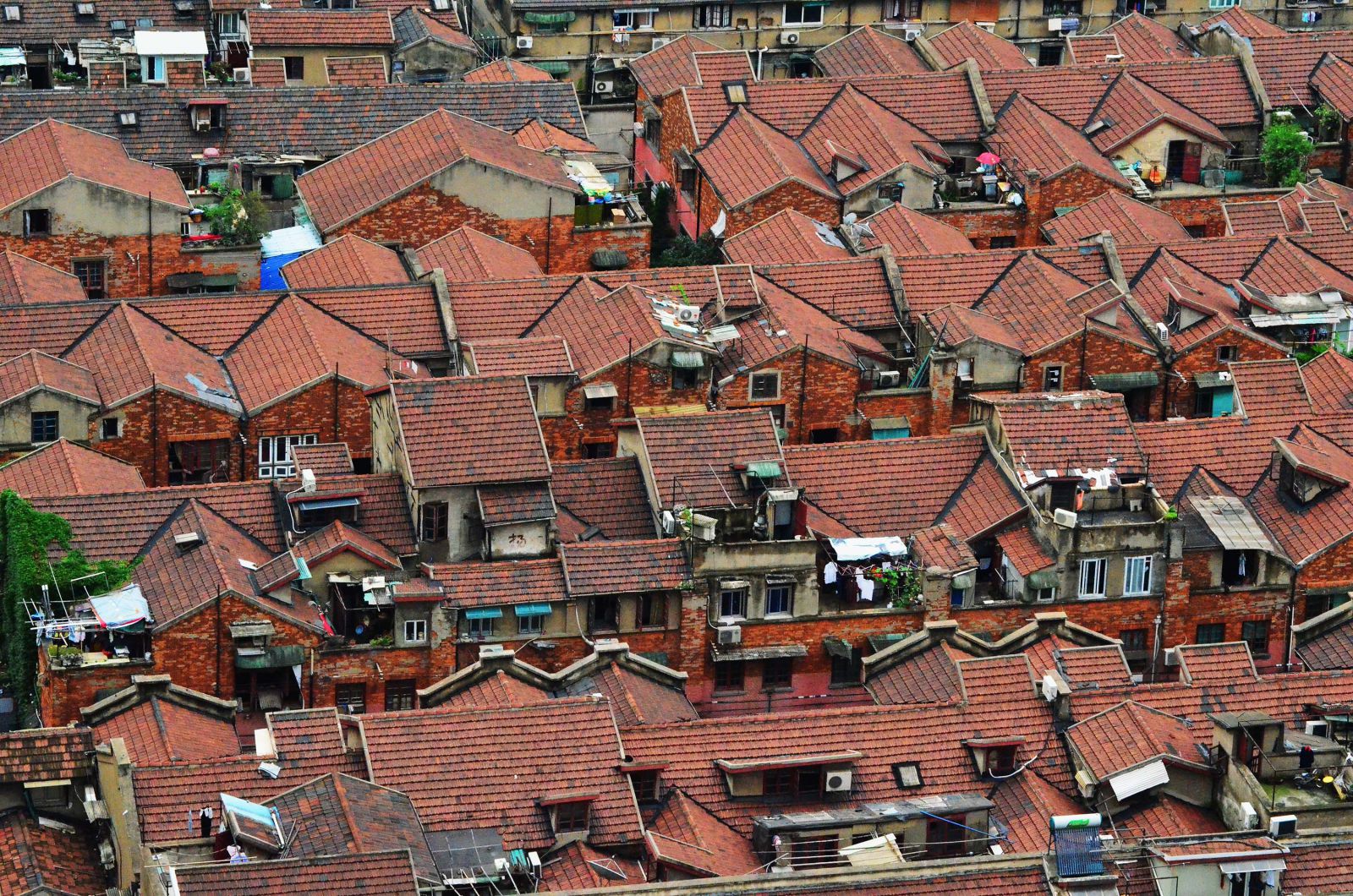
Zhang Zhijian grew up nearby, in a shikumen lane called Chunyangli, first built in the 1920s and now on Shanghai's register of protected historic buildings. The residents who still live there share a kitchen and empty chamber pots every morning. The place is “filthy, filthy, and falling apart,” in the words of Zhang Zhijian's wife, Yuan Wenjun.
Recently, more than 1,000 households in Chunyangli signed agreements with the government for a plan to rebuild the lane in place.
That is hard to call good news.
Many people had long since moved as many household registrations into the lane as they could, waiting for the day of demolition so they could get a share of the payout. Rebuilding in place left them disappointed.
Zhang Zhijian's family history in this place goes back to his grandmother. In the early 1950s, Shanghai, one of China's largest industrial cities, badly needed factory workers, and that was when his grandmother moved there from Ningbo.
His parents were later transferred out of Shanghai to Yixing, in Jiangsu, to support the building up of the interior, doing technical work at a newly built chemical machinery plant. As the first child of a family that had “gone inland,” Zhang Zhijian was allowed to keep his household registration in Shanghai.

After he was born, Zhang Zhijian lived with his grandmother in this shikumen house the whole time. He even got married in that room, all 20 square meters of it. He was a technician at the Shanghai Optical Instrument Factory then.
His life changed after he moved out. He was among the first people in Shanghai to buy a commercial apartment. China rolled out its commercial-housing policy in the 1980s, and after five years on the job Zhang Zhijian bought his first apartment, 80 square meters, in Pudong.
That apartment opened up a distance between him and the friends he grew up with.
Part of the reason things went this way for him is that he was in the first class of undergraduates after China restored the national college entrance exam. “Getting into college back then was a big deal. A lot of the big bosses today are from that class — they actually have real ability,” his wife said.
In 1995, as China was using tax breaks to draw in foreign investment, Zhang Zhijian was again among the first to join a foreign-invested company in Shanghai.
We did the interview at a casual restaurant on Dongfang Road, not far from where he lives now — a new 130-square-meter apartment, home these days to just the two of them. Their daughter is studying in California and hopes to stay and work there after she graduates.
Zhang Zhijian was joined by his wife, Yuan Wenjun, who was once chief accountant at a Japanese-invested company in Shanghai.
We recorded our conversation with them in their own words:
Zhang = Zhang Zhijian, born 1960
Yuan = Yuan Wenjun, born 1962
“Chunyangli”: “There Are All Kinds of People in This World”
Zhang: The old house most typical of Shanghai is the shikumen — I used to live with my grandmother in a shikumen in Hongkou District. Have you been to Xintiandi? Xintiandi is a rebuilt shikumen district. It was all put up new, of course, but the shape of the houses is shikumen. Xintiandi is near Huaihai Road and the old French Concession, a bit different from ours in Hongkou, but broadly the same thing.
I was born here and lived here until I started a family of my own. I graduated from college in 1982 and was assigned to a state-owned unit called the Shanghai Optical Instrument Factory — a big one, more than 3,600 people. I had to wait for the unit to allocate me housing, and that could take a long time. I couldn't wait for an apartment before getting married, so we married in the old house.
The old house wasn't big either, a bit over 20 square meters. In our day you had to have somewhere to live in order to marry, and most people had their own place. The kitchen was shared — you put a stove in there, and there was a sink for washing vegetables. In shikumen terms ours was a wing room, at the far end of the second floor. No gas, no bathroom.
Yuan: It was filthy in there.
The old house isn't safe anymore — the wiring, the pipes. They put gas in at the stairwell 20 years ago; there's still no bathroom. The place is called Chunyangli, in Hongkou District, inside a designated historic conservation zone, and it has just been rebuilt. We signed the agreement last week — rebuilding in place, with private gas and a bathroom thrown in. They're driving piles now.

Zhang: Shanghai used to have a lot of very run-down old housing — what we call shantytowns. Every city has them; up north they run block after block, very crude. There aren't many left now. In Shanghai it all came down to municipal construction: a subway line gets planned and the area is certain to be cleared, or a site happens to sit in a commercial district and a developer pays to buy the land.
We're a bit more than one stop from the Sichuan North Road shopping street. Sichuan North Road is being developed, but the demolition hasn't reached us — we fall under the North Bund comprehensive redevelopment. The North Bund is about half done; the South Bund is about two-thirds done. Eventually the whole Bund will join up. We're on the outer edge, not the most central spot, so there's no commercial project and no municipal relocation here, and the buildings aren't classified as dangerous or dilapidated either.
Our Chunyangli neighborhood has around 1,000-odd households, and a great many household registrations are packed into them. Clearing it would cost a lot. Plenty of young people bought apartments and moved out but kept their registration here.
Yuan: Just waiting for demolition.
These days you don't have to move your registration into a commercial apartment, so people leave the old ones where they are. We did too. It's our daughter Zhang Wenqin and the two of us, and later we moved my parents' registration in as well.
It was all about waiting for demolition — compensation is worked out by headcount, registrations and the original floor area. But this time there was no demolition, only rebuilding in place. Maybe it couldn't be torn down; no developer thought it was worth the money. We moved out long ago and have somewhere to live, so it doesn't matter much to us. But some households are complicated — brothers and sisters all waiting on the payout — and they were very disappointed.
Zhang: A lot of the people living there are getting on in years and don't have many other chances. They were counting on the demolition of the old houses to turn their lives around. This rebuilding takes that away. They won't get their shot at a payout.

Our neighbors next door used to be an elderly couple, and we got on well. Then in 1992 their child's work unit allocated them housing — they had a lot of people registered there, so the unit helped them out — and they moved somewhere farther away, but it was a new public-housing apartment. Their room went to a household in worse straits, and a young family moved in. On paper it was just three of them, but they were impossible people.
Yuan: They had a hard life, a really hard life. They fought over every shared space. They'd set down some useless object — nibbling away at it — and our space kept shrinking. They took over the stairs going up and down. Nobody got along. They claimed all the shared space, the rooftop terrace, everything.
Going up from our second floor is the stairway to the rooftop terrace, and every bit of it was covered with their things. Mops, brooms, stools from that apartment, all dumped there. They were fiercer than us — they put their things out there and wouldn't let us hang laundry. Truly impossible.
Now we rent that old room to a young man. With no private bathroom and no gas, it's cheap, 1,200 yuan a month, and he can stay on after the rebuilding. That's exactly why we rent it so cheap: we don't want trouble. When our tenant first came, that neighbor said he had to look him over first — if three or four people were going to move in and affect him, he wouldn't have it. Whenever we brought someone to view the place, they'd try to run them off. So we picked someone simple and rented it to one young man.
They're just impossible people.

Zhang: In an old shikumen the kitchen is shared, and it's tiny. Up our stairs, halfway to the second floor, there's a small landing, a bit over one square meter, where two households cook.
That kitchen has a bigger end and a smaller end. When the old neighbors were still there, we just put a coal stove down; there was no line drawn. We were on the small side, they were on the big side. After the new family moved in they kept the big side, and their things spilled onto our side too, though our space was already small. In the end we drew a line and laid a low course of brick down the middle, and they still pushed over it, squeezing us into something tighter and smaller still.
Their logic was: I'm the fierce one, so I get to take it. There really are people in this world who won't hear reason. We decided there was no reasoning with them, so we went to the neighborhood committee. No use. The committee came and talked to them, and they cursed the committee members out of the house.
Nothing to be done. There are all kinds of people in this world.
In the old days, Shanghai's old houses saw a great deal of this — neighbors fighting over shared space, no solidarity among them. It was very common. You could call it a Shanghai trait.
It has something to do with the shrewdness Shanghai people are known for. In Shanghai's local culture, houses have always run small. When there's shared space, you have to fight for it. Shrewd people work out the angles and fight for some local advantage. Shrewd isn't necessarily an insult, and it isn't necessarily a compliment either.
Yuan: In the first round of signing for the rebuilding, they refused, because of their illegal structures. This time, anything not on your original property deed counts as illegal — including that rooftop terrace, which was shared and which they'd claimed, with an attic built on top of it. All of it has to go, and none of it counts toward floor area. Their place used to be big, and now they're unhappy: the government has touched their turf. We signed in the first round. There are still holdouts, mostly people with illegal structures, and the government has to talk them round.
“From the Expo Park to Dongfang Road, From a State-Owned Factory to a Japanese Company”
Zhang: I graduated from the University of Shanghai for Science and Technology, in precision instruments, which is how I ended up at the optical instrument factory. Back then we didn't really have our own ideas about choosing a major; precision instruments just sounded high-end. As students we visited chemical plants and machinery plants, turning and milling work (note: turning, milling, planing and grinding are the four basic types of machining, an important part of making parts) — iron shavings everywhere, very greasy. Precision instruments were more like today's electronics factories: the workshops were relatively clean.
By the '90s, state-owned factories were all in trouble. My old optical instrument factory had once been a huge operation. You have no idea how hard things were for a lot of state-owned factories then; the state was carrying a heavy historical burden. Everything used to belong to the state, which bought up all the output and distributed it — a planned economy. The state told you what to make, but if what you made didn't fit the market, it didn't sell.
The trouble with a planned economy is the plan. The market shifts a lot, and you still have to pay money for your raw materials, and the workers still have to be paid. So a lot of factories couldn't keep going. And how could the state possibly carry all of it?
It couldn't, so it carried only the industries with an international name. That was the era of “keep the big ones, let go of the small ones” — hold on to the key, large enterprises. Shanghai was among the first places to close its textile mills and steel mills. Everything else that had to close was closed, and what had to be merged was merged.
A lot of workers were laid off then. In fact things were already going wrong in the '80s, and the whole country was being dragged down, so that was when they took the chance to start attracting foreign investment.
I felt I was still young, so I jumped to a foreign company. The pay really was much better than at the state-owned unit. I went to a Japanese company that used to make photocopiers and fax machines, my income went up, and that's why I bought my own apartment so early.

My wife had been at a state-owned unit too, and she changed jobs in the same period.
Yuan: I was an accountant at a medicinal-herbs company for six years, then left for a foreign firm. I got into the herbs company through the back door — I was somebody's connection. To get into a state-owned enterprise back then you needed connections. State-owned units didn't recruit from outside; the organization arranged everything, and wherever the school assigned you after graduation, that's where you went. My father knew someone under the pharmaceutical administration bureau, who introduced me to the herbs company. It was also close to home.
By the time I went to the Japanese company, they had started hiring openly. No back door, not a single person you had to know. You brought your professional title and your diploma — I had a junior-college diploma in finance and economics plus an accountant's title, and that was enough then.
Everyone felt at the time that anyone with real ability should go to a foreign-invested company; the state-owned ones were for coasting to retirement.
We were young then — you could still move in your thirties. Past 45, foreign companies basically wouldn't take you. But it has turned around: foreign firms aren't doing so well anymore, and the state-owned ones are doing better.
I was at Kurokawa, a textile company. A lot of Japanese came to Shanghai then; the '90s were the peak for Japanese-invested companies. There was a policy: first they brought the investment in, then once the projects landed the companies got a break on corporate income tax, and if what you made was for export, the value-added tax rebate ran as high as 14%.
I worked at Kurokawa Textile for 12 years, and then it closed. Our garments were dyed, which is heavily polluting, and the state tightened the export rebate — it kept dropping, no longer encouraged. Labor costs in textiles went up too, and the company couldn't carry on.
At the Japanese company they didn't do anything that didn't pay, and everyone minded their own work. At state-owned enterprises people liked to cluster and talk; at the foreign company there was one big open room, with the boss and us clerks, section chiefs and department heads all sitting together. State-owned units were all little separate rooms, and it drove you mad.
Pay wasn't high at state-owned units, but there was a lot going on — useless, low-efficiency work, meetings and study sessions every day. At the foreign company, working hours were for work, and you had tea on the break. Much more efficient.
We had one cashier for renminbi, one for foreign currency, and then me: general ledger and export tax rebates. I preferred the foreign company. The staff was leaner, the taxes were simple, whatever you owed you paid at once, no dragging it out, so there was less to deal with. State-owned enterprises were more of a headache: always stalling, always getting their books checked, plus bank loans and a mountain of receivables and payables.
State-owned enterprises also liked to dodge taxes, putting pay through as subsidies. Foreign companies weren't like that. Someone like my husband got nothing beyond his taxed salary, not one cent; every cent was taxed.
Zhang: In the '90s every region rolled out its own tax breaks to attract foreign money. It used to be “two years free, three years half”: the first two years exempt, then 12.5% a year in years three, four and five. Now it's 25% across the board. Back then a lot of foreign companies opened and closed and opened again, all because of the policy. Now foreign and domestic firms get the same national treatment; corporate income tax has been unified at 25%.
A lot of foreign companies weren't big and their products weren't sophisticated. What they were after was the tax break. They'd run five years, and once the “two free, three half” ran out they'd close up and register a new company somewhere else. That's how a lot of these small firms operated. Companies from Taiwan, Hong Kong, Korea and Japan all did it: if they couldn't operate where they were, they moved.
Now, on one side, the state discourages polluting industries; in some places they can't even register. Some poor regions chasing GDP might still let them in, but a place like Shanghai certainly won't take anything polluting.

Later, after our daughter was born, the old house felt impossible — her mother couldn't work the coal stove, and daily life was hard. When our daughter was small we moved in with her grandmother. Her family had already moved into a new public-housing apartment, but it was only a bit over 50 square meters, and though the gas and bathroom were private, it was still small.
Grandma had the big room; the three of us were in one small room, 10 square meters — a bed for the two of us and a bed for our daughter, very small, and we had to fold it away in the morning and set it out again at night. As we accumulated things, it got hard even to walk. By then our daughter was starting school, and we felt we had to solve this one way or another.
At the Japanese company my monthly pay was around 2,000-plus yuan, against a few hundred at a state-owned unit. It felt like real money then, and after four or five years on the job we bought an apartment in Pudong: two bedrooms, one living room, 80 square meters. There were no bank mortgages yet, and though the apartment was cheap, a bit over 200,000 yuan, we couldn't put our hands on that much at once, so we borrowed some from relatives too.
Later it felt too small again, so we bought three bedrooms and two living rooms, over 130 square meters, on Dongfang Road. This one was on a mortgage, which the bank loan let us pay off bit by bit. We chose this area because our daughter was about to start middle school, and the school is right by Dongfang Road. We've been here over a decade; we bought sometime in the early 2000s. And now — well — the price has gone up a great deal. Shanghai housing is very expensive now.
“We Borrowed Money for Every Apartment We Bought”
Yuan: We bought our second home in 1997. We were so happy to have our first commercial apartment, bought by the two of us on our own, and we bought a television and an air conditioner too. It was two bedrooms and one living room; most households bought one air conditioner, but we bought two, one for the living room, and with two bedrooms we needed at least one more. When it was hot, the three of us squeezed into our daughter's small room, because our own bedroom had no air conditioning, and when guests came everyone slept on the floor.
Back then it was six days on, one day off — Monday through Saturday, very little rest.
I took on a lot of side work then, to make extra money. I did the books for a man from Wenzhou and a man from the Northeast. People coming to Shanghai from other provinces to register companies weren't familiar with filing taxes here, so they looked for a local.
The man from Wenzhou paid me 450 yuan a month and I did it for a long time: once a week, 100 yuan a visit, 50 of it for the fare. Every Sunday I went out to Beiqiao, which was very far. My salary at the Japanese company was 2,500 yuan; the man from the Northeast paid me another 800. He wanted me roughly every week too, also somewhere far, out in Jinshan.
I'd leave in the morning and get back at three or four in the afternoon. I honestly can't remember how our daughter did her schoolwork in those years. My husband was working overtime, I had money to be made outside, so I took the side work.
If I regret anything, it's that when our daughter was small our finances were tight and we spent too little time on her. With the time and energy parents give their children today, she'd have done even better. I feel guilty about it. It was all to earn a bit more money.
...Back then all we wanted was to buy an apartment, and even the first one was bought with borrowed money. There were no mortgages, so you borrowed from relatives. Between us we worked 30 years, and we were paying off debt the whole way through. We borrowed money for every single apartment we bought.
Our first apartment was 230,000 yuan; we borrowed 160,000 from relatives, two-thirds of it, and it took the two of us five or six years of salary to pay it back. As soon as we'd cleared it, we decided that area was too far out, and our daughter was about to start high school, so we wanted somewhere more central. The down payment this time was another 160,000 yuan, which we had by then, and the apartment cost 800,000, with the remaining 80% on a mortgage. That was the first time we borrowed from a bank.
“We Want to Buy a House in America”
Zhang: When we bought that first apartment, our biggest aim was to give our daughter a quiet place of her own where she could study. After we moved into the two-bedroom, she had a desk to herself. She also learned piano, so we put a piano in.

The apartment we're in now is in a good spot too, 130 square meters. So we did it step by step, on our own — from the shikumen, to the new public housing, to the big apartment we have now. We improved things a little at a time, in line with what we earned. Later our daughter went to college in Beijing, and told us she wanted to go and see America. At first she only said she wanted to see what the outside world looked like. After she had spent two years at the University of Southern California, we went over for her graduation, and we talked about a lot of things.
She said she wanted to stay in America.
She has a job now and doesn't need us financially; she'll probably build her career there for the long run. From here on we may move back and forth between China and the US — once we're in America we can't just live in a hotel the whole time. Our next step is to work toward buying a house in America ourselves.
We'll go back and forth: once we retire, live here a while, then go and live there a while.
If the shikumen does get demolished, we plan to put the compensation toward buying in America. That may just come a little later now.
“We Haven't Fallen Behind in This Era, and We Haven't Missed Anything”
Zhang: People our age all liked the idea of going into business — back then it was called “going out to sea,” starting your own company or opening a factory. It wasn't as common as it is now. If we had done that then, we might well have succeeded, and today we might be bosses with a lot of assets. But having a lot of assets and a lot of money doesn't necessarily make you happy.
For our generation, ten years ago, back in the '90s, a lot of people were laid off. The two of us both had some professional skill, so although we didn't have many resources, we bought our own apartments and sent our daughter abroad to study, all on what we earned ourselves.
Set against the very successful, we think we've done all right, and we're content. We've nothing to worry about. Every yuan we made came honestly — not like the people who make a bit of money and then one day it all comes out, and for one reason or another they're back where they started, or in prison.
That's the thing we're proud of: we feel at ease, nothing hanging over us.
In the '90s a lot of factories shut. There are no factories in central Shanghai now; they either closed or moved to the suburbs. So a lot of people our age were laid off. The ones without a skill ended up as security guards or gatekeepers in housing compounds, or directing traffic on the street, or —
Yuan: All right, stop comparing yourself to them. He was in the first class of undergraduates. Getting into college back then was a big deal — a lot of the big bosses today are from that class, they actually have real ability.
Most of our working years are already behind us, and having got this far, what we ask of our daughter is that she have a profession of her own. Wherever you go, that's what lets you keep developing and hold your ground.
A lot of our classmates don't have jobs anymore. The ones who didn't study accounting went home very early — around 40 they were home, laid off. At state-owned enterprises whole batches were laid off at once, and the ones with some kind of skill found their own way.
Children today don't know what they want to do when they apply to college, not the way it was clear for us. We didn't have many choices, and whether it was work, marriage or love, nobody thought it over much — you could marry first and fall in love later, and that was fine too.
Now there's too much flexibility. People want to try everything once.

Our rule was basically “do the job you're given and love the job you do.” You were assigned to a factory and a post, and you did that job, and you had to love it, because there was nothing else. I studied finance and economics and went into the finance department, and doing finance meant loving finance. That was that. Whatever you were told to do, you did, and you had to learn to love it.
Zhang: We were all like that; it was the slogan of our generation. The state assigned you, and once you were assigned you did the job well. Not like now, when young people can choose for themselves — though now that there's a choice, plenty of people don't know how to make it.
They have choices. Not many of them choose right.
Kids today, the moment something feels uncomfortable, they're gone. In our day, if something felt uncomfortable you still had to bear it. You had to find a way to do it, and to do it well.
When people like us jumped from state-owned enterprises to foreign firms, it was because in the wider environment the state-owned ones paid badly and were losing their vitality by the day. We felt that if we stayed in that environment while we were young, we'd be wasted in the end. That's why we decided to move — not the way you all quit the moment something feels uncomfortable. We changed because the society around us had changed, and we felt we had to act while we were still young.
Yuan: Honestly, we're very ordinary, about as ordinary as it gets. We haven't fallen behind in this era — we're upper-middle, really — and we haven't missed anything either. No great ups and downs, just one step at a time. The two of us are fairly conservative; our thinking isn't very fashionable, but it isn't backward either.
Zhang: We don't want to put too much pressure on our child, insisting she reach some particular thing just to satisfy our own vanity. We're not even sure what her circumstances are like, to be honest. We mostly let her choose freely.
With young people, I think it comes down to each person's own perceptiveness. The ones with sharper perception will talk to people older than them, and take from those conversations what they need. There are children like that, but not many. Children today are a bit unmoored — they look very fashionable on the surface, but there isn't much real substance underneath.
Maybe those are just the flaws of this era.
Illustration: Lin Yuyao
At the interviewees' request, Zhang Zhijian and Yuan Wenjun are pseudonyms.

Translated from the original QDaily article. Original publication date retained.