

8:30 p.m., Seven Nights Running, Two Kilometers from the Capital Airport
Banbiadian: one week in the lives of several thousand airport workers.
Banbiadian: one week in the lives of several thousand airport workers.
At 8:31 p.m. on November 27, Yang Li, a flight attendant for a foreign airline, heard urgent, heavy pounding on her door. Her first instinct was to send a WeChat message to a friend: "They're here to drive us out."
She had seen it coming. Yang Li had returned to her rented apartment in Banbiadian, Beijing, six days earlier after finishing an intercontinental flight rotation. The next day, when her washing machine was delivered, the building manager asked what she would do if she got cleared out. That was when she first learned that on the night of the 21st, police had sealed off an entire street and ordered tenants to leave within 24 hours. For those two days, rubbish dragged out during the move piled up along roads that were normally clean.
After that, Yang Li made her plans: if she got the notice, she would move to a friend's place the next day and make do for a few days until her next flight rotation.
But she wasn't given 24 hours. When she opened the door, a man in a dark blue-and-black uniform told her she had to leave the room at once and take her cash, documents, and valuables.
Hurried along, Yang Li packed her passport, uniform, cosmetics, and a flight manual weighing more than half a kilogram into her flight case — everything she needed for any flight. Then she shoved a bath towel, bed sheets, and a few items of freshly dried laundry into another suitcase. From the moment she heard the knock to the moment she put on her coat and walked out, less than twenty minutes had passed.
Her grooming and light makeup gave no sign of the haste. But it was only once she stepped outside that Yang Li realized she hadn't taken everything she needed for work. By then her room had already been cut off from power and sealed.
Meanwhile, a crowd had begun to gather at the mouth of the alley in front of the apartment building's main entrance. More than a dozen people in dark blue-and-black uniforms had blocked the road; fewer than half wore police badges or insignia.

The mouth of the alley in front of Boke Apartments on November 27. Two farmer-built homes in the alley were also cleared that night.


Over the next hour or so, tenants filed out of the building known as Boke Apartments and from two private dwellings in the alley. The watching crowd parted to let each person through, then closed again behind them. Some had packed ahead of time and walked out with a small bag. Others came out clutching their duvets, already on their phones trying to find somewhere to sleep.
The evicted tenants mostly walked a full street's length before stopping. Only one middle-aged ground-service worker stepped out of the alley and immediately raised his phone to photograph the police cordon. An officer trained a flashlight beam on him and barked, "What do you think you're photographing?"
Like that ground-service worker, almost everyone turned out of their homes worked at Capital Airport. Among the dozen or so people QDaily spoke with on the scene were ground staff, airport retail counter attendants, VIP lounge attendants, and uniformed security screeners.
Banbiadian lies less than two kilometers in a straight line from the southern edge of the runway at Terminal 3 of Beijing Capital International Airport. Throughout the clearance, arriving aircraft kept passing overhead one after another, no more than 200 meters above the ground.

A flight passing over Banbiadian
At 10:30 p.m. the police withdrew. Yang Li and five or six other tenants gradually drifted back to the mouth of the alley; the temperature had already dropped to minus two degrees Celsius. After hesitating a moment, they went back inside the building to find the landlord.
Every room except the property manager's had been sealed with a stamped official notice from the Liqiao Town People's Government. The wiring in each room had been cut. Harsh emergency lights lit up the fire extinguishers in the corridor.
By the accounts of those evicted, the enforcement team paid no attention to the newly installed fire extinguishers, smoke detectors, and emergency lights inside the building. Nor did they concern themselves with the explicit ban, written into the Administrative Coercion Law of the People's Republic of China, on "forcing parties to comply with administrative decisions by cutting off water, electricity, heating, gas, or other utilities." That law, in force since 2012, also bars enforcement agencies from carrying out compulsory enforcement at night or on public holidays except in emergencies.
Nobody dared tear the seals. The landlord had gone out that evening to find help and hadn't returned; word came through the property manager that tenants could ask for the seals to be removed temporarily when they came back to move their things. The women sat for a while in the property manager's small room, then each went off to wherever they were staying.
Boke Apartments, cleared out, on November 27

Not everyone had somewhere to go.
At 11 p.m., three security screeners who looked to be around twenty found a table at a nearby restaurant and ate braised chicken with rice; afterward they spent the night slumped over computers at an internet café before heading back to work at the airport. One of those screeners' WeChat Moments over the previous three days were, in turn, a screenshot of a Tmall shop's customer service refusing to ship to Beijing, the line "I go to sleep scared every day, I go to work scared," and "Done with this broken place — my home's been sealed."
Several hundred people endured a wretched night beneath the roar of jet engines, while a few thousand others who worked at the airport breathed a sigh of relief. The seventh 8:30 p.m. had passed.
After 2008, Banbiadian Slowly Became a Dormitory Village for Airport Workers
Zhu Tong heard about the clearance of Boke Apartments that day from a WeChat group. She had already packed up in advance, stored her luggage at a friend's place on the 26th, and was going to work each day while looking for a new room.
The clearances had been going on for a full week. Unlike the heavily covered case of Daxing's Xinjian Village, the operation here followed no clear timetable and named no particular addresses; the manner of those who turned up varied as well. Some of those evicted said the enforcement team was quite polite; others said the enforcers were banging on doors, not knocking. Videos of doors being kicked in also circulated in local tenants' WeChat groups.
The only discernible pattern was timing. From November 21 to November 27, every night at 8:30 p.m. an entire street would be sealed off. Enforcement teams went door to door, affixing seals; an electrician followed to cut the wiring in each room — only rooms the landlords lived in themselves were spared.

Banbiadian at midday — airport security screeners in black uniforms, just off shift

Because there was no way to predict which block would be hit each night, Zhu Tong would go to a friend's place after her day shift and only return home once the WeChat group confirmed the night's target. As she put it, she was "afraid of being home alone when they showed up."
Banbiadian Village falls under Liqiao Town in Shunyi District. Earlier last year Liqiao Town auctioned off commercial real estate for 1.875 billion yuan, though that site is several kilometers from Banbiadian, and villagers there had heard nothing about any demolition plans. Earlier this year Liqiao Town ran one round of clearances to demolish temporary color-steel structures, which also left the apartment buildings in Banbiadian untouched.
The current wave of clearances began only after the fire. For the first two days, enforcement teams gave 24-hour notice; after that, it became immediate eviction.
Zhu Tong works at a commercial retail counter in the airport, alternating between day and night shifts. Before her college entrance exam she had spent a few months in Beijing taking a training course to become a flight attendant, but gave up after her parents objected. Still, she had a lingering pull toward aviation work, and after graduating from a second-tier university in Shandong she found a job at the airport.
The job required two night shifts a week. Six months into her time in Beijing, she was taking English classes on the side and interviewing for jobs in the city center — plans now thrown into disarray by the abrupt evictions.
Her colleagues all said Banbiadian Village was convenient. She rented a bedroom of more than 10 square meters for 850 yuan a month, with its own bathroom, air conditioning, and gas heating.
Banbiadian Village sits on the Airport Express Bus No. 1 route, which runs straight to Terminal 2 of Capital Airport; the round-trip commute cost airport workers 8 yuan a day.

Villagers had originally lived off farming. On New Year's Day 2007, the Airport Express Bus No. 1 began service, and the first trickle of airport workers started renting rooms here.
Several villagers recalled that renting was sparse before 2008. Ahead of the Beijing Olympics that year, Banbiadian Village — close to the airport — was ordered to retire its farmland for reforestation, leaving villagers with no land to farm. Relying on the village collective alone meant a daily wage of 26 yuan for men and 24 yuan for women, and only one member per household could draw it.
No land, and more and more people wanting to rent. Also in 2008, Terminal 3 of Capital Airport opened. Designed by Norman Foster — the same architect behind Apple's new headquarters — the terminal cost 27 billion yuan to build and was the second-largest in the world. Within two years of opening, Beijing Capital International Airport was handling an average of more than 200,000 passengers a day, first in Asia and second in the world.
Capital Airport is run by Beijing Capital International Airport Co., Ltd., which as of mid-2017 had only 1,561 employees on its own payroll.
Yet the airport's full operating workforce runs into the tens of thousands: airline cabin crew, ground check-in agents, airport service staff, more than a dozen VIP lounges, all manner of ground maintenance and engineering teams, cleaners, food and beverage outlets, shops, security screeners, quality inspectors, baggage handlers, special-vehicle drivers, and more — all employed by the 300-plus companies that contract with the airport.

December 1: an arriving flight passes over Banbiadian Village
Zhu Tong's monthly income ran between 4,000 and 6,000 yuan, depending on commissions. By the job postings, that was fairly typical for airport work. Security screeners earned far less: new hires spent their first year as interns before conversion, after which take-home pay was only 3,000 to 4,000 yuan a month. In Banbiadian, a room of ten-plus square meters generally went for 700 to 800 yuan a month.
From 2008 on, a handful of Banbiadian households began building rental housing on their residential plots. Once the money came in, more borrowed to build.
Unlike Daxing's Xinjian Village, where the fire broke out, there were no factories or warehouses here, and no walls plastered with small ads for miracle cures or loan sharks. The vast majority of tenants were young people who worked at the airport. They were enrolled in the five social insurance schemes and the housing fund; many had also paid the 500-yuan fee the village demanded for a Beijing temporary residence permit — a document that municipal rules said should be issued free of charge.
With residents came commerce. Through a gateway arch marked "Banbiadian Village" at the western end of the settlement, an 850-meter-long unnamed street held 14 restaurants, 6 convenience stores, 5 hair salons, 4 courier collection points, and 3 electric-scooter dealers. There were 4 clinics and pharmacies of various kinds. On weekday afternoons, several restaurants filled up with uniformed airport workers.
With little administrative interference, Banbiadian had shifted its livelihood from farming to housing airport workers and serving their daily needs. To draw young people in, the newer buildings all offered decent conditions.
Zhang Gang, a local villager now in his forties, had his family build a three-story building in 2013: shops on the ground floor, nine rooms each on the second and third, every room renting for 700 yuan a month plus 350 yuan a month for heating once winter set in. Each room had a 1.5-meter double bed, a private bathroom with a shower, air conditioning, and an electric heater.
Some years back the village had already required a switch to low-emission coal briquettes. In 2015, again on the village's orders, he bought outdoor boilers for heating water, at 800 yuan each. They were never installed before Banbiadian banned coal burning outright this year. Now, every few streets, you can spot one of those never-used, already-discarded boilers.
Banbiadian Village finished its natural-gas conversion this year; a meter installed by Shunyi Gas Company was fixed to the outside wall of every household. Gas isn't cheap: the first 2,500 cubic meters cost 2.28 yuan each, the next 500 cost 2.50 yuan each, and anything beyond 3,000 cubic meters jumps to 3.90 yuan. Since the cold set in, Zhang Gang said, his 18 tenant households were burning through more than 10,000 yuan of gas a month — several times what coal used to cost.
Zhang Gang said his earlier tenants had been mostly airport security screeners who, hearing of the clearances, moved out on their own. The rooms were all well kept; after vacating, the tenants had left behind the wallpaper, hooks, and posters they had put up themselves.

December 1: after the tenants moved out

December 1: after the tenants moved out


Discarded boilers and newly installed yellow gas meters
As the resident population grew, more formal-looking apartment buildings began to appear. Boke Youth Apartment, where Yang Li lived, was finished only last year. She paid 1,200 yuan a month for a 25-square-meter studio: bathroom on the left just inside the door, kitchenette with a range hood on the right, and inside it a wardrobe, a sofa, and a coffee table, with glass panels for soundproofing.
Yang Li's monthly take-home pay was around 11,000 yuan, but she spent only eight days a month in Beijing: first flying to her airline's home base as a passenger, then operating ten intercontinental flights of more than ten hours each, with 36-hour rests between flights, before flying back to Beijing. That worked out to more than 100 yuan a night just to be here — part of why she didn't want to spend too much on rent.
There were other options nearby. Capital Airport's managing company had a street-front apartment building, but not every airport worker was eligible to stay there, and it required an application. As for the conditions, one security screener described it as several people to a room — "just like a school dormitory."
At the nearby Yinghua Garden estate, before the evictions, 1,000 yuan a month would get you only one bedroom in a two- or three-bedroom flat, shared bathroom included.
After learning of the clearances, Zhu Tong went to Yinghua Garden to look at rooms. The asking price a broker had received was 3,800 yuan for a two-bedroom unit. But the viewing drew a crowd — 15 people showed up at once. The landlord, seeing the demand, quoted 4,200 yuan; when only two or three people walked away, he pushed it straight to 4,800.
"I Don't Dare Sleep Until They've Finished"
At 8:30 p.m. on the 28th, a group of delivery riders and security screeners stood on the roadside debating why no one had come tonight. One said, "When they don't show up, I'm actually more on edge" — "I don't dare sleep now; I have to wait until they've finished their sweep."
Like Zhu Tong, they spent every day waiting for the clearance teams to arrive. The local tenants' WeChat group had hit its 500-member cap, and none of them yet knew that the clearance on the 28th had started more than an hour early. Only after someone reported that the night's sweep was already done did the group break up.
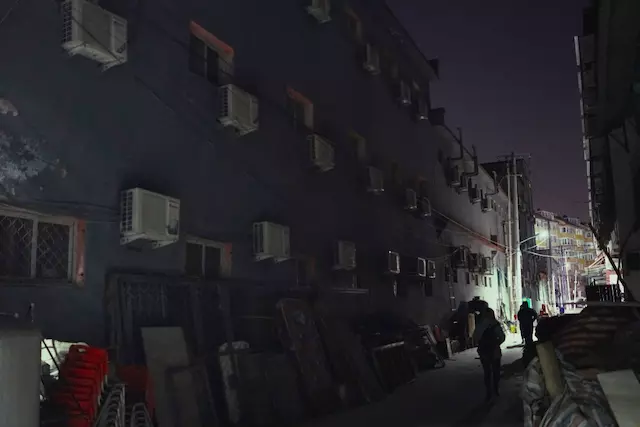
November 28: an apartment building cleared out several days earlier — no lights on upstairs

November 28: an apartment building cleared out several days earlier — no lights on upstairs
By 8:30 p.m. there were no lights on in the upper floors of the cleared building. A Kuaishou livestreamer who documented the evictions every evening turned up and reported that he'd arrived too late — many residents on the targeted street had already moved out ahead of time, the clearance was over in under an hour, and he'd have to come earlier tomorrow.
From the 28th on, the pattern of clearances shifted again. Zhu Tong said that on the 29th nobody came at all; she shared in the group a report from Economic Observer saying Beijing's eviction campaign was beginning to ease.
But around 7:30 p.m. on the 30th, enforcement teams appeared again — this time near a YTO Express outlet.
That YTO outlet had been one of the first targets of the clearances: it was sealed the day after the Daxing fire, on November 19, and the notice on its door spelling out which fire-safety violations had led to the closure was still there. ZTO and STO courier outlets were sealed at the same time.
It wasn't just the collection points. Several major courier-company sorting hubs were also shut down. Now the outlet franchisees drive to the roadside at 6 a.m. each morning to wait for the company's truck, then sort parcels by the roadside in temperatures of minus five or six degrees. With nowhere to take the sorted parcels, they stack them on the roadside opposite the post office, call recipients to come and collect them, and send anything unclaimed after three days back.
A courier sorting parcels by the roadside after his warehouse was shut

The road in front of the post office became a makeshift collection point

A fire-safety closure notice
One of those franchisees told QDaily that his outlet used to handle 700 to 800 deliveries a day, earning him a little over one yuan per parcel. Now he could only complete a few dozen a day. When he called recipients, nearly half said they had already moved and wanted their parcels sent back.
Every business was suffering. In a supermarket of more than 200 square meters, the drinks refrigerators were already more than half empty. The couple who ran it said they had stopped restocking a week earlier and still had 100,000 yuan of goods unsold. As the residents thinned out, their daily turnover had fallen from an initial 3,000 to 5,000 yuan to 1,700 to 1,800. In the group chat they used for purchasing, another supermarket a hundred meters away was being offered for transfer at a loss.
The couple had moved here three months earlier after a demolition in Huairou; they were open around the clock. Before opening, they had already rebuilt the emergency exits to pass fire inspection and installed emergency lights and fire extinguishers — but they were still afraid of being shut down.
As the clearances went on, rumors circulated among villagers about what the new rules might be. Some heard that, going forward, buildings up to three stories could be rented out, and a landlord with no more than ten tenant households would be compliant. Others heard that those who met fire-safety standards could apply for an inspection. One video showed the town mayor suggesting that, once management was regularized, a 30 percent rent levy might be introduced to pay for streetscape improvements.
But all of this was still just talk — nothing in writing. Nobody knew what would actually happen next.
Zhang Gang's building had not yet been cleared, but all his tenants were already gone. Now every room had a smoke detector, every doorway a fire extinguisher, the corridors emergency lights and safety signs. He went to the village committee to request an inspection, only to be told there was no agency that could send anyone to check for safety compliance, and no timeline for what came next.
After the first few days, later clearance teams no longer posted fire-safety findings — they simply evicted tenants. Over years of "relieving Beijing of non-capital functions," the numbers alone seemed to be what mattered. The fire was the catalyst: even Banbiadian, which had already finished its coal-to-gas conversion and existed mainly to serve the airport, could not escape.
On the evenings of December 1 and 2, no one came to clear anyone out. But Zhu Tong had already stopped watching the group chat every night. On December 1 she moved into her new place, found through an agent — a bedroom of less than 10 square meters in a three-bedroom, one-living-room flat in Yinghua Garden, at 2,000 yuan a month. Nearly three times the rent for less space, but at least she no longer had to fear being swept out in the middle of the night.
Yang Li still hadn't found a room. On December 1 she went back to her apartment to collect the rest of her things and, at the makeshift roadside collection point opposite the post office, picked up a pair of winter boots that had been mailed from central Beijing twelve days earlier. She had already applied to push her next flight back by a day — which meant her schedule for the coming twenty days would take her entirely out of Beijing.
Photographs by QDaily. At the request of those interviewed, Yang Li, Zhu Tong, and Zhang Gang are pseudonyms.
Translated from the original QDaily article. Original publication date retained.