

The Phone Industry Was the Past Decade's Biggest Growth Engine. This Year It Failed for Good | 2018's Biggest Business Stories ②
A full year of decline, and this is only the beginning.
A full year of decline, and this is only the beginning.
Editor's note: Some of this is the result of change already under way — and it will go on reshaping our lives. Some of it is the intervention of forces far less controllable, which force market participants to keep adjusting their strategies. And some of it comes from the companies themselves: once a company reaches a certain size, the question becomes how it squares itself with the public, with consumers, with state power and with everything else around it.
Not artificial intelligence, facial recognition or full-screen displays; not India, Africa or Southeast Asia; not Apple's unprecedented three new models in one year, not Samsung's and Huawei's vertical integration, not OPPO's and vivo's sales channels — none of it broke through the phone industry's growth ceiling.
The second quarter of 2017 brought roughly the first decline since the word "smartphone" existed, and the market has not managed to stop since.
In 2017, 1.472 billion smartphones shipped, 1 million fewer than the year before. Compare the four quarters just past with the four before them and the gap widens to 55.9 million.

The Chinese market, once the fastest-growing, has done worse: through September, smartphone shipments in China were down 12% year on year, with four straight months of double-digit declines. February's drop reached 38.7%.
With high-speed growth gone, phone makers took the hit first. Apple went from a trillion-dollar company to an $800 billion company in two months. Samsung Electronics' CEO admitted the company was in crisis. Xiaomi went public, but its share price has already fallen to half of this year's high. For the smaller companies it is only worse.
But the phone industry's reach extends well beyond phones. It worked its way into daily life long ago; poor or rich, no one can now do without this device that stays beside them around the clock. Phones have even come to affect how ideas spread and whether democracy advances or retreats.
Trump and Obama argue over which of them laid the groundwork for the growth, but their influence is probably nowhere near as large as that of this industry, now more than a decade old. Since the iPhone arrived in 2007, the smartphone has been the vehicle of the information revolution — a revolution that began with the personal computer in the 1970s, was amplified by the World Wide Web in the 1990s, and in the smartphone era came to cover most of the planet.
Smartphones have driven, created and shaped growth in almost every industry: phone manufacturing itself, the app economy and the many services of the mobile internet, and the corporate operations and labor relations the mobile internet has remade.
Smartphones Were the World's Biggest Driver of High-Speed Growth Over the Past Decade
The phone industry alone is about the size of the world's 27th-largest economy, and the supply chains feeding it are just as big
About two-thirds of the world's people now own a phone, more than half of them smartphones. For comparison: in 2007, of 250 million US mobile phone users, only 15 million used a smartphone.
The smartphone industry generates $478.7 billion in sales revenue, equivalent to the world's 27th-largest economy — on 2017 global GDP rankings it would sit between Belgium (26th) and Thailand (27th).
The smartphone revolution began with the 2007 iPhone: first a phone and an operating system that were easier to use, then app marketplaces and steadily improving apps and services.
Microsoft, Palm and Nokia all had smartphones at the time, but nothing changed until Android came along — Google updated it quickly and gave it to phone makers free. Samsung, HTC and Chinese companies like Huawei, Xiaomi, OPPO and vivo joined in, and phones spread to every corner of the planet.
The phone companies with the largest market shares, and the supply-chain companies making their components and services, piled up wealth fast.
In 2007, Apple's revenue for the whole year was under $40 billion — less than it now makes in a single quarter. By the iPhone's fourth year on the market, phones accounted for half of Apple's revenue; now they contribute about 60%. Apple has turned completely from a computer company into a phone company.
In 2007, Samsung Electronics took in about $100 billion a year; by 2017 it had doubled that, counting both phones and the components that go into phones.
Apple has more than 300 suppliers worldwide, most of them outside the US. Displays come from Japanese and Korean companies — LG, Sharp, JDI. Core processors are made by Taiwan's TSMC. Camera modules have kept Sony fed. In the end the parts are shipped to China and assembled into finished products.
Foxconn, which does the assembling, grew just as fast: from a company with $10.73 billion in revenue in 2007 to a giant with more than $150 billion in revenue and over 500,000 employees in 2017.
Smartphones took the world's internet population from 1 billion to 3.6 billion
In 2005, only 1 billion people on earth could connect to the internet — 16% of the world's population — and most of them lived in richer places. The International Telecommunication Union put internet penetration that year at 8% in developing countries and 51% in developed ones.
By then the personal computer had already existed for 20 years, and Bill Gates had become the world's richest man by selling software to businesses. The PC had simply never brought the internet to most ordinary people.
The smartphone did. After 2007 the world's internet population grew faster and faster; by 2017, 3.6 billion people could get online, half of everyone alive, and the gap between developed and developing countries had narrowed sharply.
This was not because computers had spread. Getting online by phone drove the process.
A 2005 report from the China Internet Network Information Center (CNNIC) counted just 4.5 million people nationwide connecting to the internet from a mobile device. By 2017 the figure had grown 175-fold, to 788 million. More than half of all Chinese people now use a smartphone — WeChat, shopping, food delivery, ride-hailing, mobile payments. The internet moved out of the offices of companies and state institutions in first- and second-tier cities and into the daily lives of most ordinary people.
The venture capital firm KPCB's 2018 Internet Trends report found that worldwide, the average adult with a smartphone spends 5.9 hours a day looking at its screen.
People are used to hailing rides, paying, shopping and getting information by phone. Outside places with extremely poor material and natural conditions, most of the world has woven the device and the network tightly into daily life. Even in war zones, Syrian refugees on the run have treated smartphones as necessities on a par with water and food.
From toys to branded phones: an upgrade for Chinese manufacturing
In 2006, 172 categories of goods made by Chinese contract manufacturers ranked first in the world by output, but few had much to do with high technology: 70% of the world's toys, 50% of its telephones and shoes, and more than a third of its color TVs and luggage were made in China.
Phones brought a new opening. By 2017, nearly every smartphone in the world was made and assembled in China. Chinese brands grew up on their own, too, rather than only building products for other people's labels.
At the peak of the domestic handset boom in 2003, Huawei began making and selling 3G phones for carriers. The phones had no brand name, only a string of model numbers, and were mostly white-labeled by the carriers, who decided both what got built and how it was sold. Today, on the back of Android, Huawei is the world's second-largest phone maker.
Also around 2000, before he founded OPPO and vivo, the Jiangxi businessman Duan Yongping was still mainly selling point-and-read learning machines and audio repeaters through his company BBK. Entering the smartphone market pulled BBK out of making study products that could only be sold in China, and out of a niche market into mainstream consumer electronics.
Together OPPO and vivo now hold nearly half of China's market, and OPPO ranks fifth worldwide.
Advances in phone manufacturing have in turn pushed costs down further.
The spending on new technology that phones drove has spread into other fields
In the last week of this November, Amazon AWS, the world's largest cloud computing provider, announced its own server CPU, Graviton. Without smartphones, Amazon's chip would at the very least not have come this soon.
Like every smartphone processor, Graviton is built to order on designs from the British company ARM. A decade or so ago, ARM processors were a byword for low power and low performance. But under steady pressure from chip designers, semiconductor manufacturers and later the phone makers themselves, the processors in today's phones and tablets are no worse than those in thin-and-light laptops. Intel's PC processors have crept forward for years; phones never slowed down. By 2017 the iPhone's CPU was 120 times faster than in 2007.
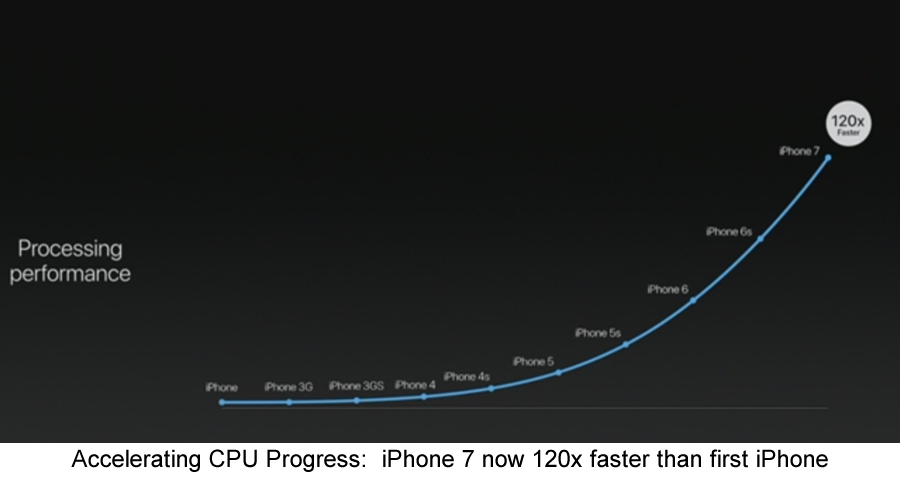
Obsolete phone processors go straight into other devices that, like phones, have to watch their size and power draw. The ultra-cheap educational computer Raspberry Pi, the chips in watches and televisions — all are directly descended from phone processors. It is hard to imagine what vendors would have spent on technology had smartphones not created a market of nearly 1.5 billion devices a year, against 260 million PCs.
That huge, fast-growing market keeps absorbing new technology and discarding the companies that cannot keep up.
So battery makers will spend hundreds of millions experimenting with new materials to raise lithium battery density by a few percent a year. So Samsung, Apple, Huawei and even Xiaomi all have to build their own processors, for speed gains users may never notice. So manufacturers keep refining techniques that are centuries old — enough that the Aluminum Association still marks, on its website, the change Steve Jobs brought about.
Phone apps became an industry worth tens of billions of dollars a year, bigger than the whole software business once was
In 2008, the App Store launched alongside the second-generation iPhone, and Google's Android app market went live the same year. Microsoft's and Nokia's smartphones could install apps too, but neither had ever built a single, central channel for distributing them.
The rule in both phone app stores was simple: users buy and download from the store and the app appears on the phone screen; developers work from clear tools and documentation, submit their software, and it goes live. At Apple, everything else — payment, even sales tax — is handled by Apple on the developer's behalf.
That freed apps from being productivity tools. Before phones, most product revenue at the world's biggest software companies — Microsoft, Oracle, Adobe — came from corporate customers; software meant office equipment, not entertainment.
In 2007, three of the ten apps worldwide that users spent the most on (excluding games) were plain productivity tools, with little to do with entertainment or socializing. In 2018, every one of the top ten by consumer spending is entertainment or social.
Software finally became something everyone could use.
It also set off a boom across the software industry. In 2007, Microsoft's revenue from business products — mostly Office and Windows — was $16.3 billion. In the first half of 2018 alone, the Android and iOS app stores took in $33.4 billion, a figure growing 30% a year; over ten years the two stores have listed more than 5.1 million apps.
Apple takes 30% of app revenue. Over the past ten years it has paid developers more than $100 billion, which means total sales topped $140 billion.
That excludes the other revenue developers can earn through apps, such as advertising — the source of the tens of billions of dollars a year that Facebook and WeChat make.
Google takes no cut from developers, but the Google Play store has always left out the Chinese market. Add in what developers earn from advertising, subscriptions and the rest, and the revenue the app market generates across the whole ecosystem is far larger than the headline figures suggest.
Figures from the US Department of Labor and outside researchers show that after 2008, employment in internet, data and computer operating-system work kept climbing, growing far faster each year than the economy as a whole. By 2018, employment in computer systems design and related services in the US had reached 21.14 million, up 48% from a decade earlier.
China shows the same pattern. The China Statistical Yearbook 2015 records 3.363 million people employed in information transmission, software and IT services in 2014, double the 2008 figure. Pay in Chinese IT has risen even more sharply. In 2008 the average annual income in the industry was 26,345 yuan (worth 33,678 yuan today after inflation); the figure released this year has shot up to 133,150 yuan, the highest of any industry.
Software companies swelled along with the shift. Ride-hailing, food delivery, social networking, payments — some business models exist only because of smartphone apps.
After the bubble burst, a few internet giants came back as the economy's leaders
In 2006, of the world's ten most valuable companies, Microsoft was the only tech firm; oil majors held four of the spots. ExxonMobil, then number one, was worth less than $500 billion — under half of Apple's peak this year. Tencent had already become China's most valuable listed internet company on the strength of memberships and games, but its $6.6 billion market cap was less than 3% of PetroChina's.
Now it is different. Google, Amazon, Alibaba, Facebook and Tencent have each, at some point, ranked among the ten most valuable companies in the world.
All of them existed before smartphones took off, but only after phones turned billions of people into potential users did each come to rule its own territory. Google has a lock on search worldwide. Facebook and Tencent dominate the social business, one globally and one in China. Amazon and Alibaba lead e-commerce, one globally and one in China.
Ride-hailing, food delivery, home rentals: a new labor relationship was built
Facebook was the first internet giant born after the dot-com bubble. Mark Zuckerberg soon took a $500,000 investment from Peter Thiel. In the years that followed, Facebook raised more money than Apple, Microsoft, Amazon and Google raised before their IPOs plus what they raised in those IPOs, combined.
Today capital gathers around the mobile internet faster and in larger amounts: Uber, Didi, even Airbnb have each raised more than Facebook did back then.
Ride-hailing, food delivery, renting — most of these companies used the mobile internet to rewrite the traditional employment relationship.
In 2017, 4.8 million Americans worked gig jobs, far more than the 2.73 million employed in IT. A 2017 sharing-economy report from the Internet Society of China and the State Information Center counted 40 million people doing such work in China, equal to 4% of the country's labor force.
A user moves a finger; delivery riders, drivers and couriers tap their screens and follow the instructions to complete the order step by step and earn their pay. People have begun to question the fairness and the distribution involved — are delivery riders swept along by a gamified work system that leaves no room for fairness?
Still, you cannot deny that taxis, Airbnb and food delivery share one thing: the new models raised efficiency.
Efficiency gains and better use of resources show up in every region and every industry
Finance is one example. In 2007 Alipay's main entrance was still the PC, and it had 40 million users. This year it has 870 million active users, 700 million of them in China — a scale comparable to WeChat Pay. Which is to say that most Chinese smartphone users use at least one of the two mobile payment tools.
Mobile payments did what banks could not: they used a device everybody already owns to let everybody simplify borrowing, saving and paying.
Afghanistan's terrain is harsh and its transport infrastructure poor; banks cluster in cities large and small, and 97% of the country has no bank. In 2008 the local telecom carrier Roshan and Vodafone launched M-Paisa, which let users send money to each other by text message.
The same thing happened in Africa: by 2016, mobile payment penetration in Somalia had reached 50%.
With enough commercial interest at stake, carriers built base stations even in poor and war-torn regions, put phones no different in kind from anyone else's into local hands, and sped up the movement of information.
Without the phone underneath it, none of this might have happened.
Phone Makers Tried Everything, and None of It Turned the Tide
China's phone market started shrinking earlier: six straight quarters of decline since the second quarter of 2017. Over that year and a half, each phone maker has tried its own way out.
OPPO and vivo, whose strength is sales and marketing, each have more than 250,000 offline stores in China and are fond of celebrity endorsers and variety-show sponsorships. To get users to replace their phones, this year the two started telling technology stories instead. Beyond putting a full-screen display in every new model, OPPO and vivo also came up with pop-up cameras, color-shifting back covers and other baffling "new technologies." OPPO says it will put "4 billion yuan" into R&D next year.
Xiaomi, known instead for online sales and value for money, has sped up its offline rollout. Mi Home stores are opening at more than 10 a month on average and now number over 500; Lei Jun wants 1,000 by 2020.
The three companies with deeper pockets — Apple, Samsung and Huawei — keep spending more on new technology, trying to raise the price of each unit. Last year the iPhone X pushed Apple's average selling price above $1,000 for the first time. Huawei and Samsung reached iPhone prices this year too; the most expensive Mate 20 costs more than 12,000 yuan.
CNET tallied this year's top asking prices for the flagship models of major brands in the US and UK; against last year's most expensive models, the increase generally runs 15% to 30%.
IDC, meanwhile, says the average smartphone price worldwide rose from $282 in 2016 to $288 in 2017, and could keep climbing to $317 within four years.
Phones have got so expensive that installment buying is now sold openly.
After Tim Cook said an iPhone costs "the price of a cup of coffee a day," Apple's US stores began listing iPhone prices as installments — $32 a month, say — and you have to scroll through several screens to find the actual price.
You can feel the enthusiasm for installments in the past two Singles' Day sales too: Tmall said that during Singles' Day 2017 the number of users choosing installment payment grew 76% year on year. Fenqile says one in every two people buying a phone on its platform buys an iPhone.
New technology has not stopped either. Facial recognition is standard now, and Samsung plans to release a phone with a folding screen next year. Augmented reality (AR) has become a required segment of every Apple keynote, though it must be said the live demos may be the most awkward part of each event.
None of it has stopped the smartphone's decline.
Smaller companies are having a harder time. As in any industry on the way down, the ones surviving for now are the big ones. Counting from the second quarter of last year, the combined share of the top five companies by shipments has risen from 60% to 70%.
Gionee's financial crisis turned into a scandal when its chairman admitted losing more than a billion yuan gambling. Meitu gave up developing its own beauty-camera phones. More than a dozen mid- and senior-level executives have left Meizu one after another. Earlier still, HTC, the original Android phone maker, sold its phone business to Google. Most of the smaller phone companies ended in 2015 and 2016.
By the third quarter of this year, only Huawei and Xiaomi among the top five by share were still posting growth above 20%, and that was thanks to emerging markets in Southeast Asia and Europe.
Places where smartphones have yet to take hold look like China a decade ago. Xiaomi now holds 30% of the Indian market, with quarterly growth above 100%. But it has paid for that: in India, Xiaomi gives distributors better terms, which has cut its capital efficiency. Its third-quarter results showed inventory turnover stretching to 50.8 days and receivables to 14.45 days. Its grip on the channel is loosening.
The new answers phone makers have found are 5G and folding screens. 5G comes with all kinds of stories about the internet of things and self-driving cars, but no company has yet explained clearly what it means for someone buying a phone. And the folding screens Samsung is betting on are, judging by the demo units shown so far, nowhere near ready.
The Growth Engine Has Stopped, and the Effects Are Only Starting to Show
It is now quite clear: the phone industry has failed.
People still use smartphones. They have not given them up. That much has not changed.
But among people who already own one, the gap between upgrades keeps stretching. An NPD report in July said the average upgrade cycle for US consumers had gone from 25 months a year earlier to 32 months. Asymco estimates the upgrade cycle for Apple devices has stretched from one year, when the iPhone first launched, to four years and three months.
The decline hits the phone makers most directly. Apple's market value has fallen more than $200 billion from its high this year, about half of Alibaba's entire market cap. Cook has already announced that Apple will stop reporting device sales — plainly not a sign of confidence about selling more.
The companies that build the phones and their electronic components have been hit directly too. Apple has cut its sales expectations for all three new iPhones one after another, leaving supply-chain executives and workers deeply discouraged. Several suppliers have issued gloomy forecasts; Foxconn's parent, Hon Hai Precision, briefly fell below NT$1 trillion in market value, the first time since 2013.
These are only the direct effects. The knock-on effects are surfacing now.
Over the two years in which phones went from slowing to stalling, the words used about internet businesses changed from "internet dividend" and "mass innovation" to "winter" and "second half."
Fewer new phone users means no more new internet users either.
The global pool of internet users is nearly exhausted as well. At present 3.6 billion people can get online, 7% more than the year before — well down from 12% growth in 2016. The growth of more than 20%, sometimes far more, seen between 2010 and 2014 is never coming back.
The mobile internet's user base is not changing, but every company still wants your attention on your phone. That means the cost of acquiring users online is starting to soar.
Google and Facebook at one point even planned to bring the internet to mountainous regions with balloons or drones. In developing countries they released stripped-down, data-light versions of their apps. All of it to win over the last remaining new users — and each experiment ran into its own obstacle.
With new customers too expensive, business empires built online are going offline to hunt for traffic. From 2017 to now, Alibaba and Tencent have together put at least 100 billion yuan into offline commerce. Amazon, the largest e-commerce company in the US, spent $13.7 billion in one go on the grocery chain Whole Foods, and has opened a string of bookstores and convenience stores.
What is true for the big companies is more true for the small ones. KPMG data show that, through the third quarter of this year, the number of venture capital deals worldwide has fallen for six straight quarters. And the "unicorns" that raised money earlier now have to face the question of how to make money once growth stops. Hence the crises at Uber, Didi, Palantir, Mobike, ofo and others, and the ever-heavier losses carried by Meituan, which is already public.
The computer revolution that began in the 1970s has driven global growth ever since. PC, internet, smartphone: every ten or twenty years another technology has picked up the baton and delivered a longer, larger stretch of prosperity.
What is different this time is that phones have hit their ceiling. The failed attempts at something new have already piled up, and the next engine of comparable size has yet to appear.
Cover image from Pixabay
Translated from the original QDaily article. Original publication date retained.