

What Else Do You Need to Know to Read Max Weber? A Weber Scholar's Way of Learning | The Study
Yu Zhejun, a scholar of Max Weber, on the misunderstandings people have about Weber and on how to read the classics.
Yu Zhejun, a scholar of Max Weber, on the misunderstandings people have about Weber and on how to read the classics.
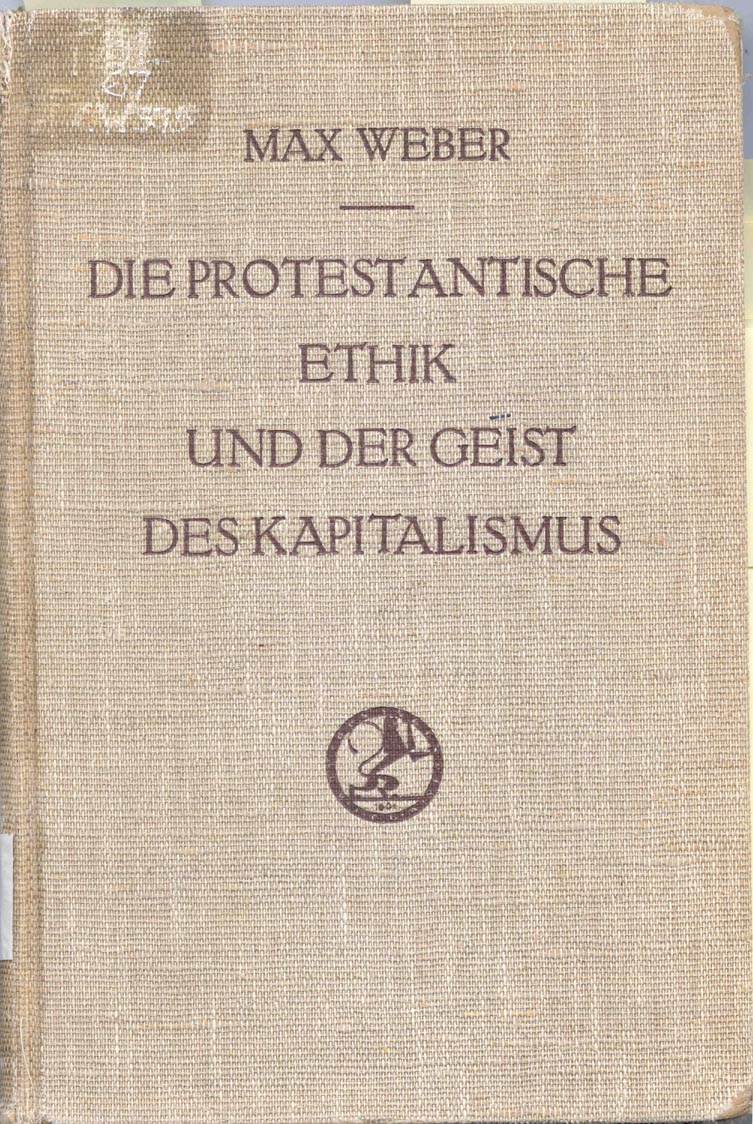
The Protestant Ethic and the Spirit of Capitalism is the book Yu Zhejun, a university philosophy teacher, has read more times than any other. It is a sociology classic, not especially thick and not especially convoluted, written by Max Weber in the early 20th century. Put roughly: Weber found that the rational economic labor that drove the flourishing of capitalism may be linked to the ascetic ideas of Protestant Christianity.
At one point Yu Zhejun's favorite philosopher was Wittgenstein — the clarity of the philosophy of language fascinated him. But Yu has spent far more time on Weber, and in doing so he shows how a professional scholar can read a book, and understand its author, in a different way.
Yu Zhejun read The Protestant Ethic and the Spirit of Capitalism while working on his doctorate at Leipzig University in Germany — partly out of personal interest, partly because he had to produce a thesis that would qualify him for the degree. His advisor was Hubert Seiwert, a scholar of religion and a former chairman of the German Association for the Study of Religions. Yu reached the same conclusion as many researchers do: Weber's theory is "very useful." Drawing on it, he wrote the only academic monograph he has published so far, Gods and Citizens, on folk religion in Shanghai during the Republican era.
At Fudan University, where he teaches, Yu Zhejun has run a close-reading course on The Protestant Ethic and the Spirit of Capitalism since 2011. On the online course platforms Coursera and MOOC, the book he guides students through is the same one. These courses have made him better known than the average university teacher. More than ten full and partial Chinese translations of the book already exist in mainland China, but a year ago Yu, as an authoritative Weber scholar, translated most of its chapters himself anyway. The new translation is part of Zhejiang University Press's project to retranslate the classics.
He has also read D. G. MacRae's biography of Weber, along with Weber's other work; two lectures in particular, "Science as a Vocation" and "Politics as a Vocation," left a deep impression on him. These books helped him see that Weber had a liberal side and was also a nationalist, that he was sensitive by temperament, and that his marriage was unusual. Weber insisted on neutrality in his writing, yet his leanings were obvious whenever he took part in political life, and that often drew criticism. But Yu thinks this is not Weber's problem alone — it may be true of modern people in general.

Asked about his daily reading habits and the books he likes, Yu Zhejun says he spends most of his time on academic books and papers.
But he has no intention of being a scholar shut up in his study, deaf to everything outside it. Part of that goes back to his own education. In 1997, after finishing high school, Yu entered Fudan University's newly founded Liberal Arts Base Class. It was a special program that admitted students outside the gaokao, through its own process; applicants had to field interview questions like "Will the founding of the European Union affect the next century?", "How much do you know about the ancient Greek philosophers?" and "What is the difference between classical and modern physics?" The university wanted its admits to become humanities scholars and, at the same time, "broad and well-rounded people."
After becoming a university philosophy teacher, Yu Zhejun stayed active on social media, with wide-ranging interests. He likes movies and BBC documentaries, and he enjoys arguing about France's "burkini" ban, Peppa Pig and the Biennale. In 2017 he launched an audio course on philosophy that introduces the classics along with 50 thought experiments. They range from whether an American soldier should shoot an unarmed Afghan shepherd who might give away his unit, to whether the science-fiction writer Isaac Asimov's "Three Laws of Robotics" could really stop robots from harming humans.
In the magazine Bookcity (《书城》), Yu Zhejun has published more than a dozen film reviews that explain movies from a philosophical angle. They will soon be collected into a book, which will come out before his second academic monograph. At times, though, he shows some hesitation about where scholarship ends and public life begins.
As for reading advice, Yu Zhejun says reading takes preparation. If you want to understand a difficult classic, you may need to have read dozens of books and countless news stories first — that is the information out of which you build a reasonably complete picture of the world. "If you can't understand the book, it isn't the book you don't understand — it's something else."
The interview took place on a cold, rainy day in early December. In one of the few cafés left on campus, we talked about Weber, how to read the classics, and what you need to do to get ready for that.
At the end, Yu recommended a few books.
Q: In 2015, Daxiang Gonghui launched a series called "Classics You Don't Need to Read," and Weber's The Protestant Ethic and the Spirit of Capitalism was on the list. You wrote a piece in response at the time, arguing that the author had misunderstood Weber on many points and hadn't really understood him. What do you think the most common misunderstanding is?
The most common one — the Daxiang Gonghui author says this too — is thinking Weber was arguing that if you believe in Christianity you get wealth accumulation and modernization. As if Weber were preaching. He wasn't. Weber's method was entirely social-scientific: an abductive inquiry, a search for causes.
Q: But you've also said the cause Weber found wasn't a strongly correlated one.
Right, and this is also a matter of "reception history." We brought Weber into China in the early 1980s. The mood then was that people had already had enough of the crude, vulgarized line that "the economic base determines the superstructure." So when a Western scholar like Weber turned up, saying what amounted to the reverse — that the superstructure, meaning religion, influences the economic base — it looked like an entirely new idea.
But because of the particular historical setting in which we received Weber, people took away a one-sided view and saw only Weber's claim that religion influences the economy. In fact Weber opposed that kind of single-cause explanation. I wrote in my rebuttal to the Daxiang Gonghui author that a fair-minded scholar would never stress one side alone. That goes double for Weber, whose own training was in economic history and national economics — he certainly knew that the economy directly influences religion, culture and the rest of the so-called superstructure.
One project I'm working on now is reading the economic-history lectures Max Weber wrote in Munich side by side with Karl Marx's Capital. I think the two have something in common. Some Germans hold that Weber had two spiritual godfathers: Karl Marx and Nietzsche. Marx's influence was mostly the use of an economic lens to analyze human history; Nietzsche's influence on Weber had more to do with value pluralism.
Q: How should we understand Nietzsche's "value pluralism"? The phrase is very fashionable now. And how did Weber talk about it?
Didn't Nietzsche say God is dead? He saw it coming early, but he wasn't anti-Christian. What he meant was that the medieval worldview and value system built around Christianity had, by then, run into a major crisis in Europe.
Weber, for his part, proposed a theory of value spheres. Look closely at our lives and you'll see that every part of them is occupied by some value sphere. He listed six: the religious, the political, the economic, the aesthetic, the erotic and, of course, the intellectual. One of his more interesting arguments is that these spheres stand apart from one another. Borrowing the "war of the gods" from Greek mythology, he argued that no ultimate value can unify them, and that the spheres exist in permanent conflict with each other. That is very different from the Christian era.
This is an analysis of the modern predicament, and it carries a criticism too — some people still want to go back to the medieval arrangement, with a single value governing all the other spheres — and Weber thought that was futile, impossible. And because it is impossible, this is where the suffering of modern people comes from: they are always in a state of being torn apart.
Weber himself was always in conflict between politics and scholarship. At the university he had to argue for value neutrality in academic research, but he was also a patriotic man, a citizen who threw himself into political life, so his restraint in the academic sphere and his engagement in the political one were themselves a contradiction. Some people think this was Weber's own personal problem; some trace it to his family history, his history of mental illness. I don't think so. Modern people are all a bit like Weber in this: inside any given sphere you act by that sphere's rules, but there's no meta-value or meta-rule to unify them. A lot of what modern people agonize over probably comes from exactly this. It isn't an East-versus-West issue. It's a modern-person issue.

Q: As far as you know, how did Weber himself handle this split? Did he accept it calmly?
He suffered a great deal, especially when it came to choosing between academic work and political work. But in the lecture collection Scholarship and Politics, he falls back in the end on something like personal heroism, a decisionism close to faith. He said modern people all have to learn from Faust: you can no longer count on being one of those all-rounders who moved easily in every field. No — like Faust, you can only sign a pact with the devil. You can only be a specialist, and only break through in a single field.
Q: The distinction you're drawing between specialists and generalists sounds a little like the ancient Greek distinction between the hedgehog and the fox. But value pluralism seems to be a different predicament, more like being pulled apart between values that are hard to reconcile or unify. So wherever values belong to different spheres, must there be conflict?
That's Weber's view, and he thought the conflict was irreducible — it couldn't be boiled down to anything simpler.
Q: What drew you to Weber in the first place?
One important reason, obviously, is that my teachers used Weber in class and I needed him for my papers. The other is that although many of Weber's arguments are easy to refute, he had a way of taking a sharp knife to a tangled knot of complicated reality or history, and that is very illuminating. Some of the questions he raised hit a sore spot in every generation. He was highly original; his classification of the types of authority, and concepts like charisma and disenchantment, are things every modern person runs into.
Then there are the lectures, "Science as a Vocation" and "Politics as a Vocation." He was exceptionally honest, the same in word as in deed. When there was a difficulty, a problem with no solution, he would tell you so and leave it lying there. Many scholars either drown in their own rhetoric or use it to dodge the problem. It's easy for the ordinary scholar to say, "I can handle these problems," and much harder to say, "This one I cannot."
Q: Newly discovered material, or even new research from other disciplines, can overturn a great many arguments in a classic. You've mentioned this yourself. People often borrow Weber's own word, "disenchantment," to describe it: the disenchantment of the classics, the disenchantment of the master. How do you think we should deal with a classic that has gone out of date?
Right. One question that matters a lot to Chinese people is this: after World War II, the "Four Asian Tigers" rose, and some people asked whether that proved Weber's thesis wrong. The same goes for China's rapid economic growth after reform and opening up — doesn't that suggest Weber failed to see that China, too, had something like a Protestant ethic quietly holding up its economic development?
These questions apply to any latecomer to modernization. The Germany Weber lived in was itself a latecomer, and he took Britain and the United States to be the best cases, the benchmarks. Weber looked at Britain; we look at how Weber looked at the question of modernization. We're the third or fourth wave of modernization. Weber's thesis may well be wrong — plenty of economic-history arguments can turn out wrong — but every generation runs into a similar situation, a similar difficulty, which is why people keep going back to that way of framing the question.
When I was in Germany, my advisor told me that the best attitude toward the great figures of history is to meet them at eye level. But as a student you naturally look up: this person is so brilliant, I'll never surpass him in my lifetime. That's normal. Then you read your way in, and you find he wasn't so perfect after all, and that his arguments can be answered too.
Reading is sometimes closer to doing mathematics — watching how an argument is derived, step by step. That matters. The process of the argument, the way of thinking, matters a great deal. Knowing only the answer and not how it was reached really is putting the cart before the horse.
You see people who have read a great many books but whose whole framework of understanding is faulty, so they simply repeat themselves. Or rather, they're always hunting in the classics for things that agree with them, so all they ever find is what they already knew, or their own stereotypes. That's one problem. Another is that a lot of paid-knowledge reading today chops the classics into fragments, or reduces them to soundbites — a five-minute summary. You can summarize a book, but once you do, the most essential arguments and lines of reasoning are gone.
Academic books are really a kind of consumption for the sake of appearing cultured; a lot of academic material ends up converted into your social currency. These books aren't that easy to understand. Without the preparation, how are you going to read them? It's too hard. And our national education system is still stuck right there.
My basic view is that although I criticize this cultural posturing, the trouble is there isn't enough of it. There has to be a process of getting used to it — which is why I teach Weber's book over and over. Why? Because most of the time in my class I'm not talking about the text. More than half of it is spent on things outside the text, doing the preparation, clearing a space. If you can't understand the book, it isn't the book you don't understand — it's something else.
Q: Take Weber as the example. What preparation does reading him require?
Broadly, you need some grasp of the whole history of Western culture, especially the large stretches of civilizational history: from ancient Greece and Rome to the Middle Ages, then the Renaissance and the Reformation — and especially the more recent one, the history of the Reformation. You need to know what the Reformation actually was: Luther began it in 1517; what he opposed and what he supported; the differences between Protestantism and Catholicism; some of the common Protestant denominations. Look at Guangxi Normal University Press's edition of The Protestant Ethic and the Spirit of Capitalism — the appendix is longer than the main text. Now that the internet is so well developed and you can look anything up on Google or Baidu whenever you like, annotation that heavy seems less necessary. But at the time, the two Taiwanese translators, Kang Le and Jian Huimei, really did need a great many notes to help readers follow the book. This is common knowledge for Westerners and may be a blind spot for us, because we've had no education in it.
That's the purely factual part. The other part is how we understand the West as a whole. That's also an important reason I teach this course. We've always talked about "opening our eyes to see the world," but two centuries on, the world we see is still very incomplete, or has obvious blind spots and weak points.
One important reason is that, as many scholars say, the evolution of Western civilization runs along two main lines, represented by two cities: Jerusalem and Athens. But the May Fourth Movement singled out "Mr. Democracy" and "Mr. Science," which is essentially the spirit of Athens. On the Jerusalem line, people assumed religion would weaken, that faith would fade. Yet from the late 20th century into the early 21st, there's been almost no sign of religion declining anywhere in the world; far from weakening, it shows a trend of revival and return. The Athens line can't be dropped, of course, but the line of faith that Jerusalem stands for has been enormously important historically too, alternating with Athens in dominating the West.
Understand both lines at once and your grasp of the West will be more complete.
Q: That sounds like an enormous undertaking. Is there a slightly easier way to work up to it?
(Laughs) In a lot of my courses I actually recommend watching movies. Books are best, of course, but you can also watch the British series Downton Abbey, for instance — the marriage of the youngest daughter and the chauffeur is a very typical religious union. If you don't know that stretch of English Reformation history, watching it may feel a bit undercooked. You can certainly watch it as entertainment, but if you learn the religious history and then go back to it, you'll see how carefully the director or the screenwriter arranged things: he is using that marriage to stand for a fault line in English society.

Or take The Tudors and Wolf Hall. Watch those two series and you'll have a very clear picture of the history of the English Reformation. There's a huge amount of material now; you can read books, or take other routes. And there are plenty of documentaries to watch too.
Q: There are also books that give secondhand readings of the classics. Is there a trick to choosing among them?
The Oxford Very Short Introductions that Commercial Press publishes. Generally, the smaller these books are, the more likely a leading scholar wrote them. From the American side there's the "For Dummies" series, a more popular sort of book. Another approach is the Japanese one, which ties everything very closely to your present-day life, even at the cost of distorting the original to cater to your needs, turning a lot of philosophers into writers of feel-good self-help. On the whole I lean toward the popular introductions from European and British publishers.
Q: What have you been reading lately?
The non-academic book that made the strongest impression on me this year (2018) is Stoner, a novel whose protagonist is an American university professor. It's close to my own experience, even though our life trajectories are quite different. Over the summer I went to Italy, and on the day I flew out I ran into a typhoon and was stuck at the airport for 12 hours, so I read the whole novel on my Kindle. It's rare to get that big a block of time for a novel.
It's basically one man's whole life, and a lot of the facets are interesting — his relationship with his family, his relationship with his wife. His wife came from a wealthy family, well above his own class.
By the second half he's essentially a defender: Stoner is holding on to certain basic things, bottom-line things. He's also morally sensitive, and can't stand people who cut corners and work the angles. I think the people who form the backbone of a society tend to identify with that kind of basic value.
Q: If you sorted the books you normally read into categories, how would you divide them?
Ninety-something percent are academic books, and even those I now rarely read cover to cover — usually it's for a citation, so I read one chapter or one passage. And then I read papers systematically.
Q: What else?
The phone — passive reading. It used to be more active: you wanted to understand something, so you went and found the book. Now there's a lot of passive reading — pushed content, the official accounts you subscribe to, things people send you. All of that is passive reading.
Q: How would you describe what it's like to be a scholar?
We're now in a state of state patronage, the same relationship as the patrons of the late Middle Ages and the early Renaissance. Everything is commissioned by the patron. Say you're a painter: it isn't that you paint something first and then put it in a gallery to sell. It's that I'm the patron, I'm very rich, you work for me. I tell you directly what I want painted — a commission. Your relationship to me involves a degree of personal dependency; it isn't a relationship between a buyer and an artist. Right now, across the board, we treat the state as the biggest patron of all. Very clearly, the overwhelming majority of work is commissioned by the state, which buys and commissions your services through various research projects. That's the trend.
Q: When did you decide to become a university teacher? Had you settled on it before you entered the Liberal Arts Base Class?
It's true that when Fudan's Liberal Arts Base Class began admitting students in 1995, it was set up to prepare people to stay on and teach. There's a background to that. After Deng Xiaoping's Southern Tour speeches, everyone plunged into business. Nearly all the clever, capable people went off to make money. In the early 1990s a Fudan salary was 200 yuan a month while people outside were already making several thousand; it was easy for scholars to feel they'd gained nothing, that they didn't count. By 1995 and 1996 the university was worrying about it: what happens when there are no teachers left?
The faculty of the Base Class was very strong at the time — the best teachers in literature, history and philosophy. On top of that they brought in a few social science teachers, in economics for instance, which I think mattered a lot. Every teacher told us the university's expectations for us were very high, that they meant to train great scholars. By our senior year we'd become clear-eyed about it: of the forty-odd people in the class, we knew it would be doing well if four or five stayed on to teach.
When I finished my master's I actually had other options. By then I'd spent four years on the news desk of the Shanghai Morning Post. From 2001 to 2004 was the best period for the urban metro papers; at its peak the Shanghai Morning Post's daily circulation reached 700,000 copies.
If I hadn't got a scholarship, I probably wouldn't have gone to Germany for a doctorate. There were no national scholarships then, so I had only two roads. Paying my own way was out of the question — I couldn't bring myself to ask my family for money again — and working wasn't viable either, since German policy capped monthly income at 400 euros, which wasn't enough to live on. Then the admission letter came with a scholarship, and that settled it: study came first. I felt that was my real goal in life, my scholarly calling.
Looking back, though, the reason I may be a bit different from other academic-track scholars probably has something to do with my time in the media. That sensitivity to the times, that ability to get things done — I think you still need those, and journalism gave them to me. Especially since what I do now is religious studies, and religion isn't purely a matter of abstract reasoning. Even doing Weber, doing sociology, there's a problem if you don't connect it to Chinese society as it is now.
The whole humanities have this problem. It's a reflexive kind of knowledge: you have to know your own situation before you can arrive at a corresponding reading. How you understand the world can affect how you understand the text, and how you understand yourself.
Q: Academic specialization is so fine-grained today that it's hard to say any philosophy professor knows every philosopher and every philosophical classic well. You launched an audio course on philosophy that amounts to a general history of the subject. Did you have to do extra reading to prepare it?
Besides the histories, the biographies, the secondary works and the commentaries, I basically watched every open philosophy course on Bilibili — the whole Yale set, the political philosophy set, the Harvard set, and I picked through the domestic ones.
Q: Has making the audio course changed anything in your life?
If there's a takeaway, it's that the commercial standard turns out to be higher than the university standard. If universities go on teaching the way they do, what happens later? Commercial courses demand more of you on structure, content and how you break a subject into individual points — including how the audience takes it in.
Q: What do you think an ordinary listener gets out of a program like this? How is it different from ordinary reading?
Learning in scraps of time. It's accumulation.
Q: "Scraps of time, a changed life"? Tencent Reading ran an ad along those lines not long ago.
That's advertising. Scraps of time aren't going to change your life. That's asking a lot. Most people use it as social currency, but there's still a small minority who need to think more deeply.
But the differences inside the audience are quite large. In a good society you could start from knowing nothing and have an unbroken ladder of reading to climb. But this market hasn't fully developed here yet, supply is short, there's no stratification by age, none by need — we're still using one big undifferentiated product to face everyone at once. That will come.
Q: From the early 2000s, it became fashionable among young scholars in Europe and America to turn dissertations or academic monographs into readable popular social science, and book editors encouraged it; to some extent it created a wave of people reading books that aren't easy to read. Do you read this kind of book?
I'll flip through them, so I roughly know what they're up to. Capital in the Twenty-First Century, for example, has a lot of descriptive content. So does Steven Pinker's The Better Angels of Our Nature, two very thick volumes. Everyone says they're good. My feeling is that they're often stating common sense, and the argument isn't very tight.
But if you're not a scholar, or you don't have much time, flipping through them is still worth it. People change. If you don't read at all, if you resist from the start, then what are you going to read?

Q: More and more books and articles are going digital. Has anything changed in your study?
There's a paradox: the newest material still has to be print, since the old material has all been digitized by now. The things that most need digitizing are exactly the ones with no electronic version. Back issues have all gone into the database, but a new issue takes half a year to get there.
Some people say we shouldn't sell physical books anymore, but that creates a problem of its own, and a philosophical problem worth debating: ownership of digital products. Sometimes a book is pulled for one reason or another, or becomes unavailable in a region, and the e-book vanishes from your device.
Digital products, intellectual property included, pose a serious challenge to the traditional concept of property. There are two lines of thought. One says we should still handle this property the way we handle a physical object, as an extension of physical property rights. The other says we should overturn the concept of property altogether. I lean toward the second. But it's disruptive: if philosophy delivers a completely different concept of ownership, do politics, law and economics have to move with it?
Q: Do you think philosophy still has that capacity to take an active part? Does everything have to wait for philosophy to hand down a definition before economics and law follow?
It's possible. The odds are slim... but I do think the fundamental force is still there.
Q: Recommend a few books.
Philosophy and the Young Child. Matthews was an American child psychologist; I love quoting him. He said a lot of modern adults have minds that have already gone rigid and dead, while young children — especially between learning to talk and starting school — have minds that haven't been boxed in or contaminated, so the questions they ask are, at bottom, philosophical questions. But parents tend to feel: how can you ask a question like that, it's an illegitimate question. Or they dodge the questions altogether.
Matthews's own child, for instance, once asked him: I have two eyes, so why do I see only one of you?
By watching children he ends up delivering a criticism of adults: the overwhelming majority of adults put themselves in an intellectual comfort zone. Questions you can answer, questions you have a ready answer for, feel safe and comfortable. What gets restricted instead are the imaginative ones — not just children, but imaginative adults too, the ones who ask the questions that look dangerous.

I'd also recommend Doing Philosophy by Theodore Schick Jr. and Lewis Vaughn. It contains 88 thought experiments and avoids philosophical soundbites. We aren't looking for conclusions; a thought experiment is essentially about laying out a situation and seeing how a person would choose in it.
Zen and the Art of Motorcycle Maintenance. The title sounds very literary, very "amateur philosopher," but it's quite healing. Even as I argue against feel-good self-help, I have to admit that feel-good books differ in quality. Or put it this way: working out how the world operates isn't a necessity, but consolation for the soul really is. Even the most steadfast rationalist runs into this problem in the end.
And there are the philosopher Alain de Botton's books. Have you read him?
Q: I've read his A Week at the Airport.
Look at everything Alain de Botton has written — I don't know if you've had this feeling — and ask what his philosophical grounding is.
His grounding is Stoicism. It isn't passive and it isn't cynical; he has some dissatisfaction with the world, but he tells you to stay composed and unhurried, to change what can be changed and not to fret over what can't. Setting aside the religious kind of comfort, Stoicism may be philosophy's best solution for modern people.
Among the older philosophies, cynicism no longer works; for a small minority it can. Stoicism is exactly what fits this moment. I don't know whether he does it consciously, but that's how it reads to me — he's very fond of the ancient Greek philosopher Seneca. Zen and the Art of Motorcycle Maintenance included: that's a contemporary Stoic too, as I'd define it, though of course he never said so himself.
Cover image from Giammarco Boscaro on Unsplash, and Wikipedia
Translated from the original QDaily article. Original publication date retained.