

Why Sweden Became a Hotbed for Great Games
Sweden has built game-development systems all over the country. How individual creative energy gathers and bursts out inside them may hold a lesson for places short of creativity.
Sweden has built game-development systems all over the country. How individual creative energy gathers and bursts out inside them may hold a lesson for places short of creativity.
According to a report from the Swedish Games Industry association, at least one person in ten worldwide has played a game made in Sweden.
This Nordic country of just 10 million people, tucked away on the Scandinavian Peninsula, ranks in the world's top 10 for game output. It turns out fine games of every size and style: the casual Candy Crush, the all-ages Minecraft, the AAA blockbusters Battlefield and Tom Clancy's The Division, the indie titles Goat Simulator and Hotline Miami, the indie mobile game Year Walk. For range and quality it gives nothing away to the United States, a market 20 times its size. EA DICE, Microsoft's Mojang, Ubisoft Massive, Paradox, THQ Nordic, Bethesda's MachineGames — studios every player knows — are scattered across the country, seizing headlines with a new release every so often. Oh, and this country also produced the biggest game streamer alive, PewDiePie.

Judging a game on its own terms, people don't usually dwell on which country made it. But Sweden keeps producing good ones, its developer count climbs every year, and new studios keep appearing — and there are reasons rooted in the place. How individual creative energy gathers and bursts out inside this system may hold a lesson for places short of creativity.
QDaily spoke with people working in games in Stockholm, Skövde and Malmö. Across three articles we will try to explain how a "small" country of ice and snow hatched a game boom that spread around the world.
1. Long Nights, the Demoscene and the Safety Net
"Long, dark nights."
Asked what advantages Sweden hands them, almost every developer brings up how fast the daylight shrinks in winter. Close to the Arctic Circle, Sweden gets down to about six hours of light a day in late December — fitting for a region whose name traces back to "skadino," darkness. They smile without meaning to as they tell you those long nights are perfect for staying indoors, playing games and making them.
Mention the long nights and the talk moves on to the ancestors who survived the cold, whose lives sound a little like a survival-horror game. Per Micael Nyberg, who works for The Game Incubator in Skövde, in central Sweden, offers an explanation: this land lay under ice for a very long time, and even after human tribes appeared the climate stayed harsh and unfriendly to life. With little to go around, people had to wring the most out of everything they had; the wish to survive sparked invention and forced them to become better problem-solvers. The long nights, when you could not go anywhere, gave them more hours indoors to think, refine one design after another and solve more problems. That habit of turning things over may be written into the survivors' genes, and it is one reason Swedish design is so strong.
A more personal explanation: Swedes were Christianized in the 11th century, and Protestantism replaced Catholicism after the Reformation in the 16th, but they were never all that close to Christianity. They worshipped the Norse gods first, and held nature in awe; modern Swedes still prefer to treat "nature" as their religion. In a country where forest covers 64% of the land, people are out in the open in all sorts of ways, and creativity gets shaped by it. Look at the folklore and the unmistakably Nordic landscapes in Swedish games and you'll see what "nature shaping creativity" means.

These slightly mystical reasons cannot explain how fast Swedish games have piled up reputation and revenue lately. The 2018 Swedish Game Developer Report lays out a run of rising numbers: against 2012, game revenue in 2017 had more than tripled, to 1.526 billion euros; total profit passed 445 million; the games reached more than a billion players. Over ten years the number of companies tripled and the number of employees quadrupled, far above the world average.
As for the games themselves: EA DICE's Battlefield V and Star Wars Battlefront II, Ubisoft Massive's Tom Clancy's The Division 2, MachineGames' Wolfenstein II: The New Colossus, Hazelight's A Way Out, Tarsier's Little Nightmares, ColdWood's Unravel, Coffee Stain's Satisfactory, Avalanche's Rage 2. Over the past two years all of them turned up, to one degree or another, on somebody's most-anticipated list, and all of them got their moment — whether they came from a company of several hundred or an indie team of a dozen.
Nearly every Swedish studio is expanding, hiring and fretting about losing design talent to rivals. The jobs added in 2017 alone (1,047) were double the 2016 figure (582), and full-time staff at game companies passed 5,300 — not counting the independent developers scattered everywhere. Making games in Sweden has become a popular career.
The hardware side looks almost too good.
Back in the 1990s, foresight in the Swedish government paved the road for a generation of geeks; today every Swedish citizen under 40 can be said to have grown up alongside a personal computer. From the 1990s on, having grasped how much computers mattered, the government passed a tax break for companies that gave home computers to every employee — "every" running from the executive floor down to the person cleaning the toilets; each of them got a machine. The government also ran its own subsidy for buying computers: any household with children could collect the money, walk into a shop and carry a computer home, and schools had to teach computing to match. That was also when the country started investing in faster networks, and by the 1990s almost everyone in Sweden was online. By 2018, 4G and broadband coverage of homes and businesses had reached 99.99%, at an average speed of 22.5 Mbps, ahead of the American average of 18 Mbps.
Swedish kids raised with a PC, and often with the internet, would sooner or later find their way into the local Demoscene if they had any interest in design or programming. The Demoscene grew out of the European geek subculture of the 1970s and 1980s: self-organized gatherings built around competition and exchange, where individuals or teams made demos to test their programming, their visual design, even their music against everyone else's. The demos were not really "games" — they were small programs that generated interactive multimedia, pulling off some feat or producing an interesting piece of electronic art. The rules of the contest prized invention over copying, and encouraged people to trade notes and grind out solutions rather than ask to be handed one.

A big Demoscene event is called a demoparty: usually a week long, with a crowd, plenty of daytime hours for socializing and evenings spent showing off the work. In the early 1990s the loudest and best-attended were Denmark's The Party, Finland's Assembly, Norway's The Gathering and Sweden's DreamHack — the Nordic countries' computer subsidies and long nights plainly produced a livelier Demoscene. The parties later drew more and more of the "tourists" the originals sneered at, people who came to play multiplayer games rather than build a demo for the competition. Even so, plenty of today's game developers first got interested in making demos after going to one.
Nyberg, who walked me through this history, was a veteran game developer before he took over business development at the incubator, and before that a geek teenager who spent his time in the Demoscene.
The Demoscene also produced one of the most important companies in Swedish game history. Four university students in Växjö met there and formed a demo group called The Silent. They started out making demos on the Amiga, then worked one of them up into a real game, Pinball Dreams. In 1992 the members of The Silent founded Digital Illusion CE; the name it goes by now, DICE, is known worldwide. Bought by EA in 2006, the maker of the Battlefield series and the Frostbite engine turns up in nearly every industry report year after year; its revenue last year, 135 million euros, trailed only Microsoft's Mojang and King, and its 722 employees are the most of any Swedish game company.

Those skill-sharpening get-togethers and that hacker culture laid the foundation for the tech startup wave of the 1990s. Many of the teams born in it went on to make their names, and grew into the big companies that now pay most of the taxes.
The startup wave was also a product of social reform. After the property and stock bubbles burst at the end of the 1980s and the start of the 1990s and set off a financial crisis, the government began "product market reform" to revive the economy. It stripped away regulation of taxis, railways, electricity and telecoms, and the Competition Act of 1993 restricted mergers by large companies, meaning to break up monopolies and let new firms into the market. Corporate tax was cut sharply at the same time, from 52% to 30% (today it is 22%). Before the reform, the government favored established firms over founders: a founder paid income tax twice, personal and corporate, while established firms had all sorts of ways to pay less. It would be too much to say the new environment tilted toward founders, but it did make the market livelier, and getting a license much easier for a new company.
The 1980s rules shielding domestic companies from foreign takeover were loosened too. Sweden opened its market, and foreign money took over more and more of the mature startups. DICE, Massive and Mojang were bought in turn, at high prices, by EA, Vivendi/Activision/Ubisoft and Microsoft; the backing behind them grew steadier, and the expanding companies added jobs every year.
The same reform brought the top rate of personal income tax down from 85% to 57%. That is still high for the middle class, but Swedes get free health care, free education and the rest of a generous welfare system, and they have not found much worth complaining about.
That welfare safety net is also treated as one of the conditions for Swedes' willingness to take risks. One survey found that 65% of Swedes aged 18 to 64 feel confident about starting a company at home; in the United States the figure is 47%.
The system, Swedes say, "allows mistakes." A young person can pick any career they like without worrying about ending up on the street. A failed startup is not the end of the world either — find another job. Even the floor of the system sits high by other countries' standards: "you have to work very hard to fall out of this safety net; if someone is out on the street, it looks more like a choice they made and stuck to." In short, the system tolerates failure.
With hardware and welfare underneath them, Swedes start with more career options and more freedom to take them. And a game industry whose parts have grown to interlock, through trial and correction, naturally gathers up anyone who wants to make games. When every step you take comes with guidance, advice, even hardware and money, and you can slip easily into one local game community after another, it is not hard to understand why people in this business find the work so easy and so enjoyable.
2. Malmö: A System Both Fluid and Firm
"As a resident of Sweden, you can have everything here."

On March 29, downstairs at DevHub in central Malmö, chief operating officer Eliana Oikawa saw off the last group of Avalanche employees.
Avalanche made its name with the Just Cause series, worked with Warner Bros. in recent years on the Mad Max adaptation, and in May puts out the wasteland game Rage 2. Founded in 2003, it now has more than 300 employees, with headquarters in Stockholm and offices in New York and Malmö. Last year it rented a large office on DevHub's second floor; now the studio has outgrown it and has to move on.

DevHub is the co-working space and event venue belonging to Game Habitat, a nonprofit founded five years ago by Martin Walfisz, who spent 12 years as CEO of Massive. It exists to hold the developer community of southern Sweden together: share information, keep people talking, make sure everyone hears the industry news and has a chance to meet everyone else.
Over the following years it filled the space left by the absence of a union, took on the work of organizing, and started running free meetups, inviting people from the industry to give talks and letting anyone curious about game design sit in. Oikawa points out that Malmö's relatively mild weather, its position as a transport hub, its schools and its openness have drawn more and more game companies to stay, and developers from many countries have gathered here. Cultural differences can leave the new arrivals without a sense of belonging for a while, and Game Habitat is the thing trying to keep them. It gives game immigrants a way, outside of work, to build lasting relationships with colleagues and settle into the local community; it hands out information, and also a way of living in which people hold each other up.
Teaching, exchange, meetups, business talks — it hosts all of it, which makes it the center of the community by right. A university student, a newcomer desperate to get in, a long-serving employee, someone who just quit and is looking: all of them find what they need here. It is fluid and firm at once. Picture an independent developer at one of these events: he can fall into conversation with a company about a deal, or find a partner he trusts and start something of his own on the spot. Everything inside is in motion, and yet almost nobody drains away to somewhere else.
Most of Game Habitat's funding comes from the government; the subsidies started in its second year. Malmö has always been friendly to the games business: led by Massive, its largest company, games bring in serious money, and expanding studios create more jobs every year. For several years the city government has wanted games to be part of the city's image, which also makes it look closer to younger voters.

It means this seriously. Malmö's tourist office even keeps an esports coordinator on staff. Paul Peterson-Rebelo holds that job, the only one of its kind in the world, alone: on one side he connects Malmö to the big game companies and tries to bring in major esports tournaments; on the other he stays close to the esports community and lobbies city councillors to back the events and release city money. Unlike China, where esports sponsors are relatively easy to find, Malmö sets a high bar for a sponsor — the company's values have to match the values the city stands for. So most of the time, staging these tournaments and the community events around them still depends on public funding.
Back to Game Habitat. Its original plan was to grow the community as large as it could, as fast as it could, and to secure a permanent home. A healthy community makes the local industry run more smoothly, makes talent harder to lose and revenue growth more reliable — the city government could see that. Since then it has hit its target of more than a thousand members, and since last October it has had its own building downtown. The building is now the weekend gathering place and the co-working space for game developers, and DevHub's rents are competitive by the standards of Malmö's startup scene. Nordic Game Community, which runs the Nordic game developers' conference every May, sits on the second floor, as close to the developers as it can get.
Game Habitat's other source of money is membership fees. Local game companies join voluntarily to support the nonprofit's work, choosing among four annual tiers: for startups that have not shipped a game, for young companies, for mature ones and for the genuinely successful. King, Massive, Tarsier, Nordisk Film, Coffee Stain and Frictional Games, which we interviewed last year, are among the well-known members.

One name on that member list is unlike the rest: The Game Assembly (TGA). It is a free two-to-three-year game design program run by Malmö University; in a 2017 ranking it beat out 166 schools in 38 countries to be judged the second-best game development course in the world, and it has since spread to Stockholm and to Umeå in the north. It teaches programming, 3D work and level design, and because all the teaching is in Swedish it adds free language classes. Students are trained exactly the way a real studio builds a real game, so that once they graduate they can walk straight into a Malmö game company.
It is, in other words, something like a football club's youth academy, and a talent reserve for the city's studios. A senior developer, or even a founder, from any game company might turn up in the classroom to teach. You would struggle to get that anywhere else; in another city the only person from the industry you could reach would be a PR manager. Because the training is so practical, 99% of students have an offer before the course ends, snapped up by companies competing for them.
Imagine you are a beginner in Malmö who knows nothing about making games. A clear road is still laid out in front of you: apply to TGA, take a company's offer or start your own company (the city also has Minc, a well-known tech startup incubator), work out of DevHub's shared space or rent a desk or an office cheaply, go to Game Habitat's free events to build up knowledge and contacts, find development partners at the Nordic game developers' conference, expand your company by recruiting more people from the community at those gatherings.
It is hard to end up outside the community with no one to turn to. "As a resident of Sweden, you can have everything here."
Only Malmö has this exact arrangement, but every region has the one that suits it, and that is why clusters of game talent are thriving across Sweden: Umeå in the north; Stockholm and neighboring Uppsala in the center and south; Skövde further south; Gothenburg to the west. A developer can keep changing jobs and moving, and still drop into one locally fitted system after another — like changing shoes, with no great shock of adjustment.

The communities do run a little differently, and there is mild grumbling between them. Stockholm is too big, people say, its companies too large, its developer community not as tight as Malmö's, and you rarely meet a founder in the flesh. Skövde has a university town and a free incubator, but "there aren't many people and the place is small." Malmö has a community it is proud of, and yet Game Habitat "actually charges developers money." The grumbling is usually followed by: "They're doing all right, though. Worth talking to them."
What does not vary is how seriously game education is taken. Nowhere shows this better than Skövde, 20 square kilometers (about the size of Shanghai's Xuhui district) with a population of around 50,000. Its university and science park are proud of being miniature — and small as the town truly is, it is the main training ground for Swedish game talent and the host of the Sweden Game Conference every October. How this tiny city became a hub of the games industry through education, and how the viral hit Goat Simulator was born there, is the subject of the next article.
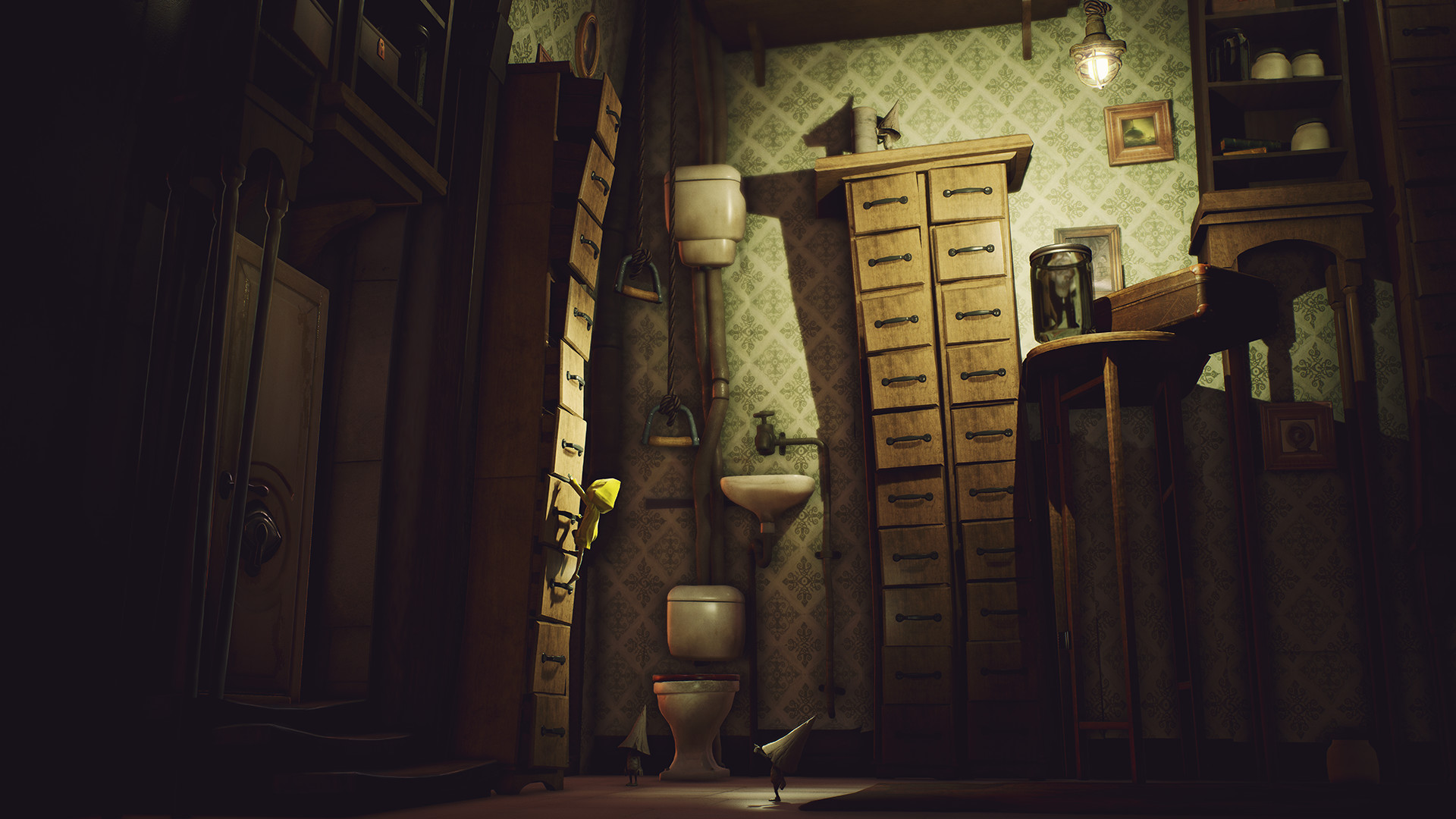
Cover image from Tom Clancy's The Division 2 and Little Nightmares
Translated from the original QDaily article. Original publication date retained.